Mexican legislators defend remittances against possible tax in the US

A Mexican delegation seeks to protect the flow of remittances in the face of a possible tax measure in the US.

Mexican delegation mobilizes to protect remittances

A plural commission of Mexican senators, supported by the Secretary of Foreign Relations (SRE), traveled to Washington this Wednesday with the aim of articulating a diplomatic strategy against the possible imposition of taxes on remittances by the US government. The delegation, made up of representatives of four political parties, held key meetings with the Mexican ambassador to the US, Esteban Moctezuma, to consolidate economic and social arguments that support their position.

Arguments and data for negotiation

The legislators analyzed detailed information on the impact of monetary transfers in both economies, highlighting that Mexico received more than 60 billion dollars in remittances during 2024, according to data from the Bank of Mexico. This financial flow represents a vital source for millions of families and contributes to local development. Roberto Velasco, head of the North American Unit of the SRE, emphasized that the measure would affect not only migrants, but also receiving communities in the United States.

RelatedTax on remittances in the US would affect tourists and non-residents

Among the key points on the agenda is a strategic dialogue scheduled for this Thursday with US congressmen, where studies will be presented that demonstrate how remittances:

  • Reduce pressure on US welfare systems
  • They promote economic stability in regions with high migration
  • Generate bilateral trade benefits

Economic and diplomatic implications

The tax initiative, still under discussion in the Capitol, could establish a tax between 3% and 5% on each transaction. Experts warn that this would discourage the use of formal channels, increasing the risks of informal operations. Senator Geovanna Bañuelos pointed out that “the measure contradicts current trade agreements”, while her colleague Alejandro Murat stressed the humanitarian nature of these transfers.

The SRE also coordinates meetings with think tanks and the media to amplify the message. According to diplomatic sources, the aim is to balance the narrative on remittances, highlighting their role as a development tool rather than as “capital flight.”

Next steps and call to action

The delegation will hold meetings with key senators from both parties in the US, including members of the Foreign Relations and Treasury committees. At the same time, a digital campaign was activated with testimonies from beneficiary families, coordinated with migrant associations.

Are you interested in learning more about cross-border economic policies? Share this analysis on your social networks and follow our coverage of Mexico-United States relations. #RemittancesWithoutTaxes

To delve deeper into the topic, explore our special on migration and global economy where we analyze similar cases in Europe and Asia.
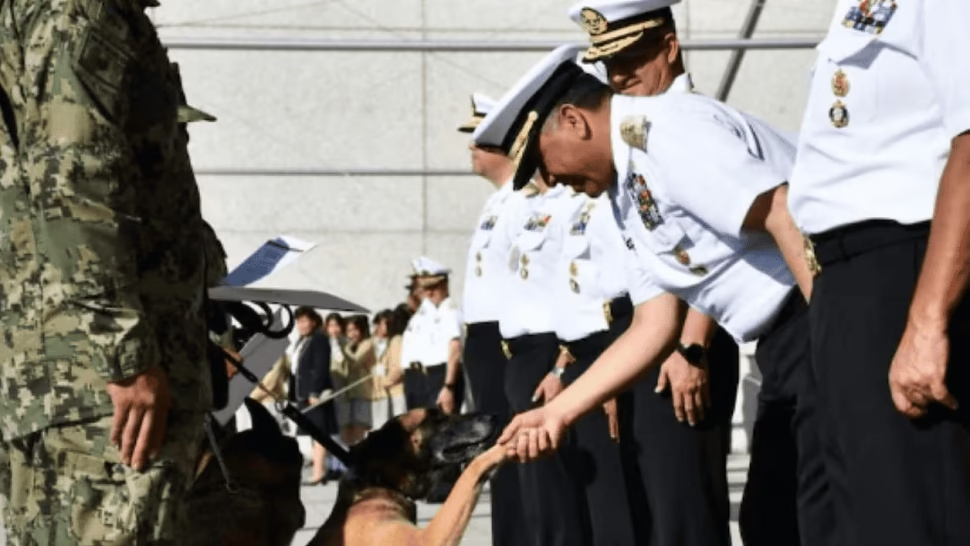

Semar says goodbye to ‘Niko’, ‘Hunter’ and ‘Hidra’, his elite dogs

Three Belgian Malinois were recognized for their work in rescues and security.

The Secretary of the Navy (Semar) held the “Four-Legged Heroes” ceremony to retire three canine elements: Niko, Hunter and Hidra. The Belgian Malinois were part of the Canine Binomial Operations and Control Group.

The honorees and their missions

During their active stage, these dogs worked in search and rescue, explosives detection and location of illicit substances. Each one formed a pairing with their handler, based on trust and constant training.

Niko was deployed in February 2023 to Adiyaman, Türkiye, after the earthquakes that hit the region. As part of the USAR-MARINA team, he helped locate a person alive in the rubble. His work reflected the preparation of the Navy in international humanitarian aid missions.

Hunter and Hydra participated in security operations together with the Search, Location and Neutralization of Explosive Ordnance (Blonae) team. They carried out inspections at strategic facilities and high-level national and international events. They also collaborated in actions against drug trafficking.

Semar highlighted the loyalty, discipline and dedication of these canines during years of service. The ceremony recognized the bond with their handlers and the impact of their work in protecting Mexican society.

Continue reading

Last Friday in June without classes due to Technical Council

On Friday, June 26, there will be no classes for the last session of the School Technical Council, according to the SEP.

Classes on June 26? The SEP clarifies the calendar

With the arrival of summer, parents and guardians are looking for answers about the closure of the school year. A recurring question: should preschool, primary and secondary school students go to school on Friday, June 26?

The answer is in the official calendar of the Ministry of Public Education (SEP). That day the last ordinary session of the School Technical Council (CTE) is scheduled. Teachers evaluate the period; Students do not attend classrooms. It’s a long weekend for the minors.

States can adjust

The SEP allows entities to make modifications in the event of extreme weather conditions or closure adjustments. These changes are published in the official state newspapers. The federal authority supervises that the effective school days are met, as established by the General Education Law.

The final weeks of June concentrate the delivery of ballots and the completion of contents. The delivery of grades is carried out in an orderly manner to ensure registration in the national educational system.

Summer break

Any vacation advance requires official validation. The priority is child well-being in the face of climatic phenomena or contingencies. The formal recess begins after the last scheduled school day.

Continue reading

Third edition of the Health Journalism Award already has winners

The winners were announced in five categories of the health journalism contest.

Winners of the National Health Journalism Award 2026

The third edition of the National Health Journalism Award, awarded by Opinión 51 and Merck, recognized journalistic works on physical and mental health. The jury was made up of representatives from TV UNAM, El Economista, EL UNIVERSAL and Síntesis TV.

The contest seeks to “inform, raise awareness and generate greater understanding about the health issues that impact the lives of millions of people in Mexico,” the organizers said.

Written Category

  • Inés Gutiérrez Jaber won for “For decades we ignored menstruation; now we know that it changes the brain”, published in TecScience.
  • Honorable mention: Claudia Patricia Villalobos Monroy for “Skin substitutes for the treatment of diabetic foot and burns”, from the IPN.

Video Content

  • Andrés A. Solís Álvarez for “Security under stress. Police, military and psychological care”, in Meganoticias.
  • Honorable mention: Arturo Ramírez Hernández for “This is the reality of doctors residing in Mexico”, in Siete24Mx.

Audio Content

  • Collaborative work “The Dragon’s Recipe”, by Aleida Rueda, Luis Fernando Vargas, Camila Segura, Andrés Azpiri, Rémy Lozano and Ana Turian, on Radio Ambulante.
  • Honorable mention: Maricarmen Climent for the episode “Forbidden to get pregnant”, from Pan Pal Susto Podcast.

Social Networks

  • Jimena Férez Vidal for “Why not try alcohol as a teenager”, in Madrehadisima.

University Category

  • Ximena Guadalupe Guerrero Medina for “Early detection of HPV: a biosensor that seeks to save lives in Mexico”, on TV UNAM.

The organizers highlighted the quality of the works received and the high level of the applications, which led to several honorable mentions being awarded. The award seeks to encourage the production of journalistic content that contributes to the dissemination of information relevant to public health.

Continue reading