Mexico maintains a pacifist stance in the face of conflict in the Middle East

President Sheinbaum reaffirms Mexico's pacifist stance in the face of escalating tension between Israel and Iran.

“Peace, we want peace”: Mexico’s position

President Claudia Sheinbaum was clear when leaving an event in Culiacán. When asked about the latest episode of tension between Israel and Iran, his message was one.

“Peace, we want peace, Mexico will always fight for peace.”

There were no ambiguities. He reiterated that the country will privileg diplomatic channels to address the crisis in the Middle East. It is the line that his government has set from the beginning.

RelatedMexico defines its diplomatic position in the face of the Israeli-Palestinian conflict

Chancellery on alert and with warnings

The Ministry of Foreign Affairs (SRE) had already spoken. He expressed his “deep concern” about the conflict and urged the avoidance of the use of force.

His warning was direct: there are potential serious humanitarian consequences and a real impact on global stability. The official position, they say, adheres to the constitutional principles of resolving controversies through peaceful means.

Meanwhile, Mexican embassies in the region—in Iran, Israel, Qatar and other countries—are in surveillance mode. Their main task is to monitor the situation and maintain contact with fellow citizens.

For now, they report that they are not aware of Mexican people directly affected by recent events. It is a respite, but the surveillance continues.

In summary: Mexico is rooted in its diplomatic tradition. In a world that seems to be leaning increasingly toward confrontation, he insists on dialogue. Skepticism about whether the parties will listen is understandable, but that remains the bet.

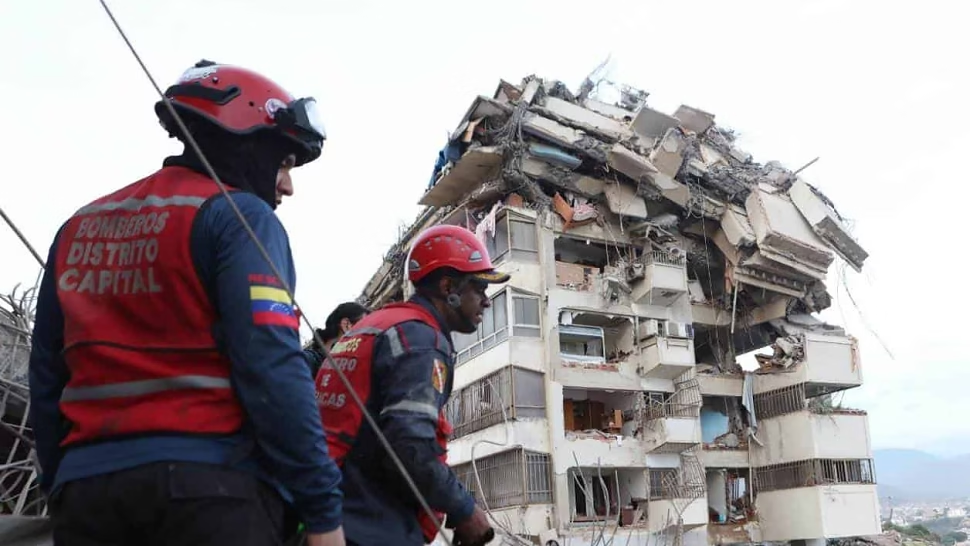
Earthquakes in Venezuela: citizens search for missing people in rubble

More than 920 dead and 51 thousand missing after two earthquakes in Venezuela.

The devastation caused by two consecutive earthquakes of magnitude 7.2 and 7.5 left at least 920 dead and more than 51,000 missing in Venezuela, according to official reports on Friday. The number of injured exceeds 3,300, while 243 people have been rescued alive.

Citizens take the search into their own hands

Inhabitants of areas such as La Guaira and Catia La Mar denounce the scarce presence of government rescue teams. With hammers and power tools, neighbors try to remove concrete slabs from collapsed buildings.

“My God, how do we get all the people out of there?” muttered Nazareth Jiménez, who is waiting for news of her brothers and nephews.

Omar Reyes walked among the rubble where two of his children are buried: “I was practically alone in this life.” He stated that about 20 relatives died.

Official response and international aid

The acting president Delcy Rodríguez assured that her government is deploying a total response in these “critical hours for the rescue.” He announced the militarization of La Guaira and the arrival of humanitarian aid. As of Friday, 861 international volunteers from Mexico, the United States, El Salvador, Switzerland and Colombia were working in the country. The UN reported that 25 search and rescue teams with 1,000 personnel are on the way.

However, residents consider the assistance insufficient. In Catia La Mar, looting of basic goods was recorded and the population improvised shelters in parking lots.

Stories among the rubble

Yuleidy Cadenas, 28, looks for her son, her mother and her brother in a collapsed tower in La Guaira. Friday was her son’s 12th birthday.

“I went up to the rubble and told them to yell at me, and no, no one. I just hope they get them out,” he said through tears.

The state press reported moments of hope: the rescue of a young man in Caracas and a girl covered in dust who emerged from a 10-story building. “We want to highlight this girl’s strength and desire to live,” said José Luis Núñez, head of the metropolitan rescue group.

Impact on the region

The International Organization for Migration estimates that up to 6.76 million people could be affected, about 2 million in Caracas alone. Loyce Pace of the Red Cross said: “People are still terrified to go back into their homes.”

The epicenter of the earthquakes was located near Morón, on the Caribbean coast, 170 kilometers west of Caracas. The superficiality of the movements amplified the destruction, explained geophysicist Marcos Ferreira of the Geological Survey of Brazil.

Continue reading

Venezuela raises the death toll from earthquakes to 589

589 dead and 2,980 injured after the earthquakes. La Guaira will be militarized.

The interim president of Venezuela, Delcy Rodríguez, updated this Friday the number of victims from the earthquakes that hit the country. The death toll amounts to 589 and there are 2,980 injured, more than doubling the previous toll of 235 deaths. The number is expected to increase, as thousands of people remain missing.

“Unfortunately, we now have 589 deaths,” Rodríguez declared before military and civilian officials. “We will go to save the trapped people, we work tirelessly on this task,” he added.

La Guaira under military control

The coastal state of La Guaira, north of Caracas and near the epicenter of both earthquakes, will be militarized. It is the most affected area. At least 100 buildings, including residential skyscrapers, collapsed in the city of the same name.

The authorities have intensified rescue efforts and are committed to recovering the devastated areas. The situation continues to evolve as evaluations progress. The magnitude of the earthquakes has caused a humanitarian crisis, and efforts are being made to provide assistance to those affected.

Continue reading

Rescuers improvise due to lack of equipment in La Guaira

Neighbors dig with their hands to rescue those trapped after the earthquake.

Freehand rescue in La Guaira

Twenty-seven hours after the earthquake, desperation is growing among the relatives of those still under the rubble. Rescue teams are scarce and lack machinery to move the mountains of concrete. In various parts of the city, the residents themselves dig with their bare hands, together with firefighters and volunteers.

Many of them maintained communication with their trapped loved ones, speaking to them to keep them conscious. As the hours passed, the voices became weaker until they died out forever.

“My wife couldn’t get there. She was bathing when the tremors hit. We tried to escape. I managed to get out of the building, but she fell, hit her head and was trapped. I know she was left naked, I would like to reach her, at least to cover her body,” said a visibly affected man through tears.

Urgent call

The situation is critical. Rescuers urgently need tools, heavy machinery and logistical support to continue their work. Meanwhile, the community organizes as best it can, moving debris with their own hands, in a race against time to find survivors.

Continue reading