Mexico insists on the extradition of García Luna and his wife

Mexican justice does not give up: it returns to the charge against the former official and his wife.

The extradition circus: Mexico does not let the García Luna case go

It seems that the Mexican Government has an obsession worthy of a Taylor Swift stan with Genaro García Luna. For the umpteenth time, he has asked the United States to return the former Secretary of Public Security and his wife, Linda Cristina Pereyra, as if they were a package lost in customs. The reason? Accusations of money laundering and corruption, because of course, in Mexico these crimes are as common as kitten memes.

“We had already asked for it before”: Sheinbaum and his reply more repetitive than a viral TikTok

President Claudia Sheinbaum, in her characteristic “I already said it” style, uttered the phrase of the day: “They are part of the procedures that exist.” Wow, what a revelation. As if we didn’t know that the Mexican bureaucracy moves more papers than an office in The Office. Of course, he made it clear that this is not new: they had already requested extradition before, but apparently Washington has a better memory for celebrity birthdays than for judicial proceedings.

RelatedMiami Court sentences García Luna to pay 2,488 million for corruption

The curious thing is that, in addition to asking the defendants, Mexico also wants them to return all the assets that García Luna acquired with what, supposedly, were funds dirtier than a teenager’s room. Repair of damage to the treasury? Yes, because nothing says “justice” like trying to recover money that disappeared faster than an influencer when they ask for proof of their claims.

Meanwhile, in Florida, lawyers from the Financial Intelligence Unit must feel like they’re in an episode of Suits, filing motions and hoping the US judicial system will heed them. Spoiler alert: it may take longer than the premiere of the second season of The Sandman.

Moral of the story? In Mexico, justice may be slow, but the insistence is more tenacious than a K-pop fan defending his favorite group. And meanwhile, García Luna and his wife are still in limbo, waiting to see if they finally have to face the music (and not exactly at a Bad Bunny concert).

Are you intrigued by how this judicial drama will end? Share this note and continue exploring more content about corruption cases that seem straight out of a Netflix script.

They demand location of two CFE workers in Hidalgo

Two CFE employees disappeared in Acaxochitlán; Family members protest lack of attention.

They demand actions for the disappearance of CFE employees

PACHUCA, Hgo.— Relatives and colleagues of two workers from the Federal Electricity Commission (CFE) demand that the authorities locate them. Adolfo López Saldaña, 40, and Marco Antonio Sarmiento García, 60, were last seen on February 26 in the municipality of Acaxochitlán, Hidalgo.

They were going to carry out work in Huauchinango, Puebla. During the transfer all contact was lost. Given this, his relatives went to the representation of the Attorney General’s Office of the State of Hidalgo (PGJEH) in Tulancingo to report the alleged forced disappearance.

They initially filed the complaint with the Attorney General’s Office (FGR), but they claim that they did not receive timely attention, so they turned to the state authorities. After that, search cards were issued. The last registration of the van in which they were traveling was in Acaxochitlán. Later, the unit was found without license plates and without the CFE logos.

His whereabouts are unknown at this time. Yesterday, Saturday, relatives held a demonstration to demand immediate action.

The CFE issued a statement:

“We have a commitment to our workers: we will fully monitor this event, endorsing our responsibility with the integrity of those who make up and are the driving force of the Federal Electricity Commission.”

The company indicated that it collaborates with the authorities and maintains communication with the families. The investigation folder was registered with the number FED/HGO/TULB/00002547/2026 for the crime of forced disappearance. Central offices also requested information for follow-up.

Continue reading

Housing for Wellbeing boosts GDP by 1%, says Sheinbaum

Sheinbaum announces that the housing program contributes 1% to the GDP and will benefit 30 million.

Housing for Wellbeing and its economic impact

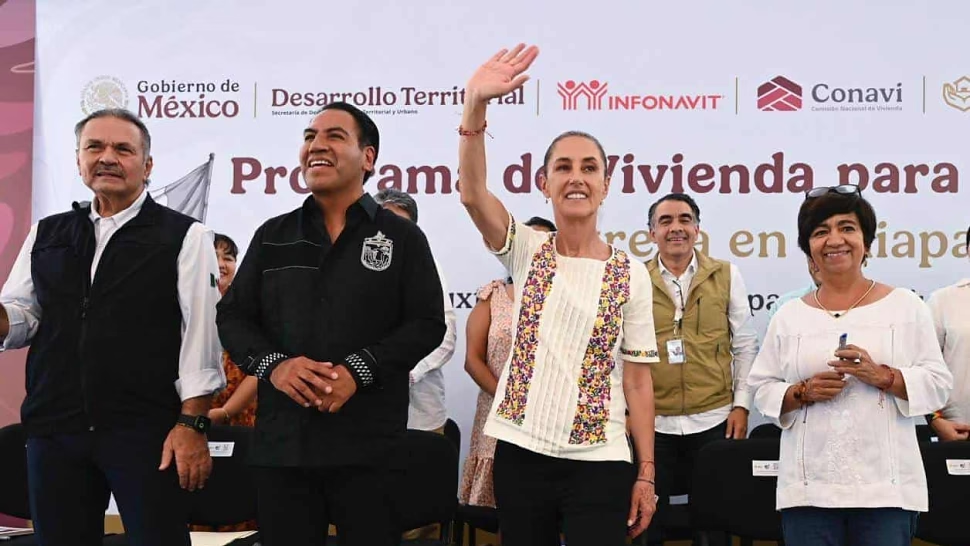
From Tuxtla Gutiérrez, Chiapas, President Claudia Sheinbaum highlighted that the Housing for Wellbeing program contributes about 1 percent to the national Gross Domestic Product (GDP). This, thanks to the jobs it generates in construction and related sectors.

“There is nothing happier that can make the President and her entire team than to see the joy on their faces for receiving a home today,” said Sheinbaum during the delivery of 48 homes in the Infonavit Lacantún development.

In addition, 401 settlement certificates from Fovissste and 503 deeds from Insus were delivered. The president stated that the program will benefit nearly 30 million people during her six-year term.

“Thanks to the Housing for Wellbeing program, it is contributing close to 1 percent of GDP to the country’s economic growth. And if we consider that each home employs at least 4 people, a very important number of jobs are being generated,” he pointed out.

Investment in Chiapas

The Secretary of Agrarian, Territorial and Urban Development, Edna Elena Vega Rangel, explained that in Chiapas 42 billion pesos are allocated to build 70 thousand new homes in the six-year period. Of these, 50 percent are already hired.

The general director of Infonavit, Octavio Romero Oropeza, reported that at the national level there are 420 housing complexes in 31 states, with 475 thousand homes. Of them, 190 thousand are already under construction, and 3,600 have been delivered. In Chiapas, Infonavit contemplates 34 thousand homes with an investment of more than 20 billion pesos.

Governor Eduardo Ramírez Aguilar thanked the President for the homes delivered, while the beneficiary Miguel Ángel Ramírez Trujillo expressed his gratitude for the future it represents for his family.

Continue reading

CRT foresees 85% of registered lines before staggered cuts

The CRT estimates that between 120 and 130 million cell phones will be registered before the progressive cut.

Mobile line registration: 85% will be linked before cuts

The Telecommunications Regulatory Commission (CRT) expects that between 120 and 130 million cell phones will be registered, which represents about 85% of the total active lines in the country.

Currently there are 144.6 million lines. Ricardo Castañeda Álvarez, general director of Regulatory Policy of the CRT, estimated that between 14 and 24 million will not be registered and will be deregistered as the process progresses.

The suspension process will begin on August 15. Lines ending in 0 will be deactivated first and then in stages until the end of the year, with the aim of avoiding technical saturations.

Castañeda explained that the extension was due to the risk that millions of users would not meet the original deadline, which would have generated operational complications similar to massive saturations in emergencies. He ruled out a new extension of the deadline.

He assured that the registry does not violate privacy because the information is managed by the operators. The main objective is to combat crimes such as extortion, fraud and virtual kidnappings.

Continue reading