Mexico faces a warmer fall and winter due to La Niña

A thermal anomaly is hovering over Mexico, transforming the cold season into an episode of unprecedented heat.

The Thermometer of Destiny: A Season that Breaks All Paradigms

As if heaven itself had decided to rewrite the laws of nature, an epic and enormous rainy season concluded its reign, leaving in its wake a transformed landscape: flooded cities, rivers that overflowed their fury, but also dams that, like full treasures, reached historic highs. It was a divine and catastrophic balancing act. However, this aquatic drama was nothing more than the prologue. The northern hemisphere is now leaning towards autumn, and with this celestial movement, the entire country is preparing for a climatic turn that will mark the final stretch of the year with a seal of fire.

The withdrawal of precipitation will be slow, almost a prolonged sigh that will become more evident from mid-October. But it is not a peace that comes, but the prelude to a new battle. The first cold fronts, those icy armies that statistically besiege the nation from September to May, will begin their advance. The strategists of the National Water Commission have predicted that its peak, its moment of greatest ferocity, will be unleashed in the months of November, December and January. The battle is scheduled, but the enemy has changed their weapons.

RelatedLa Niña will bring a warmer, drier fall and winter to Mexico

The Shadow of La Niña: A Winter Dyed with Heat

This year, the script has been altered by an invisible and powerful force. Autumn and winter will dress in a cloak of unusual heat, becoming drier and hotter than anything recorded in the recent past. The prophets of Conagua have issued their verdict: in the coming months, the vast expanse of Mexican territory will suffer temperatures that will rise between one and three degrees Celsius above the average that had prevailed during the last 35 years. It is not just any fluctuation; It is an anomaly that cries out to heaven.

The person responsible for this thermal distortion has a name that resonates with mystery: La Niña. It is the second phase, the dark and cold counterpart of El Niño, a phenomenon that stirs the waters of the Pacific and, with a whisper that crosses oceans, induces hotter and severely dry winters, with especially cruelty in the north. “La Niña is the architect of this hot winter”, says Christian Rodríguez, meteorologist and researcher at the prestigious Institute of Atmospheric Sciences and Climate Change at UNAM. His word is not a simple opinion; It is the diagnosis of a reality that is coming.

The probable formation of this phenomenon, which is expected to display its power in October or November, not only warms the atmosphere, but also weakens the legion of cold fronts. The official forecast foresees around 48 frontal systems, a figure that, although it may seem insignificant, represents a decrease compared to the 50 that constitute the usual average. “This reduction is inextricably linked to the La Niña signal, hence the torrid nature of the winters that are coming,” says the researcher, placing a warning flag on the map of the future.

But the drama doesn’t end there. The long shadow of La Niña is joined by a long-standing villain: the global climate crisis. This monster, fueled by relentless human activity, gradually raises the planet’s temperature, adding fuel to a fire that already burns on its own. Conagua statistics reveal a terrifying trend: Mexico loses one day of frost every fifteen years. This countdown, this silent theft of the cold, began to be recorded in 1950 and today, its pace only accelerates, taking us towards a point of no return where winter could be just a distant memory.

We find ourselves at the crossroads of two titanic forces: a cyclical ocean phenomenon and permanent anthropogenic alteration. The result is a cold season that refuses to be cold, a challenge to our climate memory and a reminder that the balance of the world is more fragile than we ever imagined. The thermometer has become the oracle of our time, and its message is clear and searing.

Are you surprised by this forecast for a warm winter? Share this crucial information on your social networks and help spread the word about the profound changes in our climate. Explore more analysis and predictions on our site to always be one step ahead.
Man arrested for illegal logging of strawberry tree in Querétaro

Joint operation thwarts felling of protected tree in San Juan del Río.

Operational in San Juan del Río

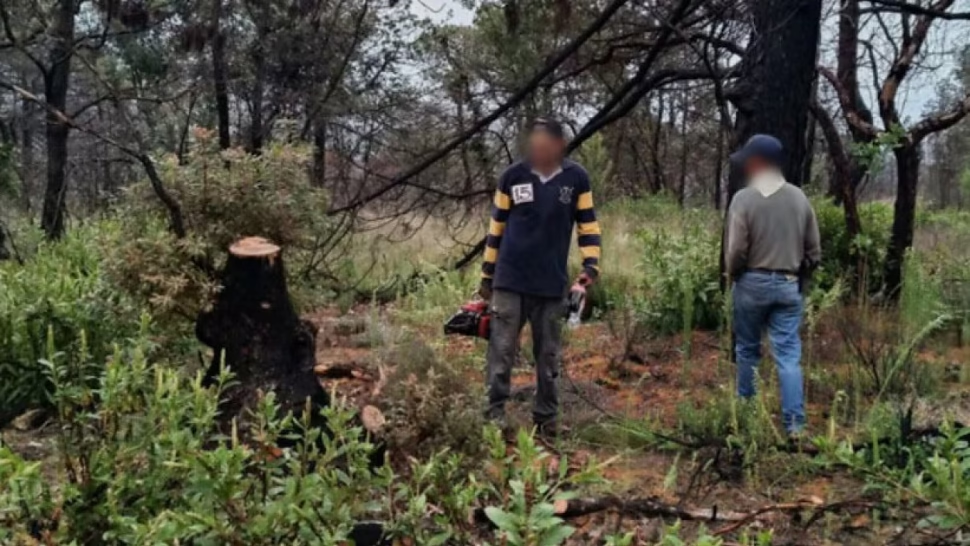
The Federal Environmental Protection Agency (Profepa) reported the arrest of a man accused of illegally felling a strawberry tree in the municipality of San Juan del Río, Querétaro. The subject was placed at the disposal of the Attorney General’s Office (FGR), along with the chainsaw used and the forestry material obtained.

The events occurred on July 2 in the Dolores de Enmedio ejido. Profepa personnel carried out surveillance tasks in coordination with the “Forest Assets” Participatory Environmental Surveillance Committee. Upon hearing the operation of a chainsaw, the inspectors deployed an operation with the support of a drone and ground tours.

Investigation in progress

Upon arriving at the site, officials found the person cutting down an arbutus tree that had survived a forest fire. Profepa pointed out that the action occurred in flagrante delicto and could constitute a crime against biodiversity for affecting protected forest resources.

The agency indicated that the case will be investigated by the Federal Public Ministry to determine responsibilities. The identity of the detainee was not revealed, although images were released of the moment he was located next to the affected tree and with the tool used for felling.

Continue reading

Fire destroys 25 homes in San José de Comondú

An accident destroyed 25 houses and damaged another 50 in Baja California Sur. Dozens of families evacuated.

A rapidly spreading disaster

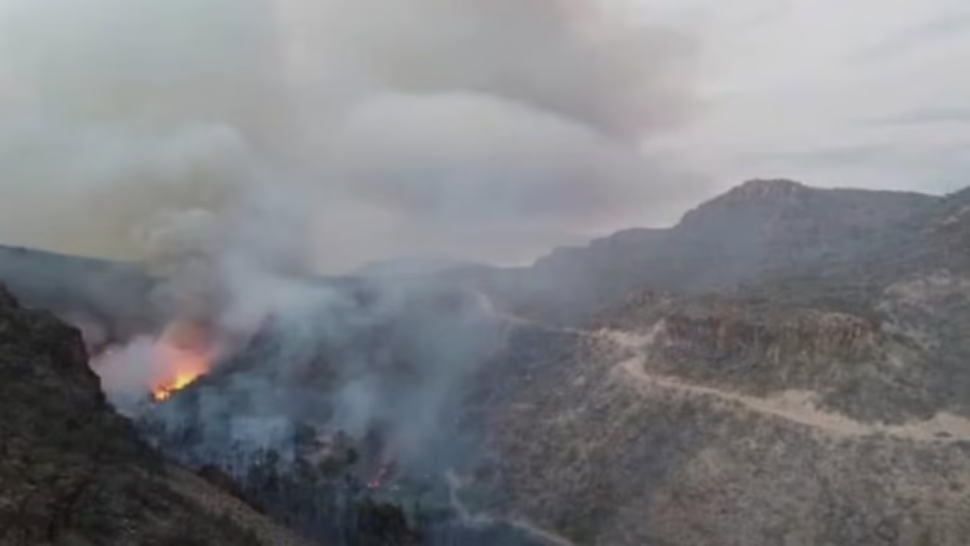
A large fire consumed part of the town of San José de Comondú, in Baja California Sur. The preliminary balance is 25 homes destroyed and damage to at least another 50. The material losses are considerable.

The incident forced dozens of families to evacuate. For more than 12 hours, firefighters, brigade members, military elements and emergency bodies worked to avoid a greater misfortune.

According to municipal authorities, the fire was allegedly caused by negligence during the burning of palm tree waste, a common practice among residents. The mayor of Comondú, Roberto Pantoja Castro, pointed out that the windy conditions, high temperatures and abundant vegetation favored the rapid spread of the flames, which in a few minutes got out of control.

Response from the authorities

Local authorities activated emergency protocols to care for the victims and assess the damage. It is expected that inspections of affected homes will be carried out and support will be provided to evacuated families.

The community of San José de Comondú faces a difficult panorama. Many families lost their homes and require urgent assistance. The authorities have called for the solidarity of the population to help those affected.

Continue reading

2026 World Cup does not boost sales in restaurants, reveals Canirac

Seven out of 10 restaurants did not see a rebound in the first month of the tournament.

World Cup 2026: a moderate boost for restaurants

The start of the 2026 World Cup did not meet the expectations of the restaurant industry. A survey by the National Chamber of the Restaurant and Seasoned Food Industry (Canirac) reveals that seven out of 10 establishments did not register significant growth in their income during the first month of the tournament.

The most and least benefited

Restaurant-bars and sports bars were the least favored. Only half of these businesses reported an improvement in consumption. At the opposite extreme, canteens benefited the most: eight out of 10 reported an increase in their sales. Bars, for their part, recorded improvements in just over half of the cases.

The increases were moderate, between 15% and 30%, with an average consumption of around 400 pesos per person during the first weeks of the championship. Canirac highlighted that, although the tournament represents an opportunity, it does not guarantee automatic benefits for the entire industry.

The organization did not offer projections for the rest of the championship, but warned that the impact varies depending on the type of business and its ability to attract fans.

Continue reading