Mexico breathes a sigh of relief with the smallest drought in two and a half years

Cyclones and monsoon give the country a respite, but some states are still struggling with lack of water.

The drought in Mexico drops like your ex’s shares (but with a better prognosis)

It seems that the universe decided to give Mexico a break after 30 months of looking at the sky as if it were a *spoiler* from a horror movie. According to data from the National Meteorological Service (SMN), only 21.8% of the country suffered from insufficient rain at the end of June. Yes, you read that right: almost half of what was dry in May (when 40.3% of the territory looked like the scene from Mad Max).

The reason? The tropical cyclones that arrived as unexpected guests at the climate party. Storms like Dalia, Flossie and Erick left more water than a Bad Bunny concert during hurricane season. Thanks to them, 20 states are drought-free, although Sonora, Coahuila and Chihuahua remain as dry as a millennial’s mood on Monday morning.

RelatedCyclone Lorena intensifies towards northwest Mexico

The Mexican monsoon: the hero that no one expected (but everyone needed)

Meanwhile, the Mexican monsoon—which sounds like a hipster cocktail name—began to do its thing in the northwest. This phenomenon, which is basically a change in winds and an increase in precipitation, promises to leave up to 800 millimeters of rain in Nayarit between July and September. That is, enough for the “it rains more than I cried with Titanic” memes to be relevant again.

According to Conagua, 65% of the annual rains in the region are due to this phenomenon, which not only relieves the thirst of the land, but also saves farmers, ranchers and even the cacti that were already making a will. Of course, in Sonora things remain critical, with 84.9% of its surface drier than the Tinder algorithm in a ghost town.

Moral: Nature gave us a break, but we should not trust ourselves. Climate change is still there, lurking like that “seen” message you never respond to. So, as we celebrate that the rivers once again have more than crocodile tears, let us remember that the water future depends on everyone.

Were you surprised by the news? Share this article and join the conversation about how to save water (because, let’s be honest, we all need to keep the planet functioning). And if you want more content like this, explore our other notes on environment and climate. The planet (and your feed) will thank you!
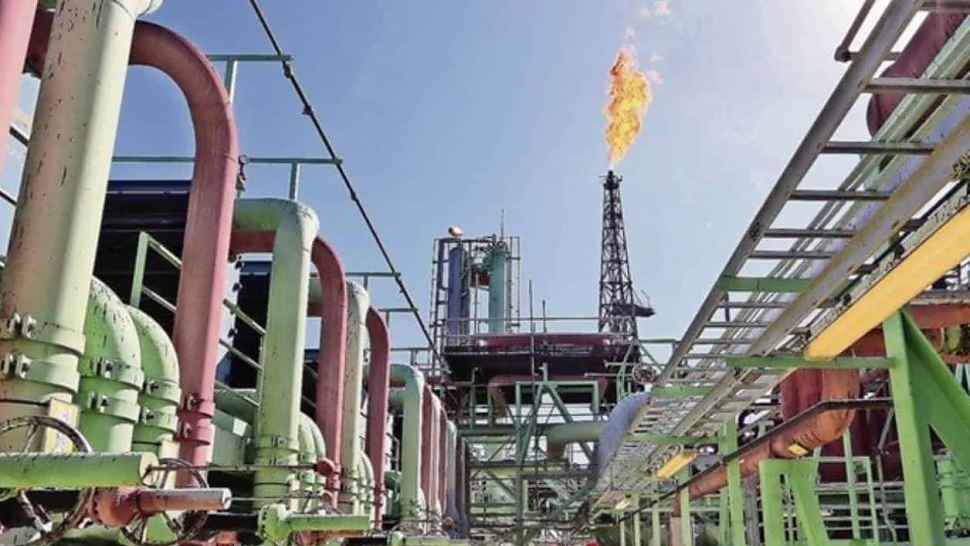

Carlos Slim foresees an oil rebound of up to 2.5 million barrels

The businessman highlights agreements between Pemex and private companies that will boost production.

Slim’s prognosis

Carlos Slim Helú, president of Grupo Carso, stated this Wednesday that crude oil production in Mexico could reach up to 2.5 million barrels per day in the coming years. The statement occurred during an event of the Mexican Union of Engineers Associations (UMAI).

“What is coming is very good oil production, as these companies that are in the sea get back to work. That of the Brazilian partner is also going to be important and we will already start producing oil to reach levels of 2 or 2.5 million barrels per day,” said the businessman.

Slim stressed that the agreements between Petróleos Mexicanos (Pemex) and private companies will bear fruit. He especially mentioned the collaboration with the Australian Woodside Energy in the deepwater Trion field. He also referred to the benefits that the association with Petrobras, the Brazilian oil company, will bring.

The increase in production, according to Slim, will not only strengthen Pemex but will have a positive impact on the national economy, with job creation and attraction of investments.

The Trion field is key to this strategy. The partnership between Pemex and Woodside Energy seeks to develop this field, which could mark a before and after in the production of Mexican crude oil.

Continue reading

80 years of Ariel: the Film Academy celebrates its history and challenges

The AMACC celebrates eight decades of Mexican cinema with new digital challenges.

The Mexican Academy of Cinematographic Arts and Sciences (AMACC) turns 80 this Friday. Its president, Daniel Hidalgo, pointed out that the organization arrives strengthened in the number of members, but immersed in a transformation marked by streaming platforms and artificial intelligence.

A journey of eight decades

Founded on July 3, 1946 by Alejandro Galindo, Gabriel Figueroa and Fernando Soler, the AMACC was born when national production exceeded 80 films annually. To reward the most outstanding, the Ariel was created, inspired by the work of the Uruguayan José Enrique Rodó. The first installment was in 1947 and the feature film La barraca was the winner.

The story was not linear. The lack of resources forced the statuette to be suspended between 1958 and 1972. At the end of the 90s, filmmaker Jorge Fons led a refoundation that restored credibility to the institution. The AMACC became a pillar to avoid the closure of the Churubusco Studios and the Cinematographic Training Center during Vicente Fox’s six-year term.

Adaptation and new horizons

In 2020, the Covid-19 pandemic brought the Ariel ceremony to a virtual format. After budget cuts in 2023, the Academy decentralized the event and moved it to Jalisco, with headquarters in Guadalajara and Puerto Vallarta. The response was positive.

For 2026, the nominations will be announced next Wednesday. It will be framed with the drawing of a commemorative ticket from the National Lottery for the 80 years of the AMACC.

Academia faces a present where streaming and artificial intelligence redefine the industry. Its ability to adapt will be key for the future of Mexican cinema.

Continue reading

Fundidora Park toughens measures after disturbances at Fan Fest

Authorities close access and warn of break-ins after incidents at the Monterrey Fan Fest.

Incidents at Fan Fest trigger legal warning

The Fundidora Park Administration reported that those who enter without authorization could be placed at the disposal of the authorities for trespassing on private property. The measure comes after the disturbances recorded during the broadcast of the match between Mexico and Ecuador.

On Tuesday night, the Fan Fest area reached capacity an hour and a half before kickoff. Given the saturation, elements of the National Guard and Civil Force closed access to the park.

Reactions and use of irritant gas

Hundreds of fans who were left out showed their dissatisfaction. Some tried to force open the gates; Others jumped over the metal fences of Parque Fundidora and Paseo Santa Lucía to try to enter.

To contain the situation, the security forces used irritating gas. There were moments of tension and confrontations between police and assistants. Videos spread on networks show pushing and people running in the surroundings.

The Park Administration reiterated that access should only be through authorized entrances and respecting the capacity. Any irregular entry may lead to legal consequences.

Continue reading