Peru breathes a sigh of relief after repairing its energy backbone

Peru repairs its main gas pipeline after weeks of rationing that skyrocketed prices and paralyzed industries.

The pipeline that paralyzed a country

There is finally a light at the end of the tunnel. Or rather, gas in the pipeline. This Friday, the interim government of José María Balcázar announced that the only pipeline that carries gas from the Amazon to Lima, broken since the beginning of March, was repaired.

“Since 6:00 in the morning today, gas transportation has restarted comprehensively,” said Balcázar.

It sounds technical, but in practice it means that thousands of taxi drivers and 900 small industries can breathe again. The supply is gradually restored, they promise that by Saturday it will be enabled for everyone.

RelatedPeru has a new interim president amid political crisis

A ‘routine maintenance’ that cost millions

The company Transportadora de Gas del Perú (TGP), led by US funds, said it all started with a leak during maintenance work. A seemingly small error in a tube more than 700 kilometers long that generates almost half of the country’s electricity.

The consequences were brutal. More than two million homes with direct connection affected. Almost a thousand industries and 42 thousand businesses paralyzed or operating half way. The unions estimate losses of about 300 million dollars a day.

In the streets, the blow went straight to the pocket. Rina Palomino, a mother in a soup kitchen in Lima, sums it up better than any economic report:

“These days we are having a very difficult time.”

The price of gas cylinders skyrocketed. The same thing happened with food and transportation. Banking analysts warn that this chaos could inflame the monthly inflation rate, after Peru closed 2025 with one of the lowest rates in the world.

Now it’s time to see if the flow returns as quickly as the official promises. And above all, how long does it take for Peruvian families to feel that relief in their domestic budgets.

Venezuela reports 3,342 deaths after earthquakes

The authorities update figures from the earthquakes of June 24. The UN estimates thousands of missing.

New official balance sheet

The Government of Venezuela updated the number of victims of the two earthquakes that occurred on June 24. The new report, released on July 5, raised the total number of deaths to 3,342 and injuries to 16,740.

“Official balance as of July 5: 3,342 dead and 16,740 injured,” says the official note.

The previous figure, released a day earlier, recorded 2,954 deaths. The increase reflects the complexity of the rescue and identification of bodies in the affected areas.

Figures of missing people

Authorities have not provided an official number of missing people. However, the United Nations estimates that the number could reach 50,000, while other projections place it at around 10,000.

Given the magnitude of the tragedy, Venezuelan authorities buried more than 150 unidentified bodies in a long line of individual graves. The measure seeks to avoid health risks and provide a dignified burial to the victims.

Continue reading

So much “patriotic pride” to cover your face: the masked racists who marched in Washington

About 400 masked Patriot Front members marched near the Capitol on July 4. Behind the "patriotic" uniform is a fascist group that produces most of the US's racist propaganda and recruits young people under false pretenses.

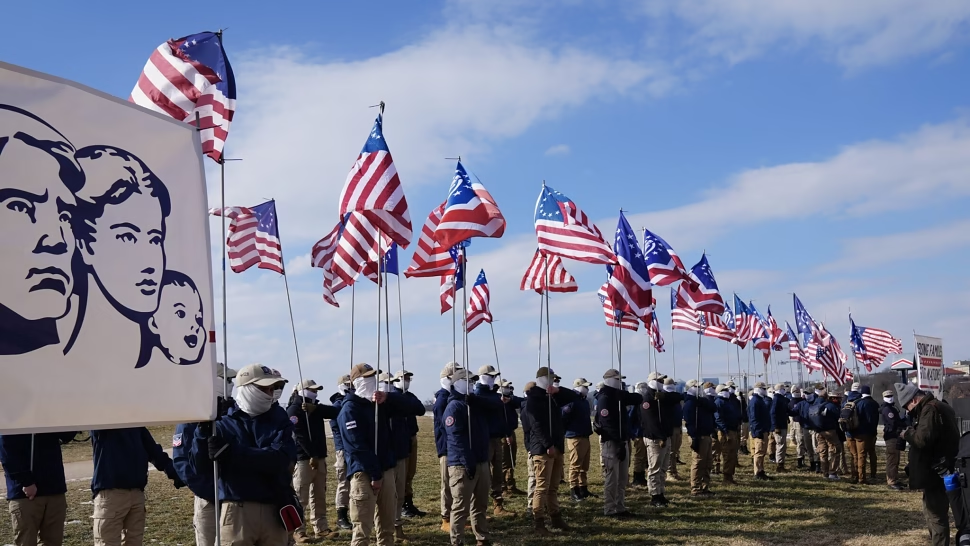
Hundreds of members of the white supremacist group Patriot Front marched this Saturday, July 4 through various areas of Washington D.C., during the United States Independence Day celebrations. The group itself boasted online that it had arrived in the capital with around 400 members, captured traveling in formation on the city’s Metro.

Dressed in their characteristic uniform – khaki pants, cap, blue t-shirt and their face covered with a white cloth and sunglasses– they advanced to the rhythm of drums near the Capitol and Union Station, chanting “Reclaim America” (“Let’s take back America”) and carrying American and Confederate flags.

And there is the contradiction that explains itself: a group that calls itself the vanguard of “patriotism” and that marches to project strength and intimidate does not have the courage to show a single face. The mask is not an aesthetic detail; It’s a confession. They cover their identity because they know what they stand for and they fear the consequences—losing their jobs, having their neighbors and families recognize them—when their name becomes linked to an ideology that maintains that the United States should be a country “only by and for whites.”

It’s not just any group: what they defend

Behind the clean aesthetic is an openly fascist ideology, thus classified by the Anti-Defamation League (ADL) and the Southern Poverty Law Center (SPLC), which classify it as a white supremacist hate group. It is not a free tag:

  • Its logo is the fasces—the bundle of wands with an ax that was the original symbol of Mussolini’s fascism—, surrounded by 13 stars.
  • His manifesto maintains that membership in the American nation “is inherited by blood, not by ink.” That is to say: for them, someone who is not white cannot really be American.
  • Their stated goal is to turn the US into a “pan-European” ethnostate that excludes people of color, immigrants and refugees.
  • It is the main hate factory in the country: according to the ADL, Patriot Front alone generated 82% of all incidents of racist and anti-Semitic propaganda reported in the US in 2021—almost 4,000 incidents spread across virtually every state.

And although they sell themselves as “peaceful”, the record says otherwise: in 2022, 31 of their members were arrested piled into a U-Haul truck with riot gear, near an LGBT+ event in Idaho, accused of conspiring to cause a riot. In the last year alone, two members were arrested with arsenals of illegal high-powered rifles.

How they recruit: the “patriotic” trap

The most worrying thing is that it is growing: it went from a handful of members to around 540 at the beginning of 2026, doubling almost every year, with a presence in every state except Hawaii. How do they achieve it? Leaked internal documents reveal recruiting machinery targeting young white men:

  • Patriotic bait: they hand out flyers with harmless phrases like “America First” and images of white men, deliberately hiding their true racist ideology until the recruit is already inside.
  • “Fight clubs”: They operate a network of clubs where young people meet first online and then in person—in gyms, training in martial arts and boxing—and there they get hooked.
  • Sect vetting: applicants are forced to empty their pockets, they are searched by microphones and they are prohibited from using cell phones. And in a chilling detail, each new member is ordered to secretly have his face photographed and write down his license plates—insurance to blackmail or control him if he ever wants to go out or talk.

It is the same logic of the march: hide your face on the outside, while inside they make sure to have identified everyone who enters.

The Washington Metropolitan Police indicated that it monitored the group’s activity, protected by the First Amendment, and that no arrests were reported during the July 4 parade.

With information from the ADL, the Southern Poverty Law Center, ProPublica, Al Jazeera and NBC Washington.

Continue reading

Cuba faces the largest simultaneous blackout in its history

The Electrical Union predicts that 72% of the country will suffer electricity outages this Sunday.

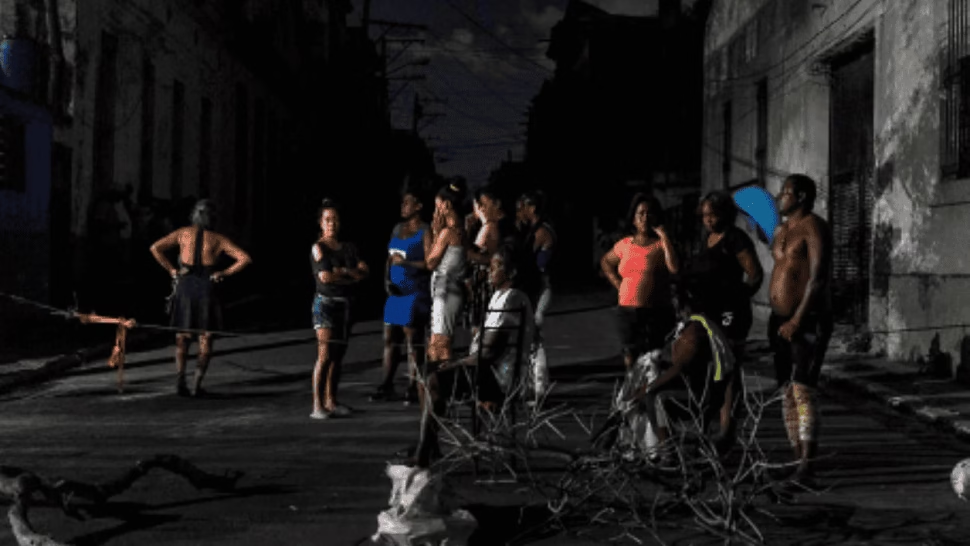
Cuba is preparing to record this Sunday the largest simultaneous blackout in its recent history. The forecasts of the Electrical Union (UNE) indicate that up to 72% of the national territory will be affected by electricity outages during the hours of highest consumption.

The energy deficit in figures

The state company reported that during peak hours the system will have only 1,000 megawatts of generation compared to an estimated demand of 3,100 megawatts. The deficit reaches 2,200 megawatts and the expected impact is 2,230 megawatts.

The crisis is due to the limited availability of the generation park. Ten of the country’s sixteen thermoelectric units remain out of service due to breakdowns or maintenance. More than a hundred distributed generation engines and several floating power plants are idle due to lack of fuel.

If the forecasts are met, the blackout will exceed the record recorded last Friday, when the outages affected 71% of the country.

The Cuban government has described the energy situation as “acute”, “critical” and “extremely tense.”

Specialists attribute the deterioration of the system to obsolete infrastructure, decades of insufficient investment and difficulties in guaranteeing the supply of fuel. These factors have aggravated power outages and population discontent.

Continue reading