Mexico, among the five OECD countries with the greatest confidence in their government

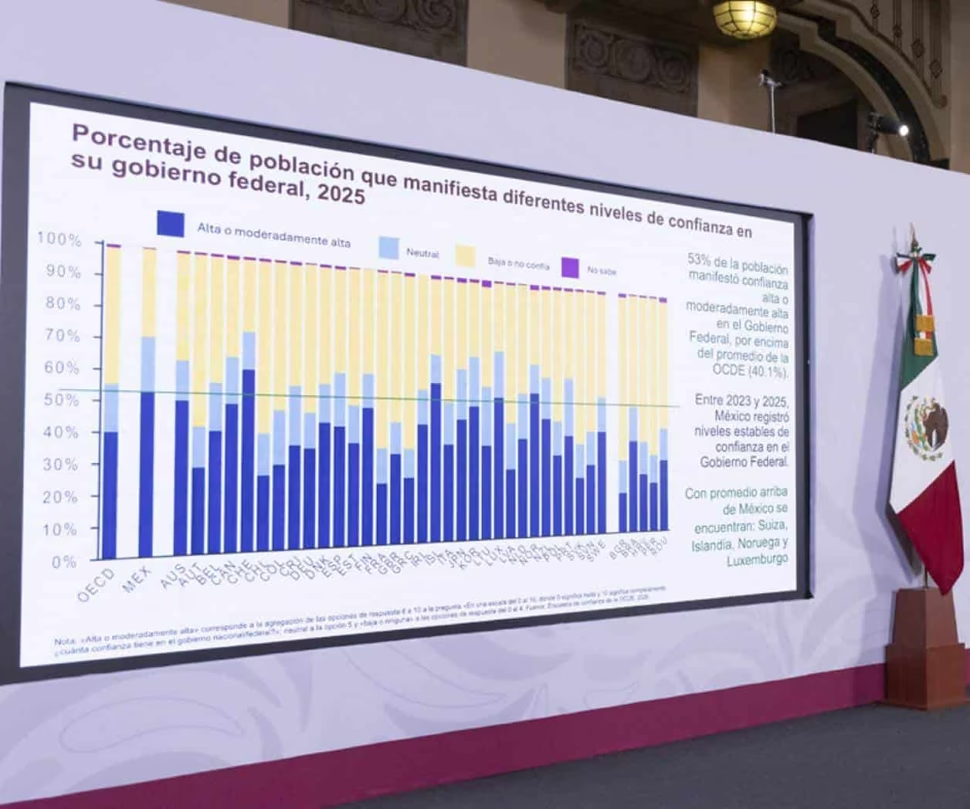
53% of Mexicans trust the Federal Government, according to an OECD survey.

Mexico is among the five countries of the Organization for Economic Cooperation and Development (OECD) with the highest levels of citizen trust in its Federal Government, according to the organization’s latest survey.

President Claudia Sheinbaum highlighted that 53 percent of the population reports high or moderate confidence in the federal administration. The figure exceeds the OECD average, which is 40.1 percent.

“Mexico is above Sweden, France, Finland too… between 2023 and 2025 it registered stable levels of trust in the Federal Government. There are some who are not going to like this, but no way, that’s life,” Sheinbaum said in his morning conference.

Survey results

The countries with the greatest government trust are Switzerland, Iceland, Norway and Luxembourg, all with lower population density than Mexico. The OECD report measures citizen perception of public institutions.

RelatedMexico breaks migration records in AMLO’s six-year term

The data is relevant because Mexico, with more than 126 million inhabitants, maintains stable levels of trust in a global context where institutional distrust has grown in several member nations.

National Guard: 125 thousand elements and decrease in homicides

Sheinbaum led the National Guard's seventh anniversary with deployment numbers and results.

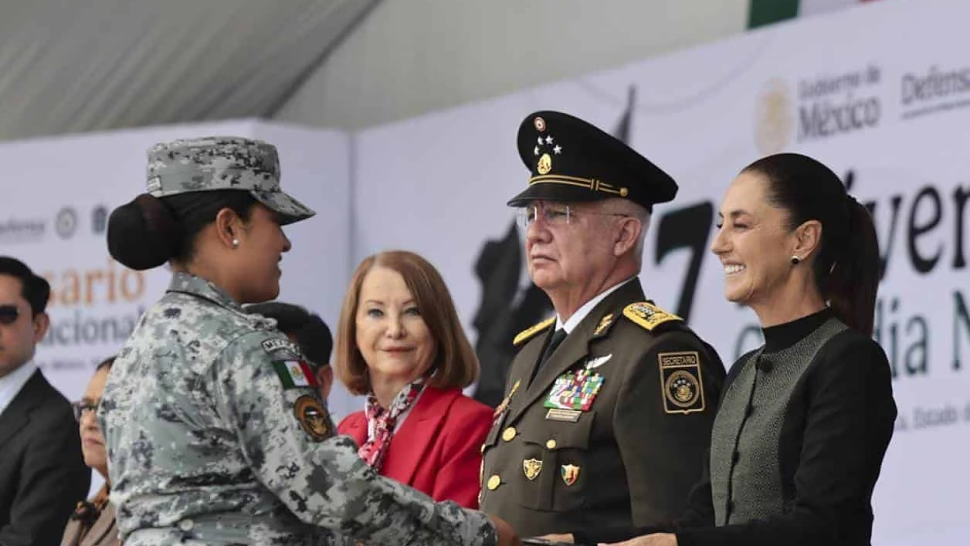
In Huehuetoca, State of Mexico, President Claudia Sheinbaum led the ceremony for the seventh anniversary of the National Guard, created in 2019.

Sheinbaum reported that the corporation has 125 thousand elements deployed in 53 coordinations and 590 barracks built by the Army. He highlighted that intentional homicide decreased 46% since October 2024, as part of the National Security Strategy.

Operating figures

Commander Guillermo Briseño Lobera explained that in the current six-year term, 45 thousand people have been arrested for crimes, 23 thousand firearms have been seized, more than 213 tons of drugs have been seized and two thousand clandestine laboratories have been dismantled.

He announced that Sedena is promoting a plan to reach 170,000 troops and 886 facilities by the end of the six-year term.

The president presented decorations to the personnel outstanding in security, training and confiscations, with special recognition to the elements of the Teotihuacan archaeological zone for their performance last April.

Continue reading

Mother of ABC Daycare victim demands justice from FGR

Victim's mother denies that the case is closed and demands that FGR resume investigations.

Juanita Luna, mother of one of the victims of the ABC Daycare, responded to the statements of President Claudia Sheinbaum. He clarified that the judicial file has never been closed and demanded that the Attorney General’s Office (FGR) continue the investigations.

The recent resolution of the Supreme Court of Justice of the Nation (SCJN) did not order reopening the case, Luna said. What it ruled is that crimes committed against minors are imprescriptible. Therefore, those responsible for manslaughter still need to be prosecuted.

Gabriel Alvarado Serrano, legal representative of the Manos Unidas por Nuestros Niño collective, explained that this judicial criterion strengthens the demand for justice. It marks a historical precedent for Mexican children, he noted.

Now it is up to the FGR to accelerate the current investigation files, the lawyer warned. If new evidence emerges, other public servants who were not originally included may be called to account regardless of the time that has passed.

During her morning conference, President Sheinbaum stated that the Prosecutor’s Office must reach the ultimate consequences in this case. He promised to deliver all the information required by the IMSS.

Sheinbaum also pointed out that the surrogate daycare model implemented during Felipe Calderón’s six-year term was marked by corruption, nepotism and serious security deficiencies. These failures led to the tragedy that claimed the lives of 49 minors in 2009.

Continue reading

They seek to hire substitute teachers during strikes in Oaxaca

Morena's initiative seeks to guarantee educational continuity during teacher strikes in Oaxaca.

Morenoist proposal in response to teacher strikes

The local representative of Morena, María Eulalia Velasco Ramírez, presented an initiative to reform the Oaxaca Education Law. Their objective: to force the state government to hire substitute teachers during teacher strikes.

The legislator seeks to provide continuity to the educational service. To this end, it proposes immediate response mechanisms in the event of any suspension of teaching activities. The proposal now remains in the hands of the local Congress.

The reality of the protests in the state

Every year, Section 22 of the SNTE carries out staggered strikes as part of its union pressure strategy. In 2024, the protests lasted a month and mainly affected basic education schools. It is not the only union: there are also recurring strikes at the “Benito Juárez” Autonomous University of Oaxaca (UABJO) and other high school campuses.

Velasco Ramírez —mother of the Secretary of Tourism, Saymi Pineda— maintains that her initiative protects the right to education under the principle of the best interests of children. According to the representative, the most vulnerable students are the ones who suffer the most from suspensions.

Measures that the IEEPO would authorize

The reform empowers the State Institute of Public Education of Oaxaca (IEEPO) to take administrative, academic and extraordinary measures when the service is interrupted due to the unjustified absence of teaching staff. Among the permitted actions are: immediately designate substitute staff, enable alternative in-person care locations in nearby facilities, or implement academic strategies to avoid the loss of the school year.

The initiative emphasizes social justice for rural, indigenous communities or areas without internet access. In these cases, the educational authority must always prioritize the in-person modality to guarantee learning.

Continue reading