Mexican banks prepare against trafficking during the 2026 World Cup

They will train 100,000 bank employees to detect cases of trafficking.

Prevention plan

The banking sector in Mexico activated a national strategy against human trafficking with a view to the 2026 Soccer World Cup. The initiative will train nearly 100,000 employees from 54 institutions affiliated with the Association of Banks of Mexico (ABM).

The operations will be carried out in more than 11 thousand branches. The objective is to identify unusual financial movements and atypical transaction patterns linked to sexual or labor exploitation networks.

RelatedMexican banks train 100,000 employees against human trafficking

The ABM, the Citizen Council for Security and Justice of Mexico City and the United Nations Office on Drugs and Crime (UNODC) designed the plan. Coordination between the financial sector, authorities and international organizations is key to anticipating risks in massive events.

The context is delicate. Official figures reported a 47% increase in people affected by trafficking in Mexico during 2025. This reinforces the urgency of strengthening prevention mechanisms.

In addition, the program includes information materials in branches and the promotion of the National Hotline against Human Trafficking to facilitate reporting and attention to possible victims.
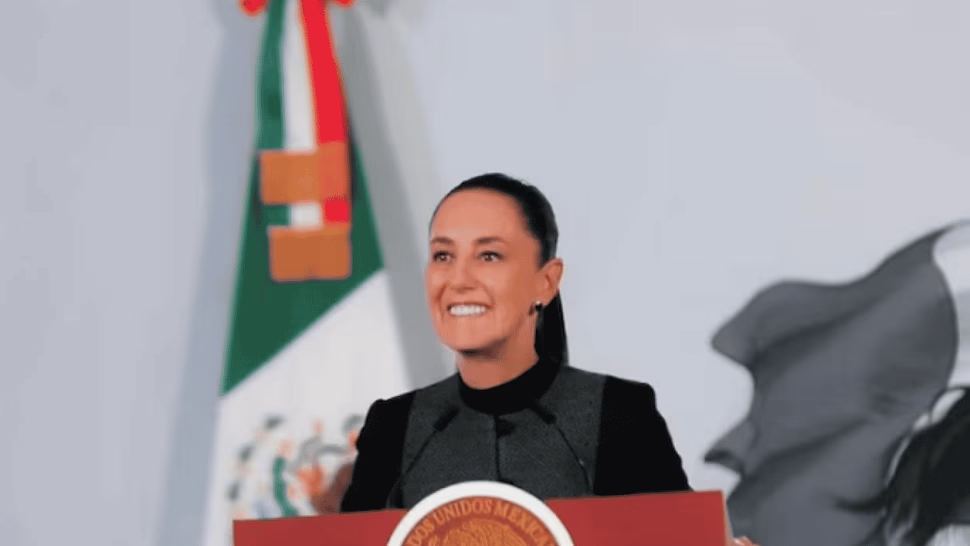

Sheinbaum prepares attendance for the Mexico vs Ecuador match

The president could go to a town hall to see the duel.

Sheinbaum and the duel against Ecuador

President Claudia Sheinbaum announced that this Tuesday she could go to a mayor’s office in the capital to witness the meeting between Mexico and Ecuador. The match, corresponding to the World Cup, will start at 7:00 p.m. at the Mexico City Stadium.

At the start of his morning conference, Sheinbaum asked reporters for their forecasts. He also noted that he is still deciding whether he will attend with the Head of Government, Clara Brugada Molina.

“Mexico is going to win,” said the president when referring to the result of the match.

Sheinbaum wished the national team success. According to official information, he has only attended the opening of the World Cup and Mexico’s first match against South Africa, held at the Deportivo Hermanos Galeana, in Gustavo A. Madero. He followed the duels against South Korea and the Czech Republic from the National Palace.

The presence of the president in a community headquarters seeks to bring the football environment closer to the citizens. So far, neither the specific mayor nor the details of his agenda for the evening have been confirmed.

Continue reading

Sheinbaum celebrates US ruling that protects children of migrants

The president supports the Mexican community in the face of a judicial decision on citizenship by birth.

Recognition of the migrant community

President Claudia Sheinbaum celebrated the ruling of the United States Supreme Court that blocked President Donald Trump’s executive order to eliminate birthright citizenship for children of undocumented migrants. In his morning conference, he described the decision as a protection for thousands of Mexican families.

“Apparently, the Supreme Court said that this decision is not constitutional. It is Mexican men and women, and other nationalities, who have children who are born in the United States,” he declared.

Sheinbaum mentioned the case of a deported worker with whom he spoke in Veracruz. After living two decades in the United States, he had to return to Mexico while his wife and children remained there. He stated that similar stories are repeated among thousands of compatriots who emigrated due to lack of opportunities.

The president highlighted that Mexican migrants contribute to the development of both countries. “They are honest, hard-working people. They found work there because there was a need for those workers in the United States. They are good people who help the economy of Mexico and the United States,” he said.

He recalled that children of Mexican parents born in the United States have the right to Mexican nationality and can obtain dual nationality by registering at consulates.

Message of support for rejection speeches

Sheinbaum sent a message of support to the Mexican community abroad. “They are heroes and heroines for us, and we must always hold our heads high. We must not allow any form of discrimination to affect us. Mexico is big and Mexican men and women are workers wherever we are,” he stated. He assured that migrants represent national pride for their effort and ability to get ahead.

Continue reading

Mexico sets 2030 to eliminate HIV as a public threat

The Secretary of Health details how the strategy will work so that the virus stops being a health threat.

The goal for 2030

The Secretary of Health, David Kershenobich, presented the details of the federal strategy so that HIV stops being a public health problem in Mexico before 2030. The plan is based on three pillars: early detection, universal treatment and prevention.

During the conference by President Claudia Sheinbaum, the official stressed that scientific advances allow people living with HIV to maintain a practically normal life expectancy and quality.

“The goal is to eliminate HIV in our country by 2030,” said Kershenobich.

Currently, it is estimated that around 460 thousand people live with HIV in Mexico. Of them, about 70% know their diagnosis. Among those receiving care, 95% are under treatment and have viral control.

The main challenge remains to identify those who are still unaware that they carry the virus. The secretary explained that a person with undetectable levels of the virus does not transmit the infection, so treatment also works as prevention.

He also highlighted the availability of preventive treatments—before and after possible exposure—and the provision of free tests in first-level units, health campaigns and specialized centers.

“The important concept is that Mexico ensures access to prevention, detection and care,” said the secretary.

These actions are part of the strengthening of the universal health system, with emphasis on ensuring that no person is left out of access to vital services.

Continue reading