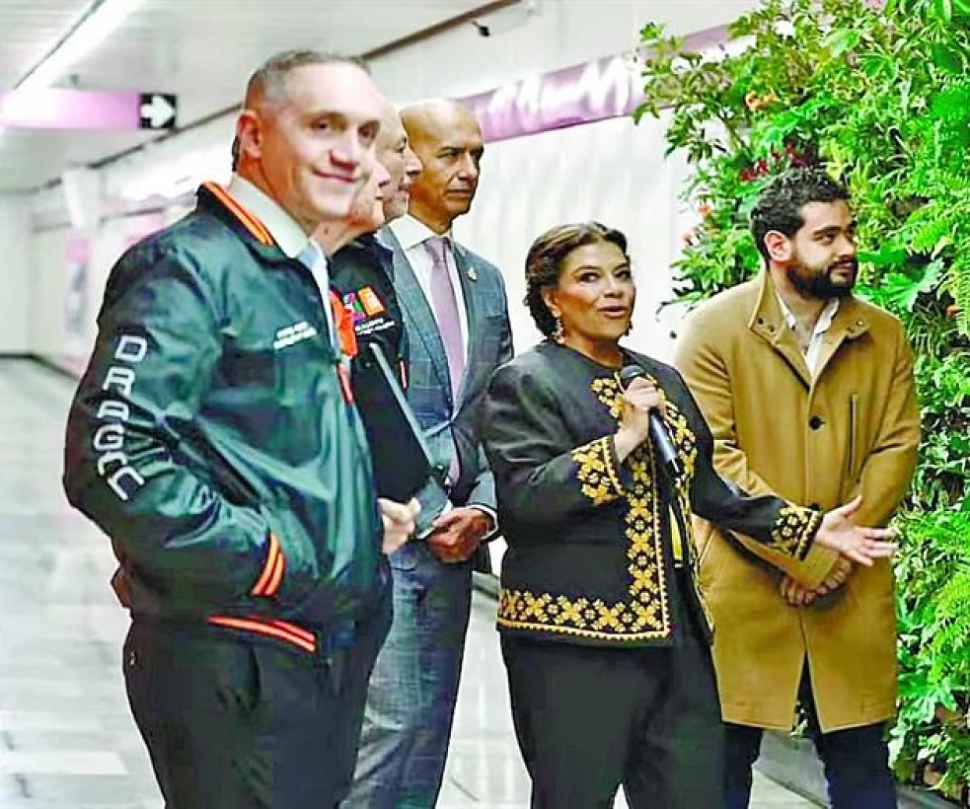
Metro CDMX concludes tests and announces reopening of Line 1

Testing of the new system concluded ahead of schedule, allowing for extended hours this Sunday.

A Miracle in the Underground: The Subway Tests End Earlier than Expected (Yes, You Read That Right)

In a turn of events as unexpected as finding a free seat during rush hour, Mexico City’s Metro Collective Transportation System (STC) has done the unthinkable: finish something before the promised date. That’s right, it’s not a New Year’s wish, it’s reality. The famous and eternal operational tests of the Juanacatlán-Observatorio section of Line 1

The head of the STC himself, Adrián Rubalcava“the tests of the new Communications-Based Train Control (CBTC) system in #LaNuevaLínea1 were satisfactorily concluded.” Basically, the digital brain that will control the trains passed its final exam and there was no need to resort to the typical “already merit.” Thanks to this milestone, which for users is more epic than the last season of any streaming series, the train service on the Pantitlán–Chapultepec section will operate this Sunday at its usual schedule, until midnight. A small respite for the capital’s residents who were planning their return home with the precision of a Swiss watchmaker.

RelatedEl Insurgente Train begins tests to connect CDMX and Toluca

A Thank You That Sounds Like Relief (and RTP)
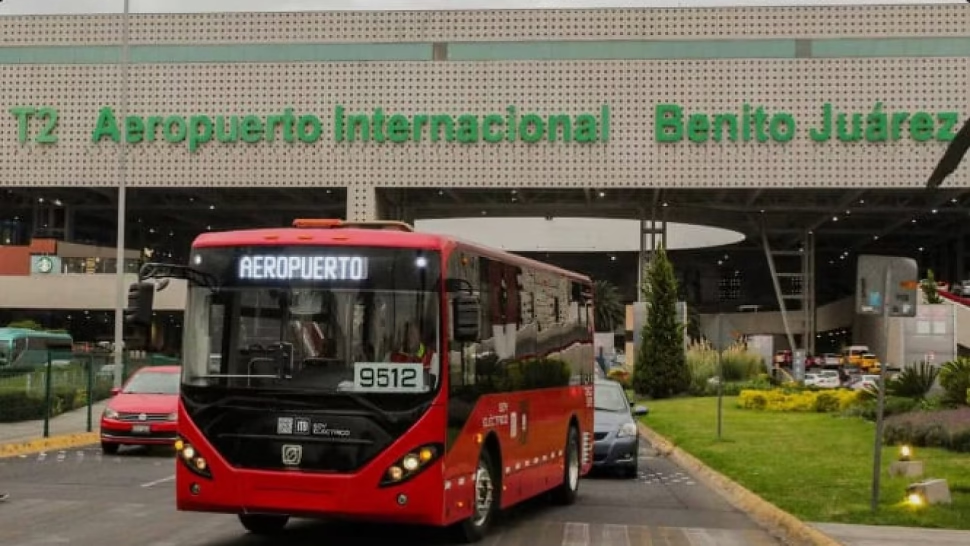
In an act of humility that we do not always see in high places, Rubalcava also took a moment to say thank you. Whom? To theElectric Transportation Service of the DF. (RTP)

But wait, don’t put away your mobility card yet. The million-dollar question, the one we all ask ourselves with the anxiety of someone checking whether a tax refund has arrived, is: When the hell is Line 1 going to completely reopen? Because the tests are fine, they’re nice and all, but what people want is to get on a car without having to make a pilgrimage.

Fortunately, someone with more authority than your dating app’s algorithm has the answer. The head of government, Clara Brugadatotal reopening to the public is projected for next November 16. Mark your calendars, set your phone alarm, make an offering to Saint Jude Thaddeus, patron saint of lost causes. It seems that the light at the end of the tunnel is, literally, the light of a Line 1 train.

Let’s analyze this event a little, because it is no small thing. The implementation of the CBTC (Communications Based Train Control) system is not a simple software change; It is the equivalent of going from a rotary phone to a next-generation smartphone. This system allows for constant communication between the train and the track, resulting in safer, more efficient operation and, hopefully, fewer intervals between trains. It’s the technology that promises to prevent your trip from becoming a forced meditation session in a hot, dark tunnel. It is the great promise to decongest one of the most critical lines of the network, a modernization project that has had users navigating a labyrinth of alternative routes and complementary transport.

The partial closure of Line 1 has been, without a doubt, one of those tests of faith for the average Chilango. It has tested our patience, our capacity for logistical improvisation and our tolerance for human heat in small spaces. Knowing that there is a date on the horizon, and that the tests are going well, is like receiving a message that your lost package has finally left customs. It generates cautious optimism, a hope that, perhaps, the city’s mobility chaos can have glimmers of order and foresight.

While the long-awaited day of the official reopening arrives, we capital residents can enjoy this small victory: a Sunday with extended hours. A gesture that, in the grand scheme of things, is a wink from the transportation gods to remind us that all is not lost. That in the midst of traffic, pollution and stress, sometimes things can go well, and even go ahead. A phenomenon as rare as seeing a UFO, but infinitely more useful.

Were you as happy about this news as we were?Share this glimmer of hope in the capital on your social networks and help us spread the word. And if you want to stay up to date with more news that reconciles Chilango with its city, explore more of our content on mobility and urban transformation.

Cierran rampa en Terminal 2 del AICM por trabajos de mantenimiento

Cierre temporal de rampa en Terminal 2 del AICM por mantenimiento.

Cierre temporal en Terminal 2

El Aeropuerto Internacional Benito Juárez de la Ciudad de México (AICM) informó este domingo sobre el cierre temporal de una rampa de acceso en la Terminal 2. La medida se debe a labores de mantenimiento en la zona.

La rampa afectada está ubicada entre las puertas 5 y 8, que conecta con la planta alta. Mientras duren los trabajos, los pasajeros deberán usar rutas alternas para llegar a las áreas de documentación y abordaje.

RelatedCorte de agua en Terminal 1 del AICM por mantenimiento

Recomendaciones para viajeros

El AICM recomendó a los usuarios considerar tiempo extra para sus recorridos dentro de las instalaciones. Llegar con anticipación es clave: al menos tres horas antes para vuelos internacionales y dos horas para nacionales.

Hasta ahora, no se ha informado cuánto durará el cierre. La autoridad aeroportuaria pidió estar atentos a los avisos oficiales y seguir las indicaciones del personal.

Continue reading

CNDH exige proteger a comunicadores y garantizar libertad de expresión

CNDH pide condiciones seguras para periodistas y combate a la impunidad.

CNDH: libertad de expresión y derecho a la información

La Comisión Nacional de los Derechos Humanos (CNDH) urgió a fortalecer la libertad de expresión y garantizar el derecho de las audiencias. Ambos pilares son clave para atender las necesidades informativas de la sociedad mexicana.

En el marco del Día de la Libertad de Expresión —conmemorado cada 7 de junio— el organismo renovó su compromiso con la protección de periodistas, comunicadores y creadores de contenido. Prometió acciones de prevención, monitoreo y medidas de resguardo.

RelatedSheinbaum expands federal protection for journalists in judicial proceedings

La CNDH recordó que esta fecha se instauró en 1951. Señaló que el ejercicio periodístico ha enfrentado censura, presiones, amenazas y agresiones que dañan tanto a los medios como al derecho ciudadano a estar informado.

Propuestas para proteger a periodistas

El reto actual, según la Comisión, es construir una relación equilibrada entre medios, autoridades y audiencias, basada en la verdad, la objetividad y el respeto a los derechos humanos.

Finalmente, la CNDH exhortó a gobiernos y medios a generar entornos seguros para el trabajo periodístico. Aseguró que continuará con acciones para prevenir agresiones y combatir la impunidad contra comunicadores.

Continue reading

Boris se vuelve tormenta tropical y amenaza el Pacífico mexicano

Tormenta tropical Boris avanza con vientos de 85 km/h y afecta al menos seis estados del Pacífico mexicano.

Tormenta tropical Boris: impacto y medidas preventivas

La depresión tropical Dos-E se convirtió en la tormenta tropical “Boris” durante la madrugada de este lunes, informó el Servicio Meteorológico Nacional (SMN). A las 3:00 horas, su centro se ubicó a unos 135 kilómetros al sureste de Acapulco y a 80 km al suroeste de Punta Maldonado, Guerrero.

El sistema presenta vientos máximos sostenidos de 65 km/h y rachas de hasta 85 km/h. Su circulación provocará lluvias torrenciales de 150 a 250 mm en el oeste y la costa de Guerrero. También se esperan precipitaciones intensas en Michoacán y el suroeste de Oaxaca, así como lluvias muy fuertes en Jalisco y Colima.

RelatedTropical Storm Raymond hits Mexican Pacific coasts

Los vientos alcanzarán rachas de 70 a 90 km/h en las costas de Guerrero y el oeste de Oaxaca. En el resto de las entidades mencionadas, las ráfagas serán de 50 a 70 km/h. El oleaje será significativo: de 4 a 5 metros de altura en Guerrero y occidente de Oaxaca, y de 3 a 4 metros en Jalisco, Colima y Michoacán.

Ante este escenario, las autoridades advierten sobre el riesgo de deslaves, desbordamientos e inundaciones. Se mantiene activa la zona de prevención por vientos de tormenta tropical desde Lagunas de Chacahua, Oaxaca, hasta Técpan de Galeana, Guerrero.

El SMN señala que Boris interactuará con una vaguada en niveles medios y altos de la atmósfera, lo que mantendrá un temporal de lluvias en gran parte del país. Se prevén acumulados intensos a torrenciales en Jalisco, Colima, Michoacán, Guerrero, Oaxaca, Chiapas, Veracruz, Puebla, San Luis Potosí y Tamaulipas. En el noreste, centro, sur y sureste, incluyendo el Valle de México, las lluvias serán fuertes a muy fuertes.

La onda tropical número 5, combinada con humedad, generará lluvias fuertes en la Península de Yucatán. Pese a las precipitaciones, el ambiente caluroso persistirá en Sonora, Chihuahua, Durango, Sinaloa, Nayarit y otras entidades.

Protección Civil recomienda extremar precauciones, evitar cruzar ríos o vialidades anegadas, y mantenerse informado a través de fuentes oficiales.

Continue reading