Manuel Minet Marrero, president of the Court of Campeche, dies

The legal community of Campeche is in mourning after a sudden health complication.

An Unexpected Loss for Campechana Justice

With deep regret, the legal community and the state of Campeche are enveloped in a feeling of loss. Governor Layda Sansores San Román used her social network account This event has shocked all those who had the honor of knowing him and working with him, leaving a void in the heart of the judicial institution.

His departure marks the end of a career dedicated to law and justice, a legacy that will undoubtedly endure. In times like this, it is when we remember the importance of valuing the tireless work of those who ensure our justice. His commitment to Campeche was unwavering, and his example of service continues to inspire new generations of jurists. His vision and dedication positively transformed the Judiciary, taking it towards new horizons of efficiency and transparency.

RelatedThey confirm the lifeless discovery of a kidnapped hotelier in Campeche

A Career Dedicated to Law and Justice

The health of Judge Minet Marrero had suffered a serious breakdown the previous week. On last September 22, he was urgently hospitalized in a clinic in the entity after suffering a myocardial infarction. From that moment on, he remained in the intensive care unit under an induced coma, while the medical staff fought for his recovery. Unfortunately, his heart could not resist, leading him to an outcome that no one expected.

This event reminds us of the fragility of life and the importance of taking care of our health every day. Let’s take advantage of this circumstance to reflect on our own well-being and that of our loved ones. Every moment is an opportunity to live with fullness and purpose, honoring the memory of those who, like the magistrate, dedicated their lives to a greater good. His final fight was a testament to strength, and his legacy drives us forward with hope and determination.

Manuel Enrique Minet Marrero, just 57 years old, leaves behind an impressive record of public service. He was a legal professional with a solid training, having obtained a master’s degree in judicial law and oral trials. As a graduate of the prestigious Autonomous University of Campeche, his career was an example of constant growth and dedication. He went through practically all the steps of the procurement and administration of justice: he served as an agent of the Public Ministry, held the position of first instance criminal judge and rose to the magistracy.

His career is a beacon that guides all who aspire to serve with integrity and passion. It teaches us that with perseverance and ethics, it is possible to achieve the highest professional goals. Every step he took was a lesson in humility and hard work, inspiring colleagues and citizens alike. His life is a reminder that true success is measured by the positive impact we have on our community and the justice system.

The culmination of his extensive and outstanding career came in October 2024, when he assumed the position of presidential advisor of the Judiciary of Campeche, the highest authority within the state court. In this leadership role, he was called to guide the destinies of Campechana justice with his experience and vision. His legal legacy and his commitment to the institution will remain a fundamental pillar in the history of the local judiciary. His leadership was a transformative force, driving innovations and reinforcing citizen confidence in the system.

Today, we celebrate his life and contributions, knowing that his spirit of service lives on in every just sentence and every act of equity. Let us continue to build on the foundation he helped establish, carrying out his mission with the same fervor and excellence. May his memory motivate us to pursue excellence in all we do, honoring his name with actions that reflect the values ​​he embodied. The future of justice in Campeche will be brighter thanks to the foundations he solidified.

Would you like to honor the memory of public figures who leave a positive legacy?Share this article to keep their story alive and explore more content about the pillars of our society on our website.


SCJN will review decree that protects works by Frida Kahlo

The Court will analyze whether the ban on exporting Frida Kahlo paintings is constitutional.

The SCJN takes up the Frida Kahlo case

The Supreme Court of Justice of the Nation (SCJN) decided to resume its jurisdiction to analyze a key case on the protection of Frida Kahlo’s work. The plenary session of the highest court will study whether it is constitutional to prohibit the definitive departure from the country of paintings by the artist that are in the hands of individuals.

The presidential decree of 1984

The central point is article 6 of the decree issued in 1984, during the government of Miguel de la Madrid. The provision declared Kahlo’s entire production an artistic monument and prohibited its permanent export. Now, the Court must determine whether this restriction exceeds the powers of the Executive Branch.

The case strikes a balance between the protection of cultural heritage and property rights. The resolution will set a precedent on the scope of the State to limit the circulation of private artistic goods.

The SCJN has not set a date for the discussion in plenary, but the debate promises to be intense between ministers. Meanwhile, collectors and heirs are closely following the process.

Continue reading

Oaxacan transporters maintain road blockade for the second day

They demand regularization of units and a dialogue table with SICT.

Mobilization of transporters in Oaxaca

Federal passenger transportation service providers keep federal highway 190 blocked for the second consecutive day, near the SICT delegation in Oaxaca. They demand the regularization of their units and attention to their demands from the federal authorities.

The mobilization is led by the General Coordinator of Oaxacan Transporters. With Urvan-type vehicles and buses, they prevent circulation in both directions. According to leader Francisco Santos, nearly 500 units are participating in the protest, which will be indefinite until a favorable response is obtained.

Historical demands

The transporters point out that the conflict has continued for more than three decades. The lack of regularization prevents them from having legal certainty to operate on federal highways. For this reason, they ask for a dialogue table with SICT officials to advance a reorganization of federal motor transportation.

In addition, they denounce the alleged invasion of routes by the Binni Bus system, which they accuse of operating without authorization on federal highways and generating unfair competition for concessionaires.

Road effects

The blockade occurs in one of the main accesses to the Oaxacan capital. The protesters reiterate that they will not withdraw their protest until they receive a concrete response from the federal authorities regarding their demands.

The situation reflects a historical problem in the transportation sector in Oaxaca. Transporters insist on the need for effective dialogue to resolve the conflict that affects mobility in the region.

Continue reading

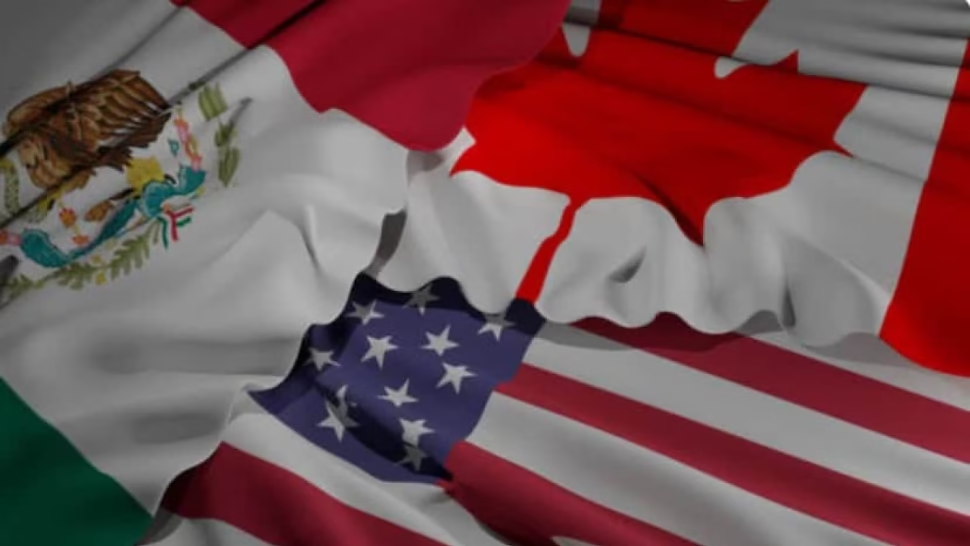
T-MEC: Mexico reduces pending issues to 14 and gets ready for a new round

Progress in the negotiation of the trilateral agreement with the United States and Canada.

The review of the Treaty between Mexico, the United States and Canada (T-MEC) entered a decisive stage. The Federal Government informed Congress that the negotiations with the United States reduced the pending issues from 54 to 14, according to a report from the Ministry of Economy published in the Parliamentary Gazette.

The issues that are still on the table

Both nations will hold a new round of negotiations on July 20. The objective: define the next steps, address the priority issues and make the results known. Among the concerns of the United States are the loss of manufacturing jobs, dependence on supply chains from third countries, the trade deficit, rules of origin and economic security.

Mexico maintains that these challenges can be resolved with a regional strategy that strengthens production in North America and reduces dependence on Asian imports.

Mexico’s proposals

As part of its negotiating position, Mexico presented 13 proposals. Among them, the elimination of tariffs applied by the United States under Section 232 to strategic sectors such as steel, aluminum and the automotive industry. The federal administration believes that withdrawing these measures would strengthen regional competitiveness and give greater certainty to investments.

In addition, the Mexican government seeks to promote investments in strategic industries: semiconductors, medicines, electronics and computing technologies. The purpose is to expand the productive capacity of North America, reduce dependence on critical inputs from abroad and strengthen competitiveness against other economic blocks.

Continue reading