Latin American field: global solution or empty promise?

Key region for food, but with enormous gaps in technology and services.

The field that feeds the world… but runs out of water

Latin America and the Caribbean have been the supermarkets of the planet for more than two decades. Since 2000, no one exports more food than this region. But the new CAF report—presented in Mexico with great fanfare—reveals an uncomfortable truth: those who produce these foods live as if the 21st century had not arrived.

Seven out of ten rural workers are in the informal sector. Without benefits, without labor rights, without protection. And that’s just the tip of the iceberg.

“The region is consolidating itself as a ‘solution region’ to the challenges of food security and energy transition,” says the report Roots of the future: the new rural world of Latin America and the Caribbean.

Nice speech. But in the meantime, agricultural productivity remains a fraction of what Europe or the United States achieve. Technology does not arrive, connectivity is a luxury and access to drinking water continues to be a dream for millions.

RelatedMexico ranks second in homicides of LGBT+ people in Latin America

Women pay the price (again)

The study also highlights something that anyone with eyes already knows: rural women carry everything. Unpaid work, fewer land rights, fewer opportunities. Gender gaps that seem stuck in another century.

And as the population ages and young people flee to the cities, governments continue to patch it up. In Mexico—which concentrates a quarter of the regional rural population—they promise legal certainty over land and gender equality in agrarian rights. It sounds nice. It remains to be seen if they comply.

The CAF proposes investing in infrastructure, digitalization and social protection. I hope it’s true. Because if I have learned anything in years covering this type of reports, it is that diagnoses are unnecessary. What is missing is a real will to change the rules of the game.
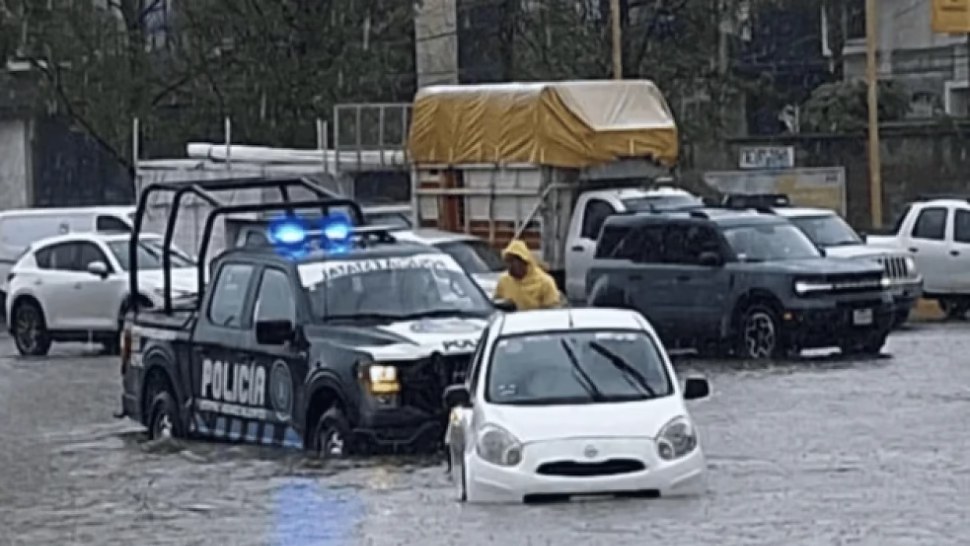
Floods in Aguascalientes after intense overnight rains

Storm in Aguascalientes left vehicles stranded and families rescued. Authorities activated protocols.

Rains collapse roads in Aguascalientes

On Saturday night and early Sunday morning, intense rains affected Aguascalientes, Jesús María and Rincón de Romo. Boulevards and avenues were flooded, vehicles were covered in water and entire families were trapped.

Rescues and attention to the population

The greatest impact occurred in the capital. Firefighters and Civil Protection worked for hours to rescue people stranded in different parts of the metropolitan area. They provided assistance to occupants of cars stuck in neighborhoods such as Parques Industrial del Valle, San Francisco de los Romo, the first ring overpass and the exit to Zacatecas.

The overflowing of some channels concentrated the water in the avenues. The State Government reported that security corporations from several municipalities maintain a coordinated operation to provide timely support.

Recommendations and road closures

During the early morning, the authorities asked to avoid driving through flooded areas and to follow official information. The Municipal Public Security Secretariat detailed that the Road Police attended to 42 stranded vehicles and carried out 18 road closures to prevent risks to drivers and pedestrians.

Municipal agents moved entire families, women and minors who could not move due to the storm and flooding to their homes.

Continue reading

CNTE raises a sit-in after 20 days of protest in the Zócalo

The dissident teachers left losses of 410 million pesos and freed up spaces in the Historic Center.

End of the CNTE sit-in

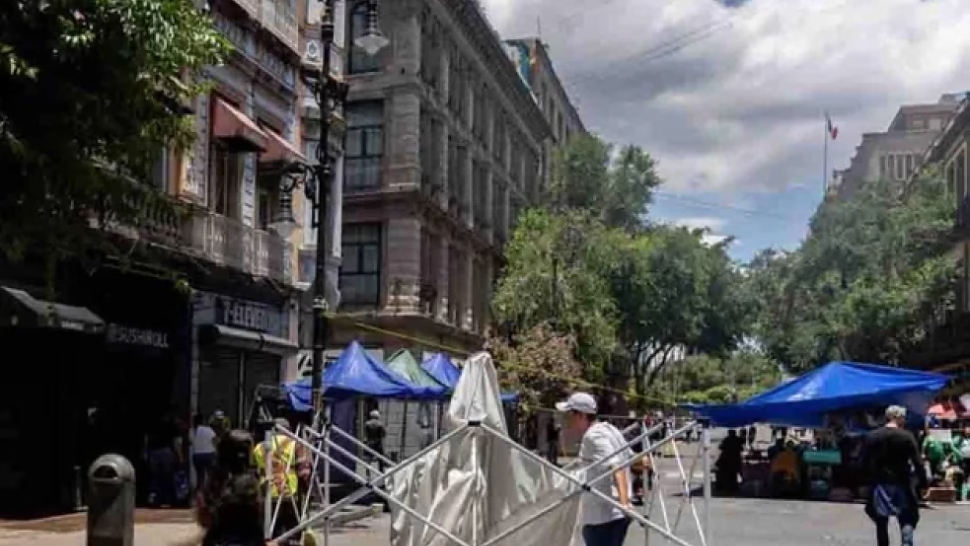
The National Coordinator of Education Workers (CNTE) ended its national strike this Saturday. For 20 days, the mobilizations and the camp in the Historic Center of Mexico City generated losses of more than 410 million pesos to established businesses, according to sector estimates.

Although it did not achieve the repeal of the ISSSTE Law of 2007 or the repeal of the educational reform, the CNTE obtained commitments, financial resources, places, recategorizations and support for education workers in several states.

The leaders assured that the withdrawal is not a defeat. They advanced a stage of reorganization to strengthen the movement and prepare new actions. They insisted that the federal government did not present a proposal to eliminate the ISSSTE Law of 2007 or to reverse the educational reform, demands that will remain in force.

Starting this Monday, around 1.4 million students who remained without classes will be able to return to classrooms in the entities where the CNTE had suspended activities.

Space release

Public space has been gradually freed up. Cleaning workers from the Government of Mexico City removed garbage in streets such as 5 de Mayo, Belisario Domínguez, 20 de Noviembre and República de Cuba. In some areas, the withdrawal was almost total; In others there were still tarps and tents.

A teacher from section 34 of Zacatecas declared: > “We are going to clean it, don’t say that we are going to leave it dirty.”

Merchants expressed relief at the departure of the teaching profession. A worker at the La Blanca restaurant, on May 5, commented: > “It’s good that they’re leaving, it was a very hard month; here we had like a 90% drop in customers.”

A snow seller on the same street indicated that they expected higher sales with the FIFA Fan Fest in the Zócalo, but the arrival of the CNTE reduced their income by 50%.

For his part, the Secretary of Education, Mario Delgado, rejected that the government had “bribed” Section 22 of Oaxaca to hold the sit-in.

Continue reading

Five deaths in bars in CDMX during the early hours of the morning

Two attacks in bars in the capital leave five dead and six arrested.

The early morning left two violent episodes in different parts of the capital

A man lost his life from gunshots outside a bar located in Plaza Garibaldi, Cuauhtémoc mayor’s office. According to the Secretariat of Citizen Security (SSC), the victim was attacked directly in the Lázaro Cárdenas Central Axis and the Republic of Honduras. After the attack, he ran inside the establishment, where he died.

The suspects fled in a gray car, but later returned to the scene along with a blue truck and a subject on a scooter. Agents approached and, after a search, they found packages with one and a half kilos of marijuana and a firearm. They were arrested.

In another incident, an alleged fight inside a bar in the Álvaro Obregón mayor’s office left four people dead and two arrested. One of them was taken to a hospital injured.

Data from the SSC indicate that several people began arguing inside the establishment, in the San Bartolo Ameyalco neighborhood. One of the subjects pulled out a firearm and shot several people. The detainees were placed at the disposal of the authorities.

Continue reading