Government enables line for victims of the attack in Teotihuacán

Hotline for victims, seven hospitalized and reinforced security in tourist areas.

The line that nobody asked for, but here it is

The Ministry of the Interior enabled a telephone number —55 1000 2000, extension 57508— to assist those affected by the armed attack in the archaeological zone of Teotihuacán. A balance: one person dead and more than a dozen injured. Because of course, after the chaos, the first thing is to score.

Rosa Icela Rodríguez explained that seven people remain hospitalized; six others have already left. Among those affected are citizens of the United States, Brazil, the Netherlands, Russia, Colombia and Canada. International tourists who came to see pyramids and ended up in the emergency room.

“The government seeks to offer information, support and accompaniment to the victims”

It sounds nice. But one remembers other similar protocols: promises that fade when the spotlight goes down.

RelatedA fire in Teotihuacan threatened history but only burned grass

More National Guard, more security?

Omar García Harfuch announced reinforcements in archaeological zones and tourist destinations. More presence of the National Guard in crowded places. Predictable measure: When a disaster occurs, the automatic response is to put more uniformed personnel.

What’s not said: How they ensure this isn’t just another temporary patch. History has taught us that these operations usually last as long as the network scandal lasts.

Federal authorities promise coordination between agencies to prevent future attacks. Hopefully this time the commitment transcends the morning conference.


Housing for Wellbeing boosts GDP by 1%, says Sheinbaum

Sheinbaum announces that the housing program contributes 1% to the GDP and will benefit 30 million.

Housing for Wellbeing and its economic impact

From Tuxtla Gutiérrez, Chiapas, President Claudia Sheinbaum highlighted that the Housing for Wellbeing program contributes about 1 percent to the national Gross Domestic Product (GDP). This, thanks to the jobs it generates in construction and related sectors.

“There is nothing happier that can make the President and her entire team than to see the joy on their faces for receiving a home today,” said Sheinbaum during the delivery of 48 homes in the Infonavit Lacantún development.

In addition, 401 settlement certificates from Fovissste and 503 deeds from Insus were delivered. The president stated that the program will benefit nearly 30 million people during her six-year term.

“Thanks to the Housing for Wellbeing program, it is contributing close to 1 percent of GDP to the country’s economic growth. And if we consider that each home employs at least 4 people, a very important number of jobs are being generated,” he pointed out.

Investment in Chiapas

The Secretary of Agrarian, Territorial and Urban Development, Edna Elena Vega Rangel, explained that in Chiapas 42 billion pesos are allocated to build 70 thousand new homes in the six-year period. Of these, 50 percent are already hired.

The general director of Infonavit, Octavio Romero Oropeza, reported that at the national level there are 420 housing complexes in 31 states, with 475 thousand homes. Of them, 190 thousand are already under construction, and 3,600 have been delivered. In Chiapas, Infonavit contemplates 34 thousand homes with an investment of more than 20 billion pesos.

Governor Eduardo Ramírez Aguilar thanked the President for the homes delivered, while the beneficiary Miguel Ángel Ramírez Trujillo expressed his gratitude for the future it represents for his family.

Continue reading

CRT foresees 85% of registered lines before staggered cuts

The CRT estimates that between 120 and 130 million cell phones will be registered before the progressive cut.

Mobile line registration: 85% will be linked before cuts

The Telecommunications Regulatory Commission (CRT) expects that between 120 and 130 million cell phones will be registered, which represents about 85% of the total active lines in the country.

Currently there are 144.6 million lines. Ricardo Castañeda Álvarez, general director of Regulatory Policy of the CRT, estimated that between 14 and 24 million will not be registered and will be deregistered as the process progresses.

The suspension process will begin on August 15. Lines ending in 0 will be deactivated first and then in stages until the end of the year, with the aim of avoiding technical saturations.

Castañeda explained that the extension was due to the risk that millions of users would not meet the original deadline, which would have generated operational complications similar to massive saturations in emergencies. He ruled out a new extension of the deadline.

He assured that the registry does not violate privacy because the information is managed by the operators. The main objective is to combat crimes such as extortion, fraud and virtual kidnappings.

Continue reading

They accuse the PAN of an irregular scheme in social support

Morena accuses the PAN of an alleged scheme to collect commissions on social programs.

Accusations for alleged diversion in social programs

Morena deputies in Mexico City accused PAN legislators of operating an irregular scheme through the sale and purchase of household products, supposedly disguised as a social support program in Tlalpan and Xochimilco.

According to the complaint, those involved acquired items such as water tanks, cisterns, solar heaters, washing machines, mattresses, laptops and screens through a civil association. They would then have resold them at higher prices to the inhabitants of those districts.

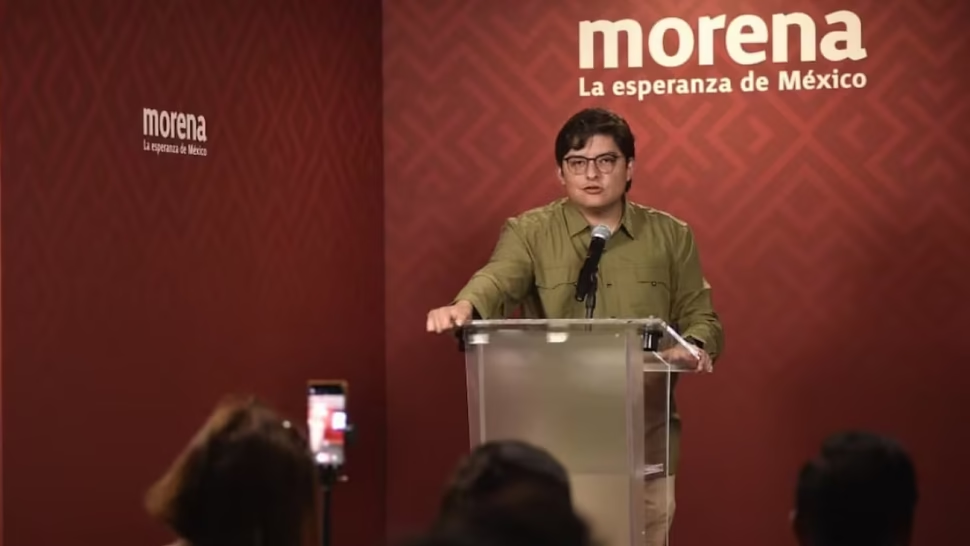
Morena spokesperson Paulo García stated that the mechanism included a triangulation of resources where the civil association paid commissions for each product delivered. In addition, legislators would have made profits between the purchase price and the resale price.

The Morenistas pointed out that the products carried names, photographs and partisan colors, which could constitute personalized promotion of public servants, prohibited by Article 134 of the Constitution outside of electoral campaigns.

The complainants announced that they will file complaints with the Electoral Institute of Mexico City so that the facts can be investigated.

For their part, PAN legislators denied the irregularities. They assured that these are operations between individuals through a foundation that sells products at low cost, without public resources.

The case has opened a debate about transparency and oversight of social programs in the capital’s mayors.

Continue reading