Police flee Escuinapa after wave of deadly attacks

The police disbandment in Escuinapa after five murders in nine days forces a special operation in the south of Sinaloa.

The southern front is crumbling

The theater of violence in Sinaloa has a devastating new setting: Escuinapa. In just nine days, five members of the municipal police were murdered. The response was immediate, but it did not come from the criminals, but from the very body that should confront them.

Thirty officers simply left. They submitted voluntary resignations or requested early retirements. A rout that reveals the magnitude of fear. Rosario Guadalupe García Camacho, local Security Secretary, admitted it crudely: she only has 49 active elements left, and 28 of them only cover road functions.

“Surprisingly, seven preventive agents, with less than six months of service, presented their voluntary resignations,” the authority cited.

The final trigger was the murder of Pablo ‘N’ this Wednesday. He was followed by an armed motorcyclist and shot to death in front of his house on 12 de Octubre Street. Neighbors found him without vital signs. It was the fifth name on a tragic list that began on March 31.

RelatedSheinbaum confirms an increase in homicides in southern Sinaloa

That day, an ambush on the Mazatlán-Tepic highway killed the deputy operational director, Esteban Gutiérrez Mazariego, and three of his men. The message from organized crime was received loud and clear.

An operation to cover the sun with a finger

Given the collapse, Governor Rubén Rocha Moya announced that a “special operation” is already being designed for the south of the state. He said that the Secretary of State Security, General Sinuhe Téllez López, has instructions to reinforce the presence.

It sounds like a repeated script. They promise to strengthen municipal bodies when they are literally evaporating due to terror. What good is an operation if there is no one to support it on the ground? The strategy seems to arrive late and poorly.

While the authorities talk about reinforcements, the police officers remaining in Escuinapa know that they are moving targets. The state lost control of the scene. Now he must convince his own men not to abandon the performance before the curtain falls completely.
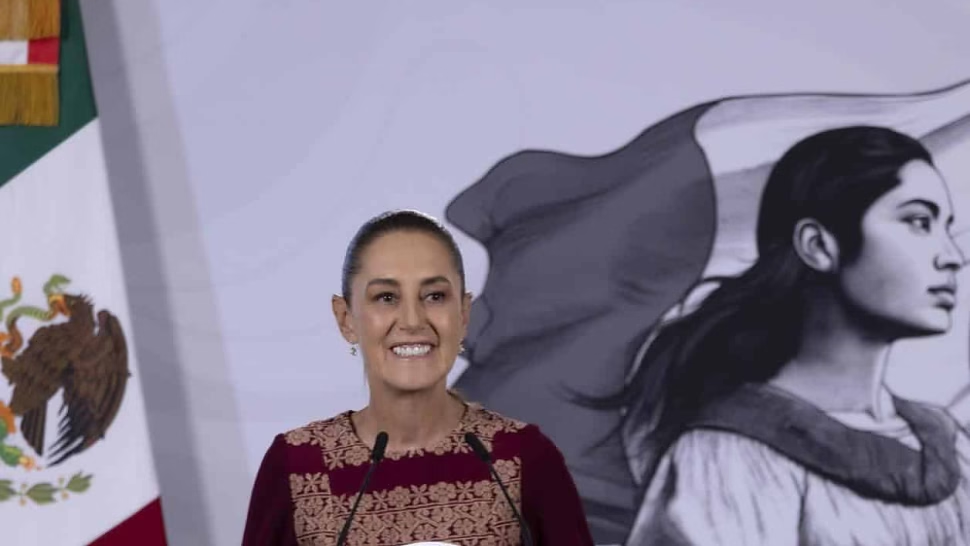
Sheinbaum asks King Felipe VI to apologize to indigenous peoples

Sheinbaum apologizes to indigenous peoples; king listens and agrees on cultural exhibitions.

Request for forgiveness and culture

President Claudia Sheinbaum expressed to King Felipe VI the importance of Spain complying with the request for an apology to the indigenous peoples of Mexico. “Fortunately, 28 million Mexican men and women recognize themselves as indigenous; 68 languages ​​are spoken in Mexico,” he noted.

The president stressed that the recognition of pre-Hispanic civilizations and the resistance of these peoples are fundamental for national identity. “We said no to racism, classism and any discrimination,” he said. The monarch listened and proposed including the topic at the indigenous peoples’ table during the Ibero-American summit in November in Madrid.

As a result, they agreed to send three exhibitions to Spain: one on Mayan culture, another on Spanish refugees, and one dedicated to Sor Juana Inés de la Cruz. Sheinbaum highlighted that the meeting was possible thanks to the king’s previous visit to an exhibition on indigenous women in Madrid, where he recognized “abuses committed during the arrival of the Spanish.”

Both leaders also discussed trade, economics and the United Nations Charter. “It was a very cordial meeting; he’s a very down-to-earth person,” Sheinbaum said. After the dialogue, they visited the mural “The Epic of the Mexican People” by Diego Rivera. The king then left for Guadalajara to attend the Spanish team’s match.

Continue reading

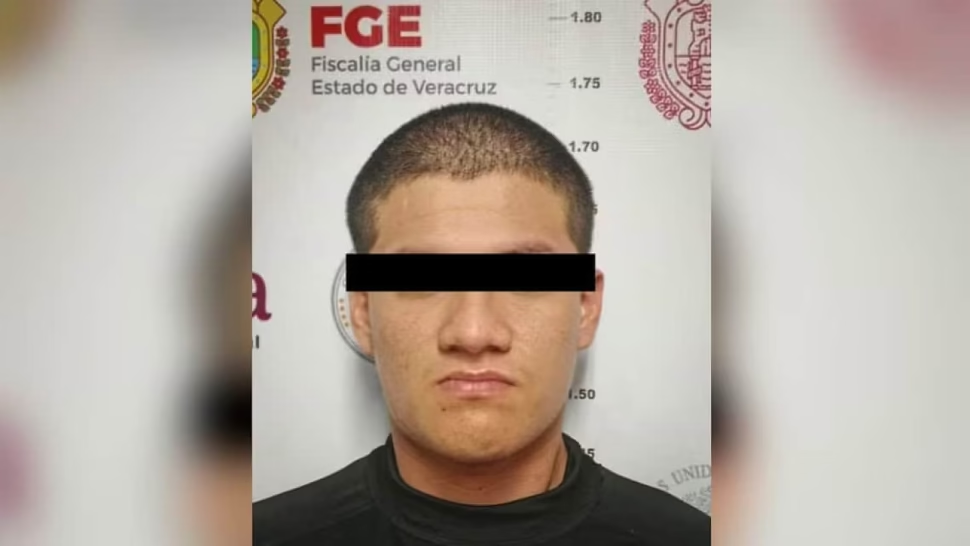
They capture someone involved in the kidnapping of a journalist in Veracruz

Family of the kidnapped journalist demands official information after the arrest of José N.

The Veracruz Prosecutor’s Office arrested José N, identified as one of the alleged perpetrators of the kidnapping of journalist Roxana Guzmán, founder of the medium Pulso Informativo del Sureste. The capture was confirmed this Tuesday, although the victim’s family assured that they have not yet received complete official information about the progress of the investigation.

The events of June 2

The attack occurred on June 2 in Nanchital, in the south of the state. An armed group broke into the Guzmán family home during the early hours of the morning. At least four men subdued the family members and also entered the journalist’s brother’s house.

Roxana’s mother, Rubicelia Ramírez, fully identified the detainee in a video released after the kidnapping. “He was at my house,” he declared.

Video that documented the attack

In a 35-second recording, the attackers are seen trying to force entry into a home while a person warns them that there are minors inside. The attackers managed to take Roxana Guzmán, as well as the family’s cell phones, and put her in a vehicle before fleeing.

Witnesses indicated that those responsible falsely stated that the victim would be transferred to a “command office.”

Reactions and expectations of justice

The arrest of José N represents progress in the investigation of the case, which has generated broad solidarity in the journalistic field and society. Roxana Guzmán’s family hopes that the necessary measures will be taken to guarantee the safety of all those involved and that justice will be done.

Continue reading

Volaris joins humanitarian airlift to Venezuela

The airline will transport personnel and 1.5 tons of supplies for earthquake victims.

Volaris activated its Avión Ayuda Volaris program to support the Venezuelan population after the earthquakes of June 24. The company coordinates two charter flights with the Salvadoran government.

The first flight, aboard an Airbus A320, departed on Thursday from the El Salvador International Airport to the El Libertador Air Base in Maracay. The second is scheduled for this Friday.

In total, about 141 people linked to support and logistics tasks will be transferred. In addition, 1.5 tons of humanitarian aid will be transported: medical supplies, rescue equipment, food and other essential goods for the affected communities.

The Ministry of the Interior and Territorial Development of El Salvador coordinates the logistics of the mission. This operation seeks to expedite assistance in the areas hardest hit by the earthquakes.

Continue reading