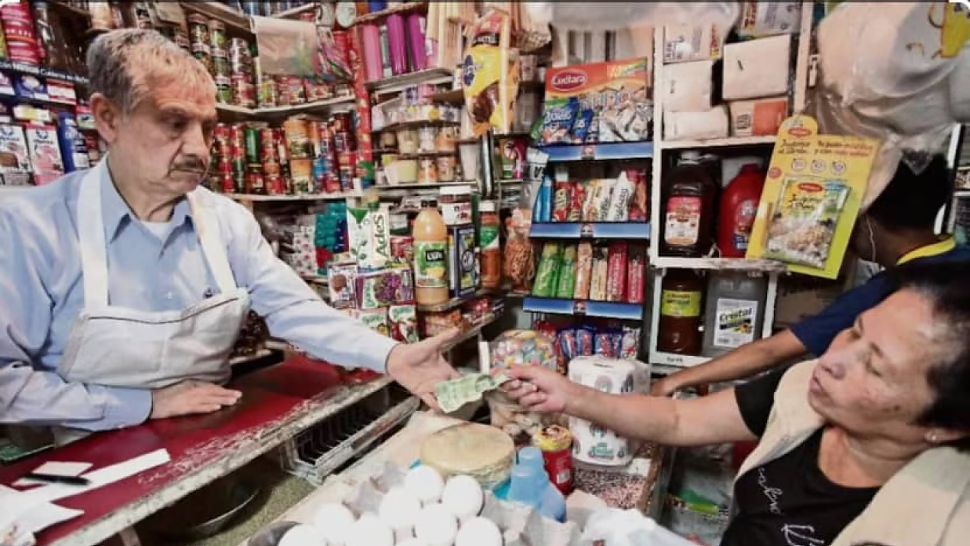
The majority of Mexicans live on the edge of their finances

A study reveals that the majority of Mexicans live at the limit of their finances and without a cushion for emergencies.

The majority live on the edge and without a safety net

The latest report on Mexicans’ finances paints a stark picture. The Bravo firm revealed that 77% of the people surveyed operate close to or above their financial capacity. That is, they live justly.

Worse still, 85% do not have enough savings to cover three months of income. An unforeseen medical event or loss of employment would leave them hanging.

RelatedSavings and finances lead the goals of Mexicans for 2026

When the budget is not enough

Here is the paradox: although 63% say they make a budget before going into debt, the average debt is around 193 thousand pesos. Bad habits with money (22%), losing your job (20%) and failing businesses (16%) are the main causes.

But the consequences go beyond the pocketbook. They get into your head and keep you awake.

85% reported high levels of stress, 66% anxiety and 53% insomnia.

The credit card is the gateway to credit for more than half. Almost 40% used their last loan to cover day-to-day expenses, and another 29% to pay… other debts. A perfect vicious circle.

The worrying thing is that almost half do not know how long it would take to pay off their commitment if they only pay the minimum, although they understand the difference. Knowledge without action.

The directors of the study, Diego Paillés and Javier Salmerón, were clear: more tools are needed. Financial education is key, but progress is insufficient.

Their call was for coordinated action. Because when almost an entire country walks a financial tightrope, the problem is no longer individual. It’s collective.
Controversy over an interview with Monsiváis reaches the Senate and the Palace

The republication of a 1999 interview unleashes accusations between the Executive and legislators.

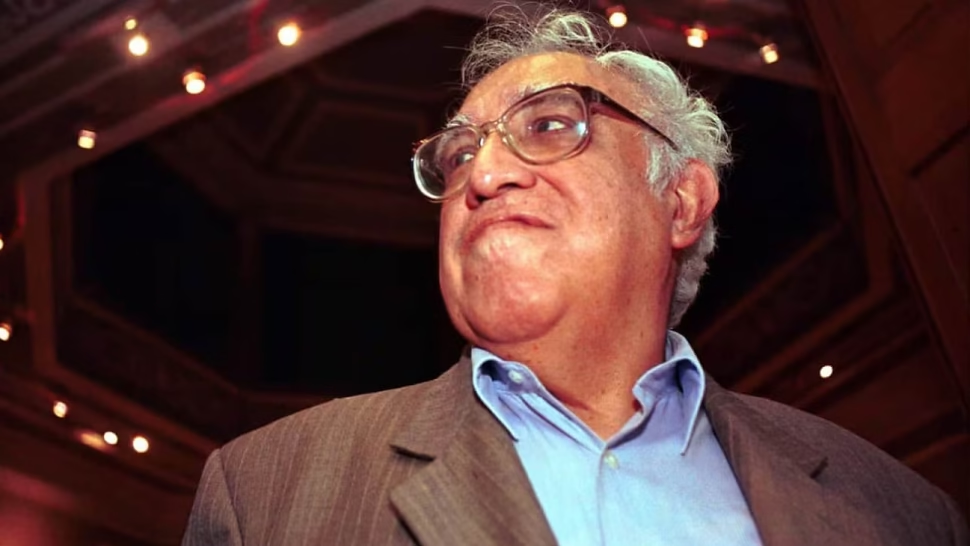
The republication of an old interview attributed to Carlos Monsiváis climbed to the center of the Mexican political debate this Wednesday. The issue was discussed both in the Senate and in President Claudia Sheinbaum’s morning conference.

The original text was written by journalist Edmundo Cázares in 1999 and recently republished by El Universal. It contains statements about the then head of Government Andrés Manuel López Obrador. Its veracity and context have been questioned, generating conflicting positions.

Sheinbaum describes the content as “grotesque”

During her conference, the president harshly criticized the publication. He described the content as “grotesque” and accused the medium of generating a controversy that distorts the tribute to the Mexican intellectual.

Reactions in the Senate

The issue also reached Congress. Senator Lilly Téllez read fragments of the text on the platform. In response, Gerardo Fernández Noroña rejected its use and maintained that it was a false publication with the intention of political attack.

The exchange reflects the polarization around the figure of López Obrador and the use of historical documents as partisan weapons.

Continue reading

PRI demands urgent action against violence in Guerrero

They denounce an incursion of armed civilians in Coyuca de Catalán; party calls for state intervention.

The national leadership of the PRI demanded that the Mexican State intervene urgently in response to the complaint by inhabitants of the Guajes de Ayala ejido, in Coyuca de Catalán, Guerrero. The residents reported the incursion of armed civilians into their community in the Sierra.

Call for safety

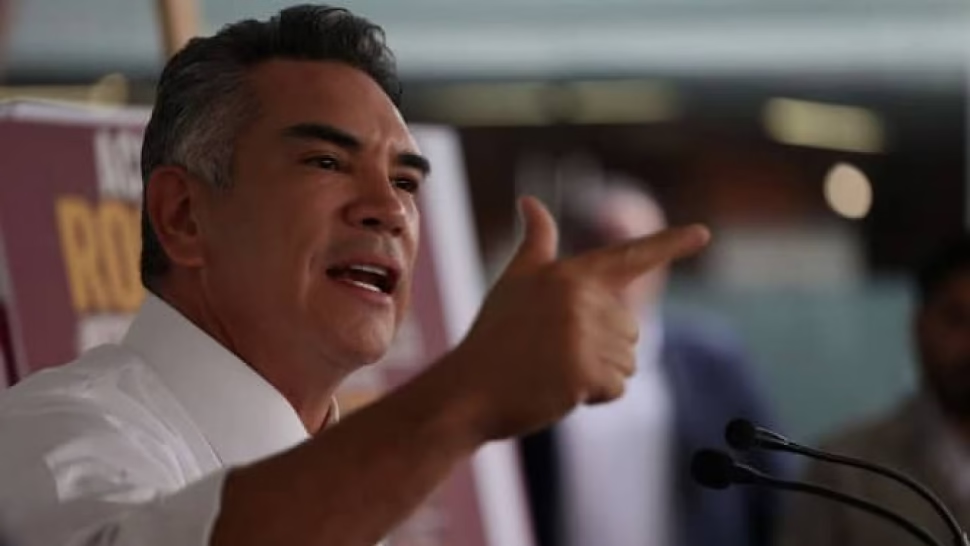
Alejandro Moreno Cárdenas, president of the party, asked the authorities to guarantee the safety of the families. He warned that these events should not be normalized due to the risk they represent for the civilian population.

The leader pointed out that in various communities in Guerrero they live under siege by armed groups. This has caused displacement, confinement of inhabitants and a constant climate of fear and uncertainty. He considered an immediate response from the State necessary.

Moreno Cárdenas also criticized the federal government for minimizing the situation of violence in the country. He affirmed that the population faces conditions of insecurity that require priority attention to restore the rule of law in the region.

Continue reading

Inflation in Mexico slows down and remains at Banxico’s goal

Inflation drops to 3.55% in the first half of June, within Banxico's target range.

Inflation in Mexico continues to decline. According to Inegi, it stood at 3.55% annually during the first half of June. This represents a drop of 0.11 percentage points compared to the second half of May.

With three consecutive months of deceleration, the indicator remains within Banxico’s target range (3% plus/minus one point). This level is key for purchasing power.

Pressures on core inflation

However, pressures remain. Core inflation—which reflects medium and long-term trends—was at 4.12%, with a biweekly increase of 0.19 points. Within this category, merchandise rose 3.65% annually and services, 4.57%.

Non-core inflation and seasonality

In contrast, non-core inflation slowed to 1.61% annually, driven by the drop in agricultural prices. Products such as tomatoes, eggs and poblano peppers recorded significant decreases.

The report also reflected seasonal movements in tourist services, related to the summer and the Soccer World Cup. Air transportation, hotels and tour packages increased. Despite this, analysts foresee a favorable trend towards the end of the year.

Continue reading