The US Chamber of Commerce attacks the Mexican SAT

The most powerful business body in the US points to "coercive" tax practices and warns of deteriorating investment climate two years before a key review.

The North American business giant drops the bomb

Just when we thought that the most tense thing between Mexico and the United States would be deciding which taqueria is more authentic, the United States Chamber of Commerce launches a criticism that sounds like a corporate ultimatum. On the eve of the review of the Treaty between Mexico, the United States and Canada (TMEC) of 2026, the organization released the report that no one asked for but everyone expected: the Mexican treasury, according to them, is behaving like that friend who always “forgets” his wallet. Neil Herrington, the vice president for the Americas, did not mince words and accused the Tax Administration Service (SAT) of applying “coercive and abusive practices” against American companies. Basically, the message is: “either they fix the fiscal mess or this is going to get ugly.”

But not everything is the SAT, oh no. The complaint comes in combination. Herrington also said that the recent constitutional reforms in Mexico are the equivalent of putting a lock on judicial independence and regulatory autonomy. In Christian: according to the Chamber, the rules of the game are changing in the middle of the game and in a way that scares investors, who are already more nervous than influencers without WiFi. Key elements such as transparency and protection of your investments — the bread and butter of any serious trade agreement — would be at risk.

RelatedMexico and Canada strengthen alliance for the review of the USMCA in 2026

It’s not (just) personal, it’s business: millions on the table

And so that you do not think that it is a baseless tantrum, the manager released the numbers that hurt: the TMEC supports more than 13 million jobs in the United States and is the support of more than 100 thousand small and medium-sized companies that depend on trade with Mexico. Millennial translation: if the investment climate in the region cools, the blow to North America’s economic security would be on the level of running out of avocado for toast. It is not a minor issue.

The catalog of complaints, however, is like a buffet of non-compliance. According to the report, Mexico has failed the trade pact in key sectors such as agriculture, energy, digital commerce, intellectual property and financial services. Although, to be fair (something this narrator rarely is), the House also criticized Canada for its messes with dairy and digital trade, and even dared to criticize the tariff policy of the Trump era for going against free trade. In other words, it was “everyone is failed” but with a suit and tie.

Faced with this panorama that seems more complicated than understanding the terms and conditions of an app, the call of the Chamber of Commerce is clear: the United States must promote a “transparent and orderly” review of the USMCA. The 2026 review is not just another procedure; It is the moment when the future of regional economic integration will be decided, especially with the specter of Donald Trump suggesting that the treaty could expire if it is not renegotiated. In other words, a season of negotiations is coming that is more intense than a marathon of streaming series, and with much more at stake.

Are you surprised by this warning from the most powerful business community in the US?Share this note on your social networks and tag those who should be aware of these trade clashes that affect us all.Explore more content on economics and geopolitics on our site to understand the rules of the global game.

Yes to disarmament: 11 thousand weapons delivered since October

The anonymous exchange program advances with financial incentives and toy barter.

Results of the Yes to Disarmament program

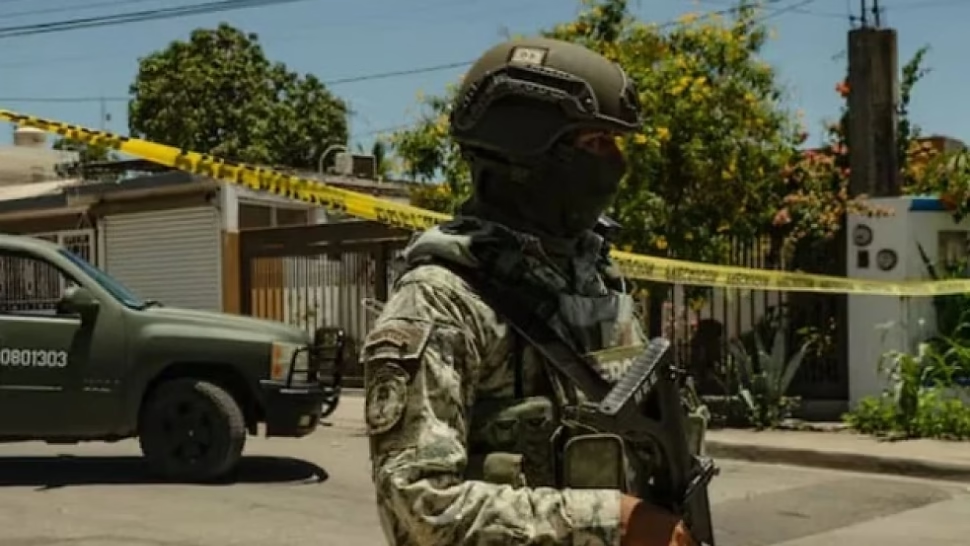
The Secretary of the Interior, Rosa Icela Rodríguez, reported that since October 2024, 11,139 firearms have been exchanged. The exchange is anonymous and in exchange for economic incentives, as part of the Attention to Causes strategy.

During the morning conference by President Claudia Sheinbaum, Rodríguez explained that the program also allows war toys to be exchanged for educational materials. The objective is to promote a culture of peace in girls, boys and young people.

Prevention actions

The head of the Interior highlighted the “Festivals for Peace”, community activities and youth programs. These actions seek to bring the government closer to the communities through tours and direct attention in areas with social problems.

In addition, new educational spaces for high school have been created, the “Ponte Pila” program has been strengthened, and reading campaigns and cultural activities are promoted. Peace councils that address family violence and substance abuse operate in 14 states.

Rodríguez assured that the federal government will continue working with local authorities to build safer environments.

Continue reading

UNAM and IMSS launch strategy against HIV

UNAM and IMSS offer preventive treatments against HIV to students and workers.

HIV prevention program for university students

The National Autonomous University of Mexico (UNAM) and the Mexican Social Security Institute (IMSS) signed an agreement to provide preventive treatments against HIV to their community. The objective is to reduce the risks of infection among students, teachers and administrative staff.

As part of the strategy, Pre-Exposure Prophylaxis (PrEP) will be made available. This medication, when used properly, reduces the chance of contracting the virus by up to 99%. It is intended for those seeking additional protection before possible exposure.

Also included is Post-Exposure Prophylaxis (PEP), an emergency treatment that must be started within the first 72 hours after a risk situation, such as a condom breaking or sexual violence. The scheme lasts 28 days under medical supervision.

Authorities noted that prevention requires a comprehensive approach. The program includes periodic HIV testing, distribution of condoms, care for sexually transmitted infections and vaccination against the Human Papillomavirus (HPV) and hepatitis B.

This agreement strengthens the health tools available to the university community, combining institutional resources to confront HIV from prevention.

UNAM e IMSS lanzan estrategia contra...

Continue reading

FBI returns to Mexico historical document signed by Hernán Cortés

A document signed by Hernán Cortés in 1527 returns to Mexico after three decades of searching.

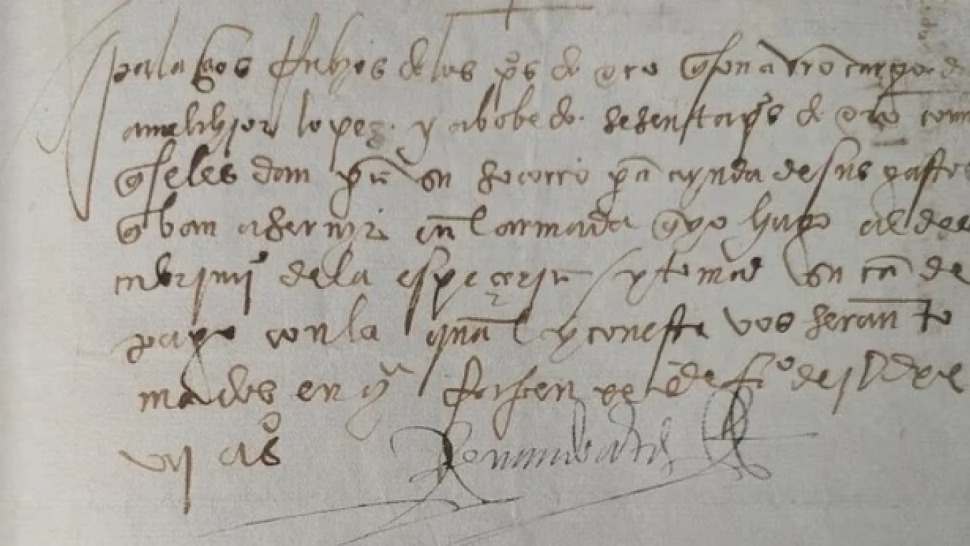
The Federal Bureau of Investigation (FBI) of the United States delivered to Mexico a document from the 16th century with the signature of Hernán Cortés. The piece was stolen from the country more than 30 years ago and is now under the protection of the General Archive of the Nation (AGN).

Recovery after an auction in the US

The Ministry of Foreign Affairs (SRE) reported that it is a payment order dated February 20, 1527. It belongs to the Hospital de Jesús fund of the AGN, which contains several folios with signatures of the conqueror.

The recovery process began in 2022. Mexican authorities received information about the sale of the document in a US auction house. After gathering evidence of its origin and belonging to the national heritage, Mexico filed a complaint with the Attorney General’s Office of the Republic.

The document, of incalculable value, is already in Mexican territory. The collaboration between the FBI and the Mexican authorities allowed his return, which concludes a long process of investigation and diplomatic management.

FBI devuelve a México documento histórico...

Continue reading