Judge stops Trump’s ban on foreign students at Harvard

A judge stops Trump's latest attempt to limit international students' access to American universities.

When justice gives Trump a “flip-flop” (again)

It seems that the American dream of studying at Harvard will not be extinguished so easily for international students. A federal judge has just put a temporary STOP! on Donald Trump’s latest whim: prohibiting the entry into the United States of foreign students who planned to study at the iconic university. Reason? According to the president, something about “protecting local jobs” (spoiler: no one believed it).

Alan’s (and 5,000 other students’) emotional roller coaster

Imagine being 22 years old, being accepted to HARVARD (yes, that Harvard), and having a presidential tweet threaten to ruin your life. That happened to Alan Wang, a Chinese who had already studied in the US and is now stuck in his native country, wondering if he will be able to start his graduate studies in August. “Give me certainty: yes or no?” he demands. In the meantime, explore options in Canada or Australia (because, let’s be honest, no one wants to deal with this drama).

RelatedFederal judge blocks Trump ban on Harvard students

Harvard, in “hold my Ivy League diploma” mode, sued the government alleging that the order was illegal retaliation (after refusing to comply with White House demands). Hours later, Judge Allison Burroughs issued an emergency brake: “Irreparable damage alert” for the university. Because, of course, losing 25% of its students (who contribute research and scholarships) is not exactly a minor detail.

This is the second round in a month where international students see their plans in jeopardy… until the courts say “nice try, Trump”. The boss? Immigration policies driven by tweets, blocked by judges, and repetition. Almost like watching Groundhog Day, but with fewer smiles and more passports at stake.

The elephant in the room: why do I hate students so much?

Trump insists that he “protects jobs”, but Harvard points out that its international students generate jobs (research, patents, etc.). Also, since when does the US reject global talent? Oh, right: since 2016. While countries like Canada rub their hands (“thank you for sending us brains, Mr. President” ), American universities see their reputations crumble. Level irony: wanting to “make America great” by scaring away those who make it great.

And now what? The legal battle will continue, but for now, students can breathe (half) easy. Of course, with suitcases ready in case Trump launches another decree between two golf games.

Are you outraged by this political game with education? Share this note and continue exploring how politics affects young people in our related stories. #JusticeForTalent

Note: If you are an affected international student, our team sends you a virtual hug (and an extra strong coffee).
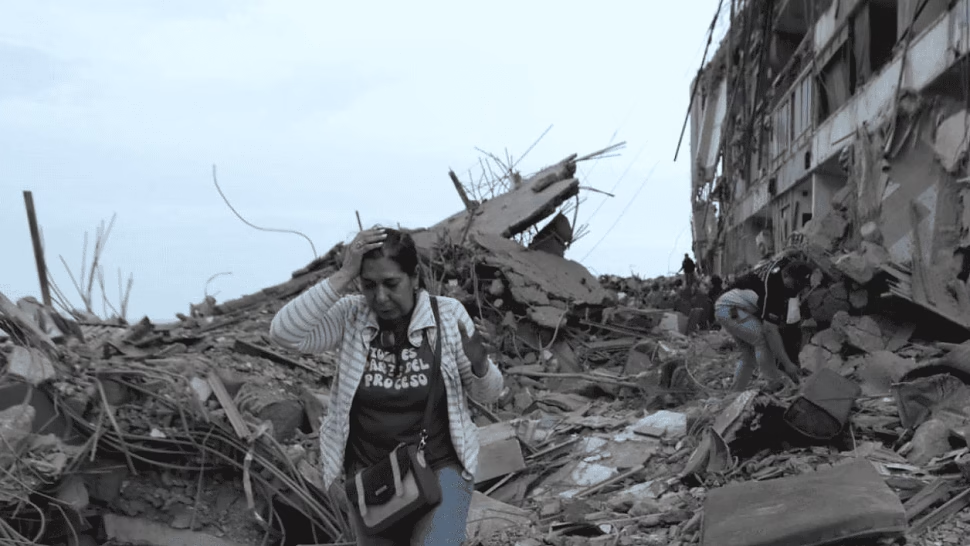
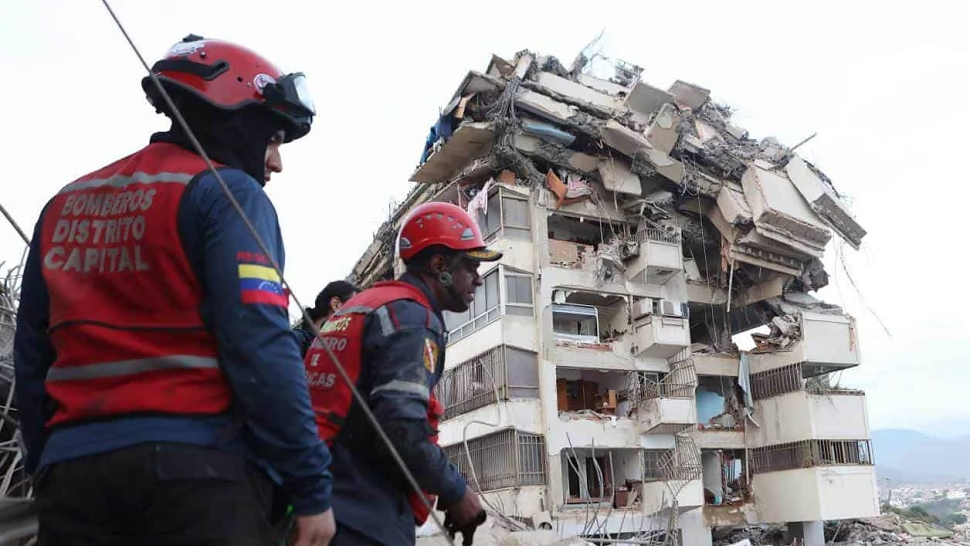
1,430 dead and 3,238 injured left by earthquakes in Venezuela

Official balance reports 1,430 deaths and more than 3,000 injured after two earthquakes in Venezuela.

Official figures after the earthquakes in Venezuela

The president of the National Assembly, Jorge Rodríguez, updated the balance of the two earthquakes that shook the country. So far there are 1,430 deaths and 3,238 injuries. Search and rescue efforts continue in the most affected areas.

Rodríguez specified that 3,142 families were affected and are being cared for in shelters distributed in the seven affected states. In addition, 430 aftershocks of the earthquakes have been recorded.

According to the open online platform, the missing number 50,947. The official, brother of interim president Delcy Rodríguez, reiterated the call to citizens not to enter La Guaira and deposit their aid in authorized collection centers.

Continue reading

La Guaira: smell of decomposition and slowness in rescues after earthquakes

After 72 hours of the earthquakes, activists report unrecovered bodies and little official response.

La Guaira: 72 hours after the earthquakes

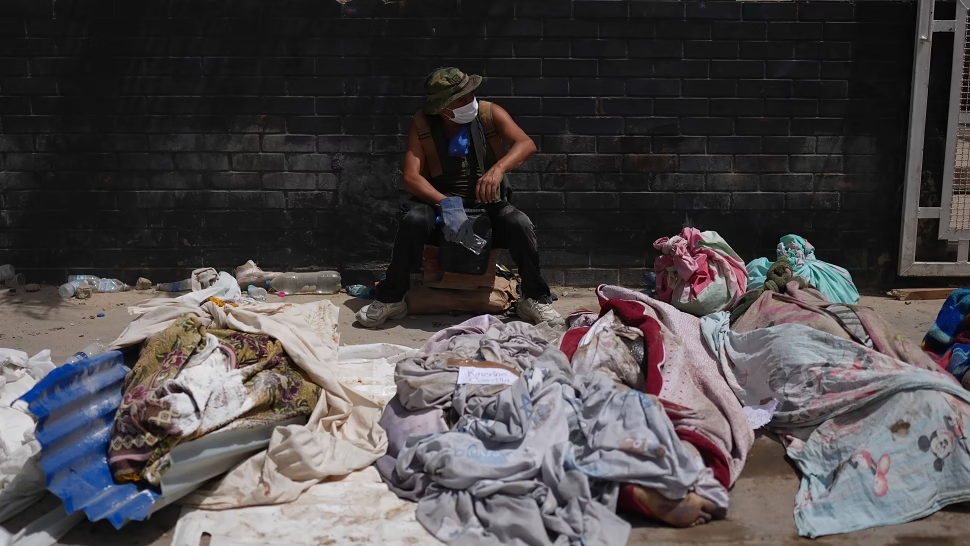
In Caraballeda, a residential area of La Guaira, the smell of decomposition was clearly perceived on Friday night. The first 72 hours after the earthquakes had passed, a key period for life rescues.

Activists from Provea, the oldest human rights NGO in Venezuela, confirmed to ANSA that during a tour of that area “we smelled decomposition (a sign of unrecovered bodies under rubble).” In addition, they pointed out that “there are few body recovery units.”

72 hours after the two earthquakes that devastated the region, activists observed “bodies that have not yet been transferred with dignity.” They recalled that “the State has the obligation to guarantee dignified recovery operations for each victim and their families.”

The earthquakes, magnitude 7.2 and 7.5, occurred consecutively this Wednesday, according to the United States Geological Survey (USGS). The epicenter was located in Yaracuy, about 300 km west of Caracas, but La Guaira, just 30 km from the capital, suffered the greatest structural impact.

The head of Humanitarian Affairs of the UN, Tom Fletcher, estimated that more than 50,000 people were missing. Journalists and observers indicated that the majority is concentrated in La Guaira, where images on networks show numerous lifeless bodies.

Journalist León Hernández, who was in La Guaira on Friday, told ANSA: “I was there… there are really thousands. This Friday night the key 72 hours for rescues were completed.” He added that “in many collapsed buildings, only civil servants and volunteers have been in charge of continuing to rescue people.” He explained that “the damage is of enormous proportions, thousands of victims. I saw complete buildings from which only one person was taken alive.”

This Saturday, interim president Delcy Rodríguez said that seven states were affected, but that the catastrophe hit La Guaira. The government reported the sending of machinery and military personnel, and the closure of access to La Guaira since Friday night, justifying it for reasons of order and security. However, local activists and journalists question the prioritization and insufficient response in the first 72 hours.

Thousands of victims remain in makeshift shelters or on the streets for fear of aftershocks. The combination of debris, heat (up to 40°C) and unrecovered bodies creates an increasing health risk. The families demand transparency in the figures, dignified access to the bodies and a state response in line with the scale of the catastrophe.

Continue reading

La Guaira: 72 hours of uncertainty after the earthquakes

The smell of decomposition and few rescue teams mark the area most devastated by the earthquakes.

Rescues in La Guaira: 72 hours of uncertainty

72 hours after the two earthquakes that shook northern Venezuela, the La Guaira area faces a humanitarian crisis. Activists from Provea, the country’s oldest human rights organization, report the smell of decomposition and few body recovery units.

“We smelled decomposition—a sign of unrecovered bodies under rubble—and there are also few body recovery units,” they told ANSA after a tour of the area.

The earthquakes, magnitude 7.2 and 7.5 according to the USGS, occurred consecutively. The epicenter was located in Yaracuy, 300 km from Caracas, but La Guaira, just 30 km from the capital, suffered the greatest structural impact. The UN, through Tom Fletcher, estimated that more than 50,000 people were missing.

Journalist León Hernández, present on Friday, described the magnitude of the tragedy:

“I was there… there are really thousands. This Friday night the key 72 hours for rescues were completed. In many collapsed buildings, it has been only civil servants and in many cases volunteers in charge of continuing to rescue people.”

He added that thousands of victims were left in makeshift shelters or on the streets for fear of aftershocks. Temperatures reach 40 degrees Celsius, combining debris and unrecovered bodies, creating a growing health risk.

Interim President Delcy Rodríguez reported damage in seven states, but the tragedy is concentrated in La Guaira. The government announced the sending of machinery and closing access from Friday for order and security. However, activists question the insufficient response in the first critical hours.

The families demand transparency in the figures, dignified access to the bodies and a state response in line with the catastrophe. The search efforts continue, but the slowness and scarce official presence mark the panorama in this coastal region.

Continue reading