Jewelry store suffers million-dollar losses after ongoing looting

A jewelry store in the Historic Center faces million-dollar losses after the riots, revealing the vulnerability of small businesses.

The day the ‘shock’ of October 2 became literal for a jewelry store

Imagine building your dream, brick by brick, or rather, link by link of a golden chain, so that on an afternoon of chaos, a group of people with more enthusiasm than conscience reduces it to a bitter memory and a loss account that would make any bankrupt influencer cry. This is the story of Melanie, a businesswoman whose premises, 24K Style, in the heart of the Majestic Jewelry Center, became the perfect loot during the riots of the October 2nd commemorative march. The losses, estimated between two and a half and three million pesos, are proof that sometimes history is not only remembered, but paid for, and dearly.

We are not talking about fast fashion jewelry that you buy online. Melanie lost the good stuff: solid chains and brand-name pieces that are the jewelry equivalent of a limited edition. “I was able to rescue something, there are those who lost everything,” he commented with a resignation that only those who have seen their job ruined understand. He had been in business for a decade, navigating the roller coaster of the economy in the Historic Center, but he had never experienced an impact of this magnitude. The memory of Tlatelolco, a tragic chapter, added a new and painful addendum for the merchants of the area.

RelatedAntigentrification march in CDMX concludes without serious incidents

Insurance, that unattainable ‘crush’ that you never wanted to have

Here comes the plot twist that hurts more than paying for shipping on an online purchase: Melanie didn’t have insurance. And before you take out your accusing finger, she explains it with the crudeness of someone who knows the system: “Like insurance for a jewelry store here in the Center is very expensive, no, I didn’t have one, no one here has insurance.” It is the eternal dilemma of the small businessman: betting everything that nothing will happen, because the cost of protecting himself is, ironically, prohibitive. A risk calculation that, this time, went horribly wrong, transforming inventory into total losses and a brutal lesson in applied finance.

Thursday afternoon turned into a real-time nightmare. While your timeline was filled with stories of the march, Melanie received the notice of the looting. Immediately afterwards, she rushed towards the jewelry center with the hope of being the heroine of her own film, of rescuing her merchandise against all odds. But the script was not Hollywood. Upon arrival, he found a scene that he cannot make a funny reel of: blocked access, the helplessness of seeing his business, his life, violated and not being able to do anything. She couldn’t get through immediately, a euphemism to describe the physical and emotional barrier between her and the remains of her venture.

This event exposes the vulnerability of small businesses at the epicenter of social protests. This is not about minimizing the importance of the protest or historical memory, but rather pointing out the collateral effect that falls on those who, like Melanie, are not political actors, but rather people trying to get their business going in an area that periodically becomes a tinderbox. The security of businesses is the great pending issue, the detail that is always overlooked in the great national debate, until it is someone’s turn to pay the price, or in this case, the gold chains.

Melanie’s story is a reminder that, in the era of the creator and entrepreneur economy, instability can come through the front door, or rather, through the one it was forced through. It is a wake-up call about the need to discuss protection protocols for small businesses, to find affordable solutions that prevent a day of protest from becoming eternal night for a family business. Meanwhile, the balance is a looted premises, a dizzying account of losses and the certainty that, sometimes, the past is not only commemorated, but repeated in the most unexpected and cruel way.

Do you know someone who has a business in the Center? Share this story to make visible the real impact behind the headlines. And if you want to know more analysis about the economy of entrepreneurs in the city, explore our related content.

México y Alemania consolidan alianza en comercio y sostenibilidad

75 años de relación: comercio récord y agenda compartida en género y clima.

75 años de cooperación

En el marco del 75 aniversario de relaciones diplomáticas, México y Alemania acordaron profundizar su colaboración en igualdad de género, desarrollo sostenible y acción climática. Así lo anunció el canciller Roberto Velasco tras recibir en la SRE a su homólogo alemán, Johann Wadephul.

El encuentro se produce luego de la visita del presidente Frank-Walter Steinmeier a la presidenta Claudia Sheinbaum. Ambos funcionarios destacaron la firma del Acuerdo Global Modernizado entre México y la Unión Europea. Velasco calificó ese instrumento como un parteaguas en la cooperación bilateral.

“Compartimos una visión común sobre la importancia del multilateralismo, del Estado de Derecho, de los Derechos Humanos, del libre comercio y de la cooperación internacional como herramientas para enfrentar los desafíos globales.”

El canciller subrayó que México y Alemania mantienen coordinación en Naciones Unidas para fortalecer la eficacia del sistema multilateral. Además, impulsarán modelos de desarrollo inclusivos, sostenibles y justos.

RelatedSheinbaum and Castro strengthen bilateral cooperation in historic meeting

Comercio récord y clima de cooperación

En el ámbito económico, el comercio bilateral superó los 27 mil millones de dólares. Velasco resaltó que ambas naciones comparten una “agenda activa” en igualdad de género, cambio climático y construcción de sociedades incluyentes.

A menos de una semana del inicio de la Copa Mundial de Futbol 2026, el canciller recordó que millones de mexicanos y alemanes esperan el silbatazo inicial del torneo.

El encuentro reafirma la apuesta de ambos países por el diálogo político y el intercambio económico como bases de su relación estratégica.

Continue reading

Sheinbaum: nueva inversión cambiará trazo del Tren Interoceánico

Tras el accidente de diciembre, la presidenta anunció cambios en curvas peligrosas del tren.

La presidenta Claudia Sheinbaum anunció que en tres semanas presentará una inversión para modificar el trazo del Tren Interoceánico, especialmente en zonas de curvas pronunciadas. Esto ocurre tras el accidente del 28 de diciembre en Oaxaca, donde 14 personas fallecieron y alrededor de 100 resultaron heridas.

“El Interoceánico está funcionando para carga, por seguridad en este momento no está funcionando para pasajeros y lo vamos a presentar pronto, pero les adelanto. Vamos a hacer una inversión muy importante para cambiar el trazo, sobre todo en la zona de curvas. Las curvas más pronunciadas que están ya llegando hacia Salina Cruz”, explicó durante su conferencia matutina desde Coatzacoalcos, Veracruz.

Cambios en el trazo

Sheinbaum señaló que el gobierno federal espera las recomendaciones de seguridad de la empresa TÜV Rheinland para iniciar cambios operativos y de rehabilitación en algunos tramos. El nuevo trazo en la parte sur evitará una zona conocida como “las orejas de conejo”, justo donde ocurrió el siniestro, para evitar curvas peligrosas.

“Yo creo que en unas dos o tres semanas ya estamos en condiciones de informar cuándo iniciaría la operación para el tren de pasajeros”, aseguró.

La mandataria reiteró que el accidente fue por una falla técnica y que el gobierno apoyó a todas las familias afectadas con una reparación integral del daño.

RelatedFGR and ARTF lead exhaustive investigation of the accident on the Interoceanic Train

Investigación de la FGR

En abril, la titular de la Fiscalía General de la República, Ernestina Godoy, informó que tras una inspección se corroboró que la calidad de la vía en el punto del siniestro, en la Línea Z, y las locomotoras cumplen con la norma aplicable.

El Ministerio Público acreditó presunta responsabilidad en homicidio y lesiones culposas contra el conductor, Felipe de Jesús Díaz, y el despachador Ricardo Mendoza, los dos únicos detenidos por el caso. Días después, fueron puestos en libertad.

Continue reading

Liberan 17 primates en el Parque Nacional Palenque en Chiapas

16 monos araña y un saraguato regresaron a su hábitat en el Parque Nacional Palenque, tras ser rehabilitados.

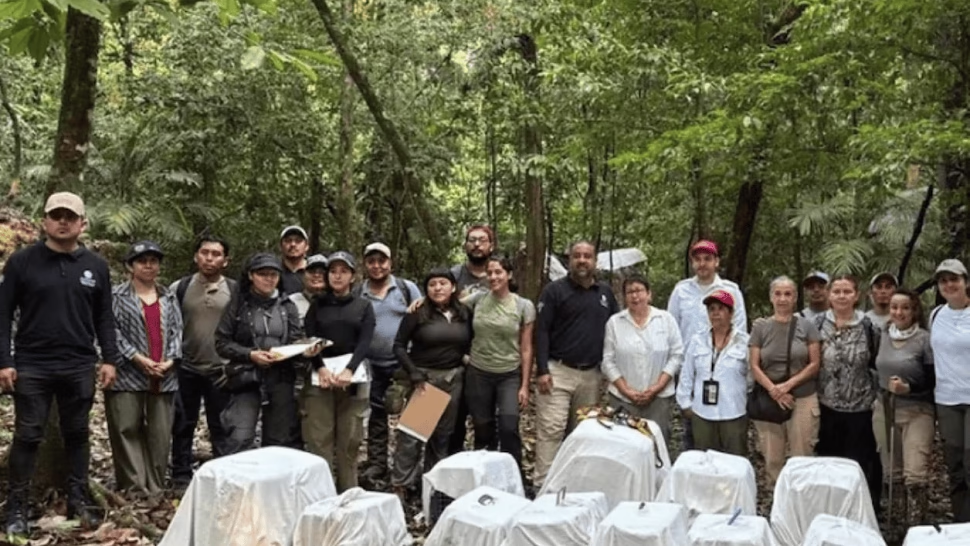
Un total de 16 monos araña (Ateles geoffroyi) y un saraguato o aullador (Alouatta pigra) fueron liberados en el Área Natural Protegida del Parque Nacional Palenque, al norte de Chiapas. El regreso a la vida silvestre ocurrió después de un proceso de rehabilitación física y conductual a cargo de especialistas.

La Comisión Nacional de Áreas Naturales Protegidas (Conanp) informó que el sitio reúne las condiciones ecosistémicas y microclimáticas necesarias para la supervivencia de los primates. En la labor participaron la Profepa y la Unidad de Manejo para la Conservación de Vida Silvestre (UMA) “Susurros”, de Palenque.

RelatedProfepa activates protocol to protect primates from extreme heat

Especies rescatadas del tráfico ilegal

La mayoría de estos ejemplares provienen de aseguramientos federales contra el tráfico ilegal de fauna. Su reintroducción, señaló la Conanp, tiene un valor ambiental prioritario.

Para garantizar el éxito, brigadas del Programa PROREST, integradas por jóvenes del ejido El Naranjo, junto con personal del ANP y médicos de la UMA, realizarán monitoreo continuo. El seguimiento evaluará evolución, desplazamiento y adaptación al hábitat durante las próximas semanas.

El Parque Nacional Palenque destaca por su riqueza cultural y biológica. Protege extensiones de selva alta perennifolia, refugio de especies mesoamericanas emblemáticas. La liberación, explicó la Conanp, demuestra la eficacia de alianzas entre gobierno, unidades de manejo y comunidades locales.

Continue reading