An Invitation in the Middle of Political Tension
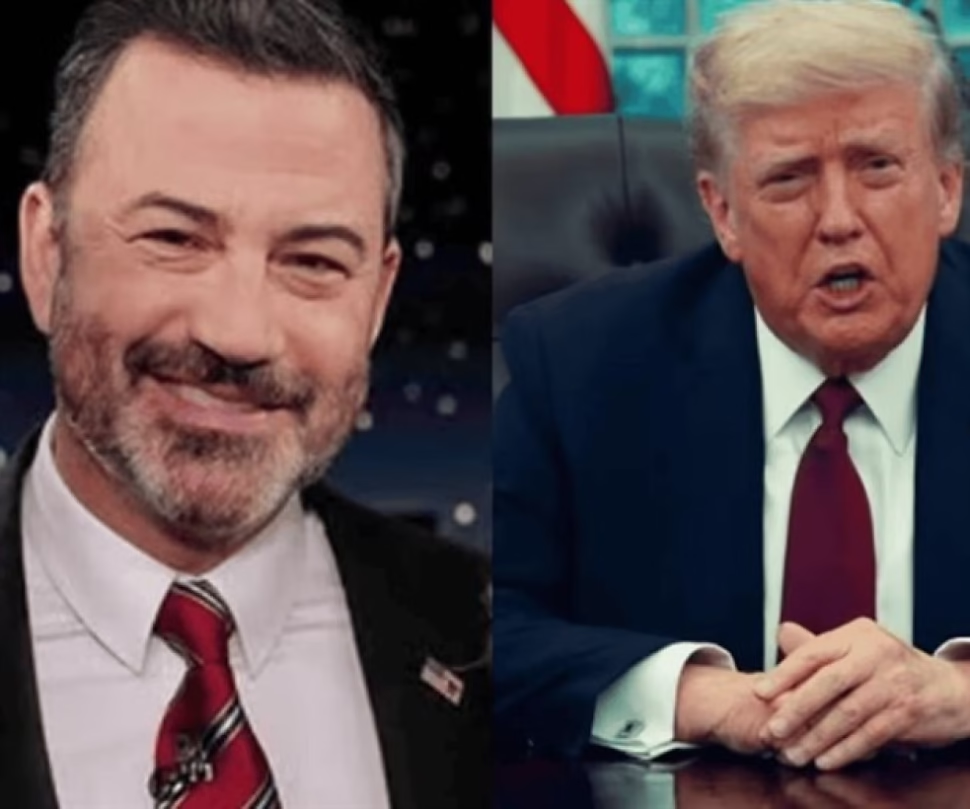
The panorama of political communication and entertainment could be about to witness a high-voltage meeting. Jimmy Kimmel, the renowned host of the late-night show Jimmy Kimmel Live!, has publicly expressed his interest in having former President Donald Trump as a guest. This statement came during his participation in Bloomberg Screentime, a prestigious panel held in New York that brought together influential personalities from business and popular culture. Kimmel stated categorically: “I would love to have Trump on the show, without a doubt,” and assured that he plans to formally extend the invitation to him to participate. This potential face to face would not be the first in the history of both, since in 2016 the then presidential candidate was invited to the show, an event that was immortalized in a photograph where both posed together.
However, the current context is marked by a bitter and public dispute that took place just a few weeks ago, which adds a layer of complexity and unprecedented expectation to this possible meeting. The origin of the conflict dates back to a monologue by Kimmel in September, where the comedian performed a satire on a violent incident involving conservative activist Charlie Kirk. During his segment, Kimmel joked suggesting that the perpetrator probably belonged to the “MAGA gang,” in a clear reference to the Make America Great Again movement, promoted by Trump.
The Presidential Response and the Chain Crisis
The reaction of the former president was immediate. Trump used his social platform, Truth Social, to celebrate the temporary suspension of Kimmel’s show, a measure that, according to several internal reports, ABC implemented due to intense pressure from its affiliate stations, many of them in conservative markets. In his posts, the 79-year-old president proclaimed: “Good news for America: Jimmy Kimmel’s show, with its low ratings, is CANCELLED.” And he added, in a contemptuous tone: “Congratulations to ABC for having the courage to do what had to be done. Kimmel has no talent whatsoever and his numbers are worse than Colbert’s, if that’s possible.”
This suspension, however, was short-lived. A wave of public support, along with the strong defense of numerous organizations dedicated to freedom of expression, managed to reverse the decision. As reported by AOL, The Walt Disney Company, ABC’s parent company, and Kimmel himself reached a renewal agreement to continue broadcasting the program, although this agreement was accompanied by certain conditions. High-level executives, such as Bob Iger and Dana Walden, have reportedly urged the comedian to moderate the political tone of his comments in the future. The strategic objective was clear: avoid new confrontations with the Trump administration and calm the anxiety of the affiliate networks, crucial for the distribution and commercial success of the show.
A fundamental aspect of these negotiations was Kimmel’s uncompromising stance regarding his creative autonomy. The presenter flatly refused to offer a public apology or accept any type of direct censorship of the content of his program. This steadfastness reflects the delicate line that late-night talk show hosts walk in the modern era, where entertainment and political commentary are increasingly intertwined.
A Conflict with Background and Future Implications
The decision to resume broadcasting generated visible discomfort in Donald Trump, who went so far as to threaten legal action against ABC. In his statements, he accused Kimmel of acting as “another arm of the Democratic National Committee” and called his program “an illegal contribution to the” opposition campaign. For his part, Kimmel has consistently defended his right and duty to address issues of political and social relevance in his space, arguing that it is an essential part of his work as a cultural commentator in prime time.
This confrontation is simply the latest chapter in a historically complicated relationship. The friction dates back to at least 2015, when Trump, in the midst of his presidential campaign, canceled his participation at the last minute, a fact that Kimmel took advantage of to create humorous segments in subsequent broadcasts. Over the years, the presenter has maintained an openly critical stance towards the former president, questioning his policies on gun control and blaming him for blocking various legislative initiatives. Trump’s possible acceptance of this new invitation would not only be a highly rated television event, but a significant exercise of media diplomacy in a deeply polarized political landscape.
Will the former president be able to share the stage with one of his most visible critics in the world of entertainment? The answer to this question will define a crucial moment at the intersection between pop culture and American politics. Meanwhile, Kimmel has thrown down the gauntlet, demonstrating that, beyond corporate pressures and personal disputes, the opportunity for direct, unfiltered dialogue is always on the table.
Do you think this television confrontation will come to fruition? Share this news on your social networks and explore more analysis on the influence of the media on current politics.