Jaime González Durán from elite soldier to leader of Los Zetas

The fall of the former military man who rose in drug trafficking and marked an era of violence in Mexico.

The criminal trajectory of “The Hummer”

In November 2008, the Federal Police arrested in ReynosaJaime González Durán, alias “El Hummer”, identified as one of the 14 founders and main leaders of the criminal organization Los Zetas. His influence extended to multiple entities in the country, with special control in Nuevo León, where he operated as regional coordinator.

Key roles in the criminal structure

As lieutenant of Osiel Cárdenas Guillén (leader of the Gulf Cartel), González Durán collaborated directly with notorious figures such as Heriberto Lazcano Lazcano (“El Lazca”) and Miguel Treviño Morales (“El L-40”). Federal intelligence placed him as the third man in the hierarchy, supervising operations in eight states and managing territorial disputes.

RelatedJulión Álvarez conquers Reynosa with a historic concert

Military background and transition to crime

His profile contrasted with his military past: between 1991 and 1999, he was part of the Mexican Army, graduated from the Grupo Aeromóvil de Fuerzas Especiales (GAFE), an elite unit trained in advanced combat tactics. Documents obtained by US agencies confirmed that his military card was issued in the Seventh Military Zone of Salinas Victoria.

Links to emblematic crimes

Investigations linked him to the murder of singer Valentín Elizalde Valencia in 2006, as well as to the expansion of Los Zetas in Nuevo León, an episode that preceded a wave of unprecedented violence in the region. Born in San Luis Potosí on June 22, 1976, his career illustrates the phenomenon of military desertion towards criminal groups.

Impact analysis

The case of “The Hummer” exemplifies the infiltration of military tactics in organized crime, where former military personnel provide knowledge in logistics, weapons and counterinsurgency. His capture in 2008 represented a partial blow to Los Zetas, although the organization maintained operations through successors.

Are you interested in understanding how criminal networks evolve? Share this analysis and discover more security research on our platform. #OrganizedCrime #MexicoSecurity

Explore more content about the transformation of posters in the last decade.
One year after the discovery in a crematorium, families march for justice

One year after the discovery of 386 bodies, families demand justice and an end to corruption.

March for justice one year later

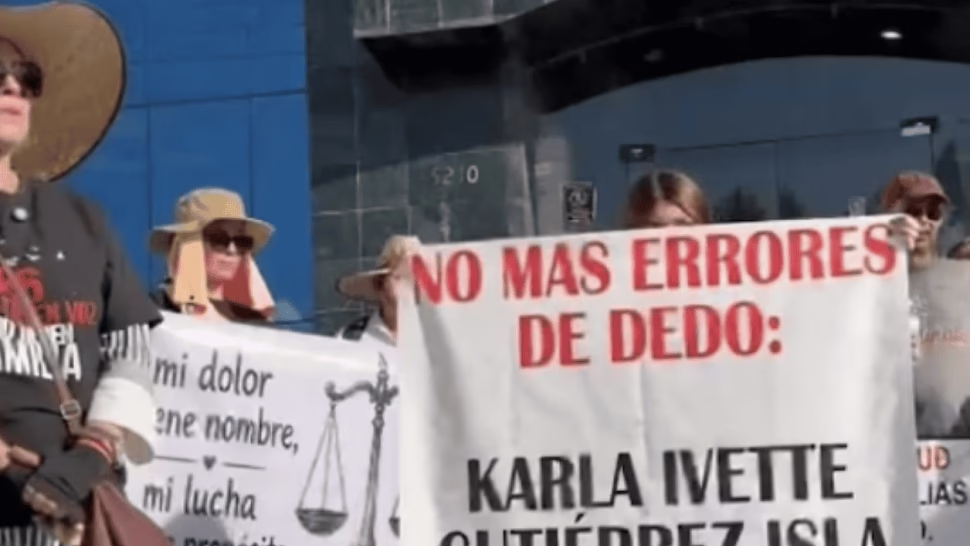
On Saturday afternoon, groups of families affected by the Plenitude crematorium case demonstrated. The discovery of 386 bodies turns one year old, and the bereaved demand answers.

The protest began at the Latinoamericana funeral home, one of those identified by family members. From there, the protesters walked towards the State Attorney General’s Office (FGE).

Dora Elena Delgado, spokesperson for the Justicia para Nuestros Deudos collective, reported that at least 1,500 families were affected. The central demand: no more impunity, no more corruption and full justice.

Actions pending by the authority

The protesters carried blankets with messages of justice. They demand action against Coespris officials involved in the case, as well as the recapture of José Luis A. C., owner of the crematorium. He was released by a federal judge, and a red card from Interpol is expected to arrest him again.

So far, of the 386 bodies found, the FGE reports that 135 remain to be identified. The identification process continues.

The collective Memory, Dignity and Justice joined the mobilization. They placed a permanent memorial in the shape of a cross outside the Prosecutor’s Office, as a reminder of the victims.

Continue reading

Sheinbaum asks to preserve native corn for national sovereignty

Sheinbaum highlights that native corn is key to food sovereignty and national identity.

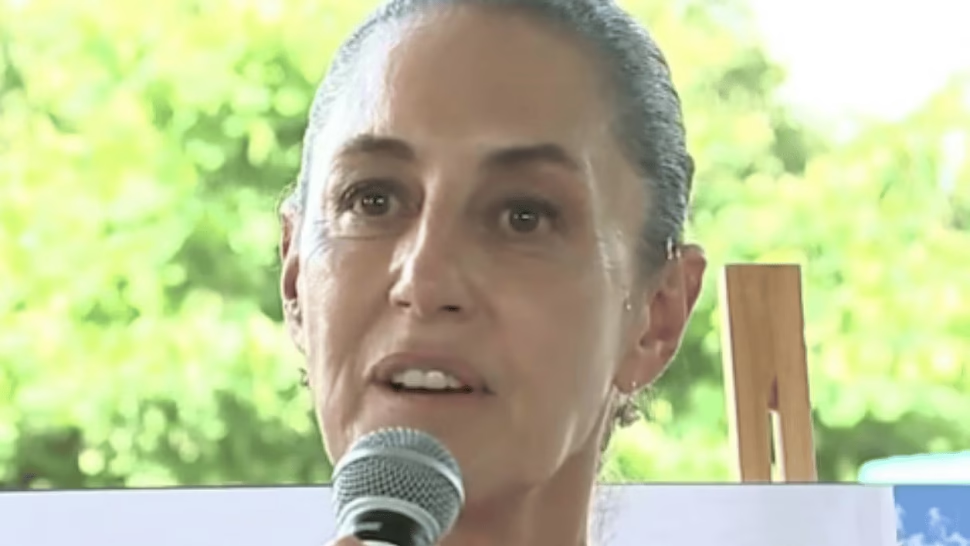
President Claudia Sheinbaum Pardo reaffirmed that the governments of the Fourth Transformation defend national sovereignty in all areas. During a meeting with farmers in Pijijiapan, Chiapas, he highlighted the importance of native corn as a pillar of Mexican identity and self-sufficiency.

Defense of sovereignty through native corn

Sheinbaum presented the “Corn is the Root” program, whose objective is to improve the conditions of producers and reduce dependence on seeds controlled by large corporations.

“Conserving native corn also means defending sovereignty,” he stated.

The president warned about the risks of hybrid seeds:

“If we continue with pure hybrid corn, people will depend on buying seeds and those who sell the seeds will be a few companies.”

He stressed that preserving native varieties is essential to avoid this economic dependence.

“If we did not have native corn, we would lose a good part of food sovereignty, of what we are as Mexicans,” he said.

In addition, it extended the defense of sovereignty to the energy, cultural and food fields. She assured that the Fourth Transformation drives her “in every possible way.”

The program seeks to strengthen small farmers and conserve the genetic diversity of corn, a central element in the country’s diet and culture.

Continue reading

Mexico sends rescue team to Venezuela after earthquakes

25 specialists and 5 canine pairs travel to support search efforts in Venezuela.

Solidarity in action

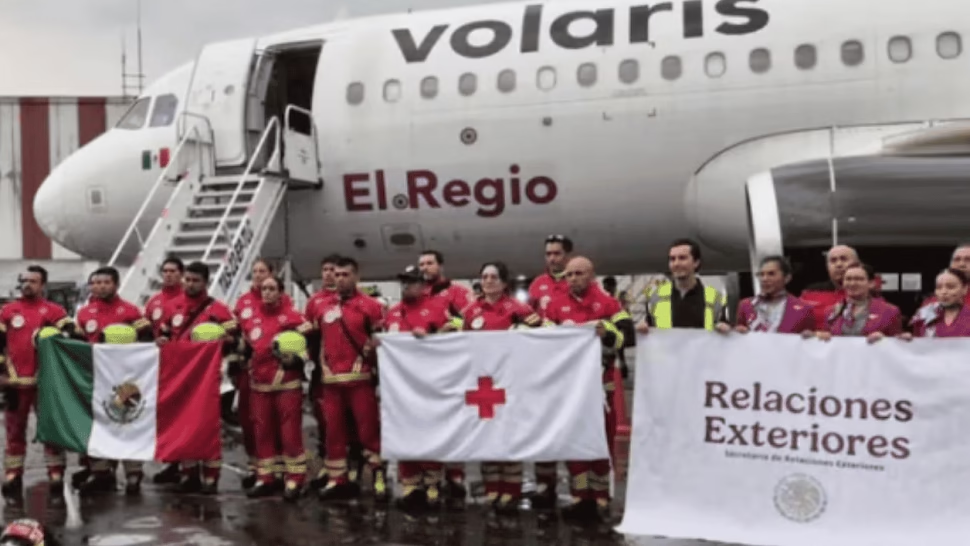
After the earthquakes of magnitude 7.2 and 7.5 registered in Venezuela on June 24, which left 1,430 dead and 3,328 injured, Mexico reinforced its humanitarian support. The Ministry of Foreign Affairs (SRE) coordinated the sending of a rescue mission with the Mexican Red Cross and the Volaris airline.

“This afternoon a support team made up of 25 specialists from the Urban Search and Rescue Unit (USAR) of the Red Cross and the Cancun International Rescue Brigade (USAR BRIC) left for Venezuela, as well as a brigade element from the Azteca Topos,” the agency indicated.

Equipment and logistics

The mission includes five canine pairs and 3.5 tons of specialized equipment for search and rescue tasks in the rubble. The shipment was transported on a Volaris flight.

“With this, Mexico reaffirms its solidarity and commitment to the Venezuelan people in these difficult times,” the SRE said in a statement. Foreign Minister Roberto Velasco heads the coordination of this aid.

Continue reading