Interoceanic Train still without passengers after derailment

While the FGR rules out faults on the track, the train continues not to operate for passengers. The victims have already received compensation, according to the government.

The official version and the rails that don’t add up

The Attorney General’s Office (FGR) has already issued its verdict: the derailment of the Interoceanic Train was not due to a problem on the track. Meanwhile, passenger service remains suspended. Does anyone else see the contradiction?

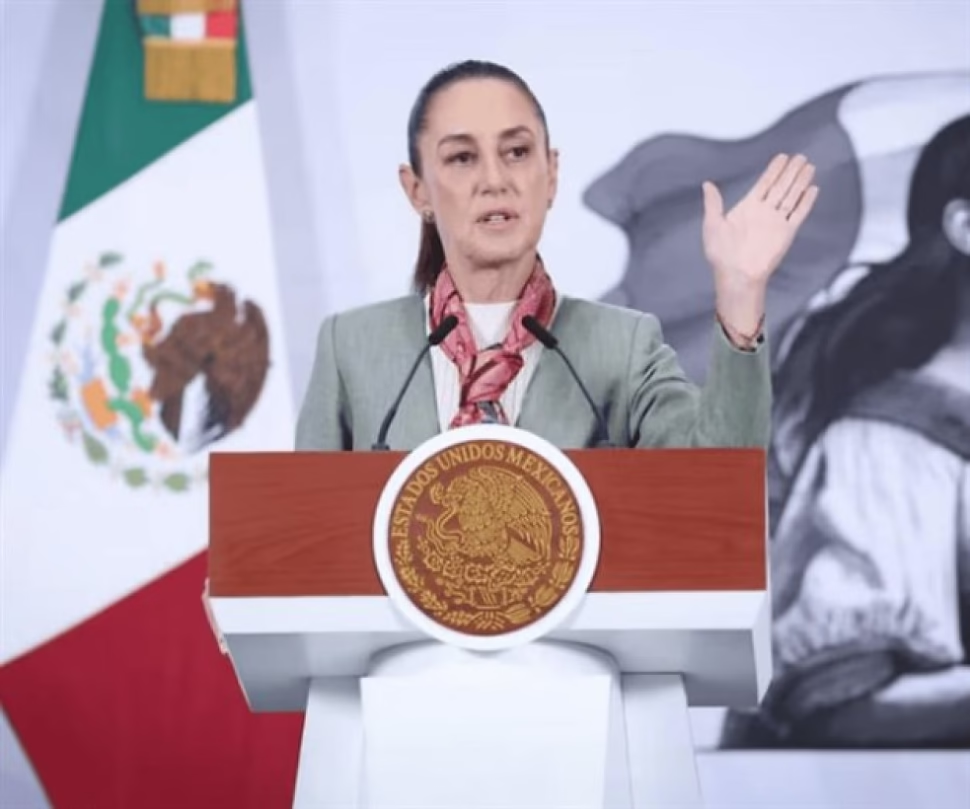
Claudia Sheinbaum, in her morning conference from the National Palace, announced that work on reopening and certification continues. The speech is one of progress, but the facts show a stationary train.

“The company TUV International continues to work, together with the Railway Transport Agency and the Interoceanic Train to be able to resolve all the suggestions that are being raised,” said the president.

For cargo it already operates. For people, no. The promise is to wait for “all suggestions” for certification to be fulfilled. It sounds reasonable, until you remember that the FGR already exonerated the infrastructure.

RelatedSemar confirms 13 deaths in the derailment of the Interoceanic Train

Repairing the damage: Quick closure or real justice?

Rosa Icela Rodríguez, from Segob, declared the repair process completed for 225 affected passengers. Among them, 14 people died and around 100 were injured.

“Absolutely all of them were attended to and the damage was repaired,” he commented.

An administrative procedure closed with bureaucratic efficiency. But when a train derails and people die, the questions about why outweigh the signed checks.

Sheinbaum reaffirms that “all necessary measures” are taken to guarantee safety. Memory is short: a little over a year ago another freight train derailed in Nayarit. The promises of then sound identical to those of today.

The truth hurts more than a broken bone: you can compensate victims, but if you don’t fix what really went wrong, you’re just buying time until the next accident.


Sheinbaum defends self-determination in Nicaragua

Sheinbaum defends self-determination in Nicaragua but rules out similar measure in Mexico

Sheinbaum’s position regarding the cancellation of elections in Nicaragua

President Claudia Sheinbaum was questioned about the decision of Daniel Ortega’s government to cancel the elections in Nicaragua, a measure that seeks to prevent the opposition from gaining power.

The Mexican president avoided issuing direct criticism and chose to defend the principle of non-intervention:

“It is the self-determination of the people, what the people of Nicaragua decide, and we always agree with democracy, in all its terms.”

Sheinbaum also responded if he would approve a similar measure in Mexico. His response was clear:

“No, here there is even a revocation of the mandate. Democracy, democracy, democracy. Each country decides, each people decides. We are in favor of democracy, but each country decides how it is organized.”

The presidential position reflects the Mexican tradition of respecting the sovereignty of other nations, although in this case the cancellation of the elections has been condemned by international organizations such as the OAS and the UN. Sheinbaum, however, did not join these criticisms and avoided describing Ortega’s action as a democratic setback.

Analysts point out that the response seeks to maintain cordial relations with the Nicaraguan regime, a historical ally of the Mexican left. The Mexican Foreign Ministry has not issued an official position beyond what the president said.

Continue reading

Wellbeing Calendar: payment to last names with S this July 27

Deposits for surnames with S. Amounts and calendar details.

Welfare Pension Payment for surnames with S

This Monday, July 27, the Welfare Secretariat deposits the resources for the July-August two-month period to beneficiaries whose first last name begins with the letter S. It is the fourth and last week of the staggered payment calendar, designed to speed up delivery and avoid saturation in branches.

The agency reminds that it is not necessary to withdraw the cash on the same day. The money remains on the Wellbeing Card and can be used on subsequent purchases or withdrawals.

During the previous weeks, other letters of the alphabet were covered, thus completing the July calendar.

Amounts in force for July 2026

The financial support maintains the established amounts: Pension for Older Adults provides 6,400 pesos; Women’s Welfare Pension, 3,100 pesos; Pension for People with Disabilities, 3,300 pesos; and the Program for Children of Working Mothers, 1,650 pesos for each registered minor.

The Sembrando Vida program, with a monthly scheme, made its deposit on July 9 for 6,450 pesos.

The alphabetical system facilitates dispersion among millions of beneficiaries enrolled in the social programs of the Government of Mexico.

Continue reading

They analyze technoaddiction in minors in the National Palace

Experts warn about the impact of mobile devices on the brain development of children and adolescents.

Experts warn about excessive screen use in minors

This Monday, during the morning conference by President Claudia Sheinbaum Pardo, specialists addressed the phenomenon of technoaddiction in childhood and adolescence. In the Treasury Room of the National Palace, the Secretary of Public Education, Mario Delgado, pointed out the importance of analyzing the impact of social networks on students, beyond the school environment.

“Algorithms obey the market, that’s how they are designed and there are interests that auction our attention in real time,” declared Delgado.

He added that the use of devices interferes with habits, attention and routines, especially at a key stage of brain development.

Tania Jiménez García, teacher in Psychological Guidance, detailed the symptoms of problematic use of technology: loss of control, intense desire, social deterioration, tolerance and abstinence. He recommended removing cell phones for children between 0 and 12 years old and offering healthy entertainment alternatives. For adolescents 13 years of age or older, a gradual decrease with therapeutic support was suggested.

Lucia Magis Weinberg, doctor in Neurodevelopment, warned that excessive exposure to screens can thin areas of the brain, erode attention and increase stress and frustration. For adequate brain development, he recommended sleeping more than 9 hours uninterrupted, doing an hour of physical activity a day, maintaining a balanced diet and avoiding substances such as alcohol and tobacco.

President Sheinbaum called on parents to inform themselves. “We are consolidating this information so that it is available and together we all make decisions to protect girls, boys and adolescents,” he stated.

Continue reading