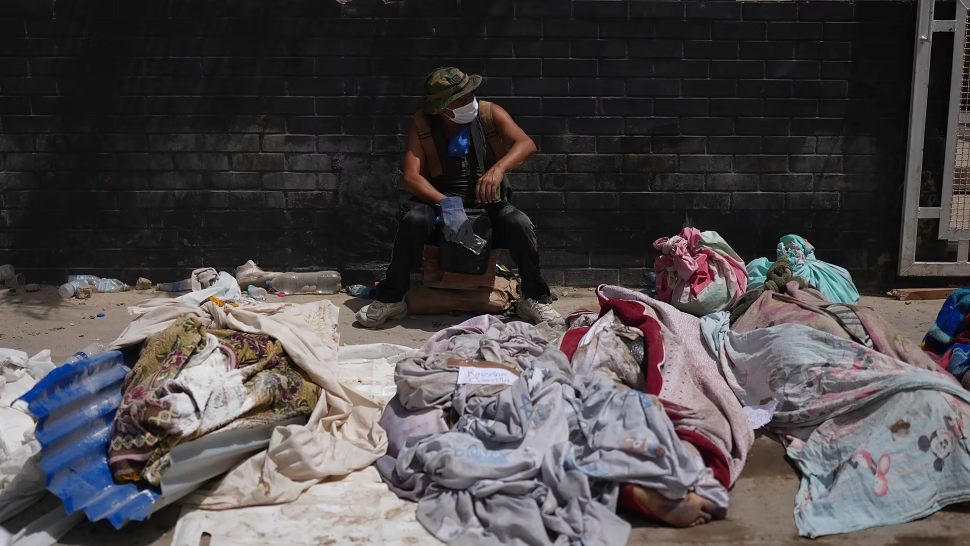
International students in the US face mass deportation due to surprise visa revocation

The American dream becomes a nightmare for hundreds of foreign students with visas canceled without explanation.

The “American dream” becomes a surreal bureaucratic procedure

Ah, Washington. The land of opportunity… until one day, without warning, your student visa disappears like money from your bank account after paying tuition. What began as a trickle of legal queries has turned into a tsunami of despair, with hundreds of international students discovering that their legal status has been revoked faster than you can say “really?”

From “isolated cases” to express deportation

Matthew Maiona, an immigration attorney, thought he would receive a couple of calls a day. Now he sees six a day from international students who, in tears and panic, ask: “What did I do wrong?” Spoiler: probably nothing. But when the federal government decides to play “I spy” with visas, even an unpaid parking ticket seems to become organized crime.

RelatedMass revocation of student visas unleashes immigration crisis in universities

Universities, those institutions that usually move at the speed of an academic semester, have had to react faster than a student running to an 8 AM class. From Harvard to the latest community college, everyone is scratching their heads wondering, “Why now? Why like this?” Meanwhile, 790 students at 120 institutions have already been affected, although the actual numbers could be as high as the average student debt in the US.

“We don’t know, and that’s the scary part,” says Ramis Wadood of the ACLU, perfectly summing up the situation. Because nothing inspires confidence more than a government that cancels visas with the same randomness as a professor grading exams on Friday night.

The new national sport: hunting students

Here’s the joke: many of those affected are from India and China, countries that provide more than half of the international students. But be careful, this is not discrimination, it is just a statistical coincidence! Like when you get fined for speeding just when the municipality needs to raise funds.

Some brave people are suing the government, because what better way to spend your last semester than fighting the immigration system? Xiaotian Liu, a Dartmouth student, has already secured a temporary restraining order. Although, let’s be honest, “temporary” in government bureaucracy can mean anything between “tomorrow” and “when the Arctic melts.”

Meanwhile, the Department of Homeland Security plays hide and seek with explanations. Protests against Israel? Traffic fines? Or just bad luck in the visa lottery? Who knows. As NAFSA’s Fanta Aw said: “You don’t need more than a small number to create fear.” And boy have they achieved it.

Students now walk around with their passports as if they were the last ticket out of a dystopia. A Chinese student at UNC Chapel Hill confessed: “You don’t know if you’re going to be the next person.” Welcome to the new reality show: “Will you survive the semester?”.

Are you outraged by this situation? Share this article and help us make this legal absurdity visible. If you want more stories about the vagaries of the immigration system, explore our related content.
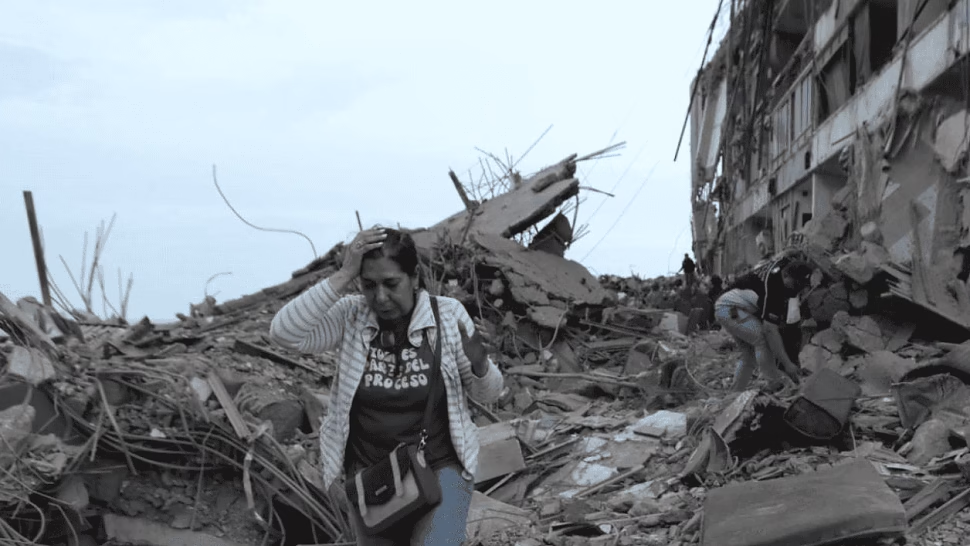
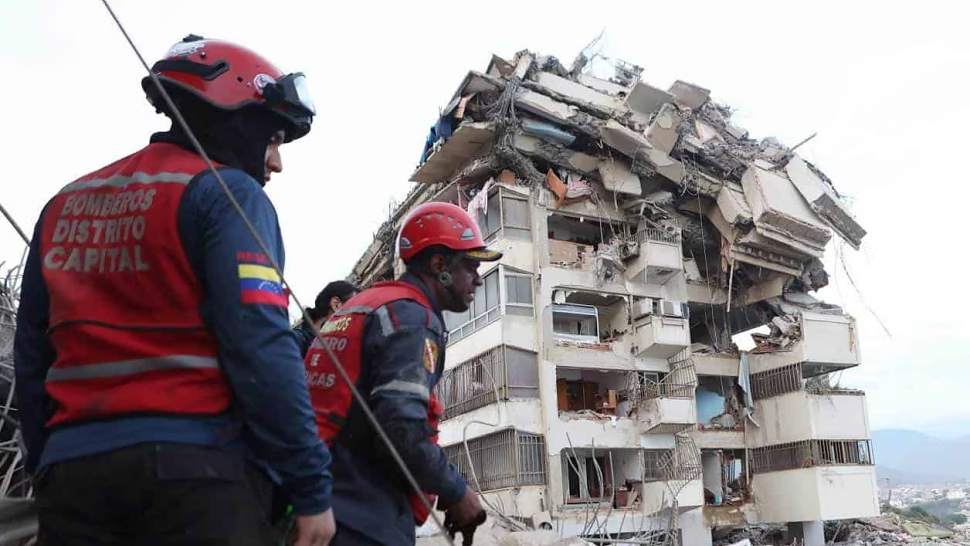
1,430 dead and 3,238 injured left by earthquakes in Venezuela

Official balance reports 1,430 deaths and more than 3,000 injured after two earthquakes in Venezuela.

Official figures after the earthquakes in Venezuela

The president of the National Assembly, Jorge Rodríguez, updated the balance of the two earthquakes that shook the country. So far there are 1,430 deaths and 3,238 injuries. Search and rescue efforts continue in the most affected areas.

Rodríguez specified that 3,142 families were affected and are being cared for in shelters distributed in the seven affected states. In addition, 430 aftershocks of the earthquakes have been recorded.

According to the open online platform, the missing number 50,947. The official, brother of interim president Delcy Rodríguez, reiterated the call to citizens not to enter La Guaira and deposit their aid in authorized collection centers.

Continue reading

La Guaira: smell of decomposition and slowness in rescues after earthquakes

After 72 hours of the earthquakes, activists report unrecovered bodies and little official response.

La Guaira: 72 hours after the earthquakes

In Caraballeda, a residential area of La Guaira, the smell of decomposition was clearly perceived on Friday night. The first 72 hours after the earthquakes had passed, a key period for life rescues.

Activists from Provea, the oldest human rights NGO in Venezuela, confirmed to ANSA that during a tour of that area “we smelled decomposition (a sign of unrecovered bodies under rubble).” In addition, they pointed out that “there are few body recovery units.”

72 hours after the two earthquakes that devastated the region, activists observed “bodies that have not yet been transferred with dignity.” They recalled that “the State has the obligation to guarantee dignified recovery operations for each victim and their families.”

The earthquakes, magnitude 7.2 and 7.5, occurred consecutively this Wednesday, according to the United States Geological Survey (USGS). The epicenter was located in Yaracuy, about 300 km west of Caracas, but La Guaira, just 30 km from the capital, suffered the greatest structural impact.

The head of Humanitarian Affairs of the UN, Tom Fletcher, estimated that more than 50,000 people were missing. Journalists and observers indicated that the majority is concentrated in La Guaira, where images on networks show numerous lifeless bodies.

Journalist León Hernández, who was in La Guaira on Friday, told ANSA: “I was there… there are really thousands. This Friday night the key 72 hours for rescues were completed.” He added that “in many collapsed buildings, only civil servants and volunteers have been in charge of continuing to rescue people.” He explained that “the damage is of enormous proportions, thousands of victims. I saw complete buildings from which only one person was taken alive.”

This Saturday, interim president Delcy Rodríguez said that seven states were affected, but that the catastrophe hit La Guaira. The government reported the sending of machinery and military personnel, and the closure of access to La Guaira since Friday night, justifying it for reasons of order and security. However, local activists and journalists question the prioritization and insufficient response in the first 72 hours.

Thousands of victims remain in makeshift shelters or on the streets for fear of aftershocks. The combination of debris, heat (up to 40°C) and unrecovered bodies creates an increasing health risk. The families demand transparency in the figures, dignified access to the bodies and a state response in line with the scale of the catastrophe.

Continue reading

La Guaira: 72 hours of uncertainty after the earthquakes

The smell of decomposition and few rescue teams mark the area most devastated by the earthquakes.

Rescues in La Guaira: 72 hours of uncertainty

72 hours after the two earthquakes that shook northern Venezuela, the La Guaira area faces a humanitarian crisis. Activists from Provea, the country’s oldest human rights organization, report the smell of decomposition and few body recovery units.

“We smelled decomposition—a sign of unrecovered bodies under rubble—and there are also few body recovery units,” they told ANSA after a tour of the area.

The earthquakes, magnitude 7.2 and 7.5 according to the USGS, occurred consecutively. The epicenter was located in Yaracuy, 300 km from Caracas, but La Guaira, just 30 km from the capital, suffered the greatest structural impact. The UN, through Tom Fletcher, estimated that more than 50,000 people were missing.

Journalist León Hernández, present on Friday, described the magnitude of the tragedy:

“I was there… there are really thousands. This Friday night the key 72 hours for rescues were completed. In many collapsed buildings, it has been only civil servants and in many cases volunteers in charge of continuing to rescue people.”

He added that thousands of victims were left in makeshift shelters or on the streets for fear of aftershocks. Temperatures reach 40 degrees Celsius, combining debris and unrecovered bodies, creating a growing health risk.

Interim President Delcy Rodríguez reported damage in seven states, but the tragedy is concentrated in La Guaira. The government announced the sending of machinery and closing access from Friday for order and security. However, activists question the insufficient response in the first critical hours.

The families demand transparency in the figures, dignified access to the bodies and a state response in line with the catastrophe. The search efforts continue, but the slowness and scarce official presence mark the panorama in this coastal region.

Continue reading