Guerrero’s secretary spends 15 months’ salary on a luxury wedding

A millionaire celebration that contrasts with the public salary and raises questions about the use of resources.

The millionaire celebration of a public official

Pablo André Gordillo Oliveros, Secretary of Welfare of the state of Guerrero, has generated controversy by celebrating a high-cost wedding whose amount exceeds one million pesos, equivalent to 15 months of his net salary (67 thousand pesos per month). The event, held at the exclusive Hacienda San Carlos Borromeo in Yautepec, Morelos, brought together 200 guests and replicated the aesthetics of the famous Baby’O de Acapulco nightclub.

Details of the event and financial context

The hacienda, promoted as a dream setting for its colonial architecture and extensive gardens, housed floral arrangements with exotic species and a thematic adaptation that simulated the interior of the emblematic nightclub. Event experts estimate that the cost included a gourmet menu, spatial design and audiovisual production, elements that significantly increase the budget for celebrations of this type.

RelatedSheinbaum demands austerity from officials after secretary’s millionaire wedding

It should be noted that this religious celebration was added to the civil wedding held on April 25 at Las Mañanitas, a renowned restaurant in Cuernavaca. The duplicity of celebrations increases questions about the financial management of the official, who holds a position linked to social policies in an entity with high poverty rates (40.8% according to CONEVAL, 2022).

Ethical implications and reactions

The contrast between luxury spending and public salary has sparked criticism on social networks, where users question the consistency of a public servant allocating resources equivalent to more than a year of income in a single event. Political analysts point out that this case reflects a recurring pattern in Mexico: the dissociation between public function and the lifestyle of certain officials.

Although there is no legal irregularity in the use of personal resources, the symbolic impact becomes relevant in a context where 52% of the Guerrero population receives income less than 12 thousand pesos per month (ENIGH, 2020). The perception of opulence could erode citizen trust in institutions already questioned by cases of corruption.

Historical and comparative perspective

This episode evokes historical debates about transparency and austerity in the public service. In 2019, the Federal Remuneration Law established salary caps for officials, but does not regulate private expenses. Countries such as Chile or Colombia have implemented ethical codes that require declaring costly events when there are potential conflicts of interest, a mechanism absent in Mexican legislation.

The Gordillo Oliveros case illustrates the need to discuss regulatory frameworks that balance individual rights and public responsibility, especially in positions related to social development. Meanwhile, civil society demands greater control over the origin of the funds used in these types of celebrations.

Are you surprised by this level of spending on a public official? Share this analysis on your networks and join the debate on ethics and transparency in public service. Explore more research on accountability on our portal.
Stampede in Mexico celebration: two dead

Two people died from asphyxiation during the stampede at the Angel of Independence after Mexico's victory against Ecuador.

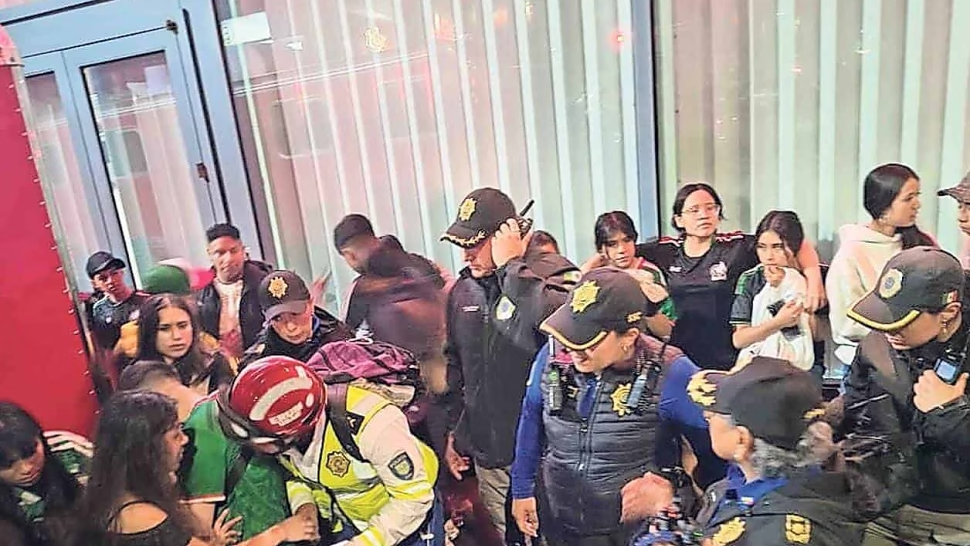
Chaos broke out when hundreds of fans simultaneously advanced towards the toilet area, while others tried to leave the Angel of Independence. The balance: two dead and multiple injured.

Jesús Góngora, witness and portable toilet worker, recounted what happened:

“There were approximately 200 people, all on top of each other, all on top of each other! And the rest of the crowd kept stepping on them.”

The stampede lasted about 40 minutes. Góngora heard screams of children and women asking for help. A young woman and a man were taken to a hospital, where their later death was reported.

“Since Mexico won, the people went crazy… they let themselves go with everything towards the bathrooms, and as a result they crushed the people, there were too many injured.”

According to the witness, the first paramedics arrived 45 minutes after the incident. Around 10:30 at night, hundreds of people wanted to leave the Angel while others tried to enter, creating riots on Río Tíber Street. At the height of the Volga River, pushes were recorded. Merchants and fans formed a human chain to contain the crowd.

The incident highlights the lack of control measures at mass gatherings. The authorities have not yet issued a detailed official report.

Continue reading

Claudia Sheinbaum: T-MEC does not end, it is only reviewed

The president ruled out the treaty ending and explained the annual review process.

Sheinbaum clears up doubts about the T-MEC

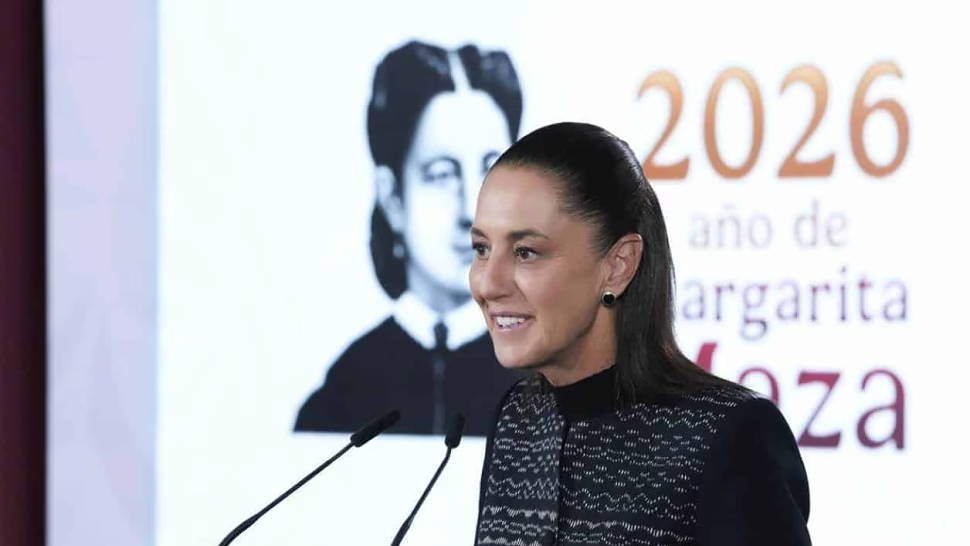
President Claudia Sheinbaum affirmed that the trade agreement with the United States and Canada remains in force. The planned review does not imply its termination, he said.

“Mexico has done everything on its part, always with the obvious limits to guarantee the development of our country, jobs and companies; always without giving up things that we cannot give up, from sovereignty to other measures.”

If the United States does not express in writing the intention to extend the USMCA for an additional 16 years, the agreement continues for the next ten. An annual review process then begins.

Sheinbaum recalled that Washington has already imposed tariffs on vehicles, steel and aluminum beyond the treaty. He considered it feasible to seek better conditions in the review.

He stressed that the three countries can compete better if they work together. The treaty benefits the American population because it reduces prices, and Mexico because it generates jobs. It also improves access to goods in the three nations.

“Tomorrow the Secretary of the Economy is coming to talk about what was discussed today. It is not that the treaty is going to end, far from it.”

This Thursday’s virtual meeting includes Secretary Marcelo Ebrard, US Trade Representative Jamieson Greer, and Canadian Trade Minister Dominic LeBlanc.

Process details

The T-MEC was signed six years ago. The law stipulates its conclusion after 16 years of validity, that is, in 2036. It also establishes a joint review on the sixth anniversary, where the parties confirm in writing whether they wish to extend another 16 years. If not, annual reviews are carried out.

“Today is not the deadline. If the letter is not sent by the US, the treaty is maintained for 10 years, only with an annual review. In five months or three years the parties can decide to extend it.”

Continue reading

High-impact crimes have fallen 53% since 2018, the Government reports

Official report attributes the reduction to the participation of the Armed Forces in public security.

Key figures

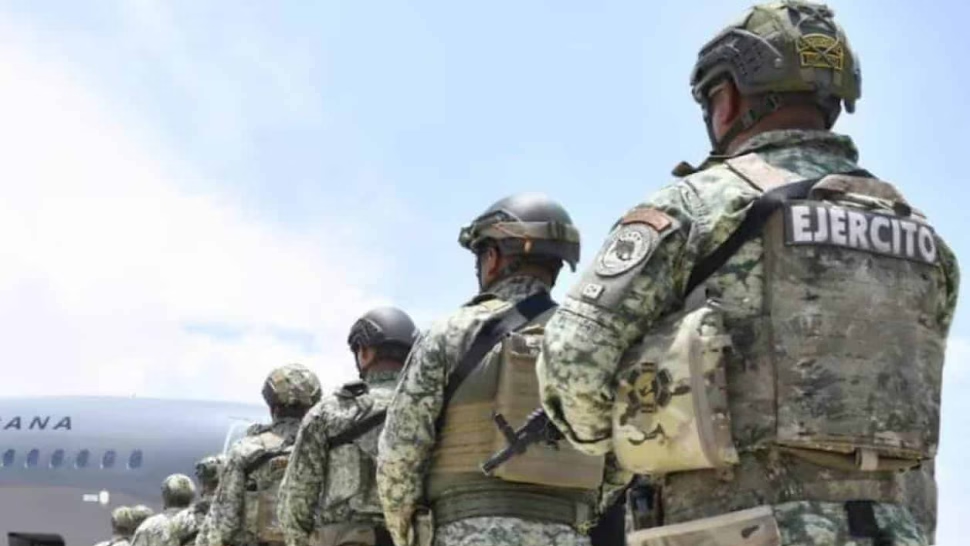
The Government of Mexico reported a 53% drop in the daily average of high-impact crimes since 2018. The figure went from 969.4 to 455.8 cases per day, according to the Seventh Semiannual Report of the Permanent Armed Forces in Tasks to Support Public Security.

The document, delivered to the Permanent Commission, highlights the intervention of the Army, the Air Force and the Navy as a central factor. The data also shows a 40% reduction in victims of intentional homicide between September 2024 and April 2026: from almost 83 to 49 per day.

During the first four months of 2026, compared to the same period in 2025, feminicide, extortion, kidnapping for ransom, intentional injuries with a firearm, robberies with violence and robbery of a carrier decreased. Vehicle theft fell 56.5% compared to 2018.

Military deployment

The Secretariat of National Defense deployed 45,247 troops between November 2025 and May 2026 in entities with a high incidence of homicides and violence. More than two thousand soldiers were sent to Jalisco after the arrest and death of Nemesio Oseguera Cervantes, alias “El Mencho.” Operations were also reinforced on the northern border and in Michoacán.

The Mexican Navy expanded its presence with 3,742 elements in 18 states for surveillance and crime prevention. In addition, it allocated more than 2,000 troops to protect 218 strategic facilities in the energy and financial sectors.

In 2026, National Defense had a budget of 170,753 million pesos; 28,867 million were allocated to public security. The Secretary of the Navy received more than 3,477 million pesos for support tasks.

The federal government assured that military action is maintained under constitutional principles: extraordinary, regulated, supervised, subordinate and complementary to civil authorities, with respect for human rights. The report concludes that the participation of the Armed Forces will continue as the central axis of the national security strategy.

Continue reading