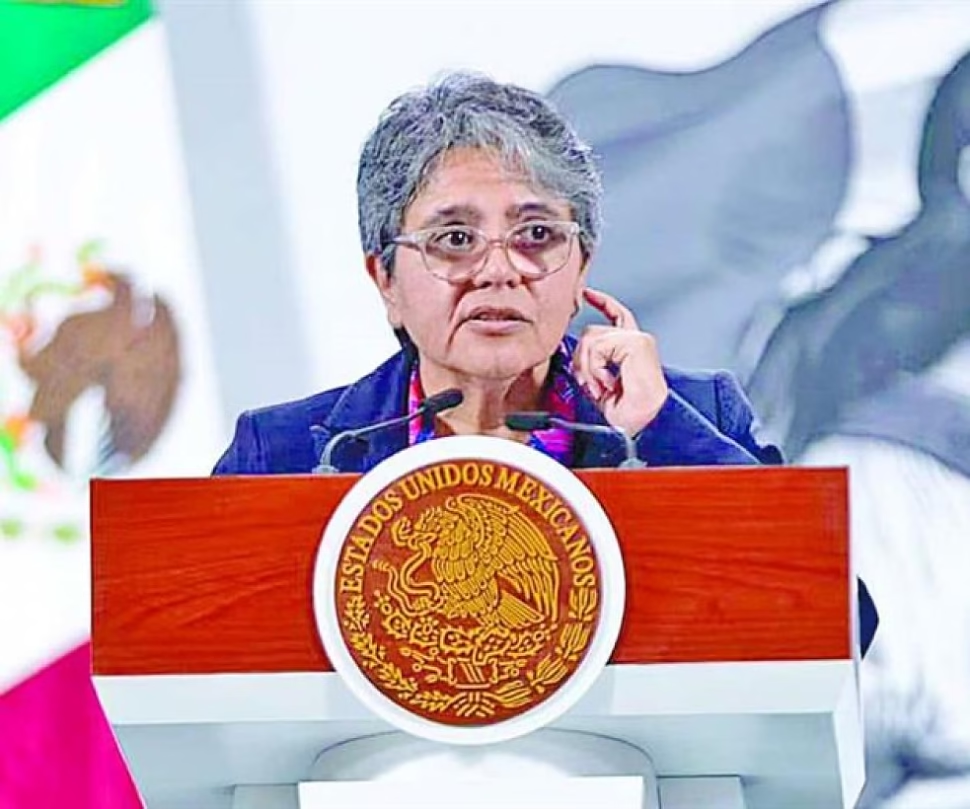
Government sanctions three companies for false documents

The companies tried to deceive the State with false papers, but the authority discovered them and the full weight of the law fell on them.

The day three companies backfired

It seems that there are companies that still believe that playing La Casa de Papel with the government is a viable business strategy. Well guess what: the Secretary of Public Service (because they changed their name, but the essence of catching criminals is the same) has just given them a lesson in reality. The official statement basically said, with all the bureaucratic elegance possible: “lying to get public contracts has consequences, friends.” And it’s not a simple scolding, it’s the equivalent of having your account suspended on your favorite delivery app, but with fines that hurt more than paying for premium shipping.

In a move that reminds us that the Official Gazette of the Federation can be more entertaining than a gossip thread, the federal agency today published sanctions against three companies that crossed the lists. These companies, in their eagerness to win bids, decided that the truth is overvalued and presented documentation that was more false than an influencer promoting a product they never use.

RelatedCheating companies get what they deserve in public contracts

The protagonists of this bureaucratic drama

In the first act of this tragicomedy we have Coordinadora y Desarrollo P&O, S.A. de C.V.. This company, in a burst of creativity, decided that an SAT tax opinion was like a college assignment: you can invent it. They presented a false tax document in a national public tender. The result: a fine of 168,283 pesos (yes, with a coma, to make it hurt more) and a disqualification of three months. The most ironic thing is that the sanction was confirmed on October 14 after the company appealed, basically like when you argue with your boss knowing that you blew it.

The second case is to frame it. Market Solutions Atmosphera, S. de R.L. de C.V.Not only did he lie, but he did it “con dolo,” which in legal language means “with all the malice in the world.” This company presented falsified documents to prove experience in a contract with the Mexican Petroleum Institute. His reward for such audacity: a fine of 924,403 pesos (almost a million, for those who do not want to count zeros) and a disqualification of 21 months. Basically, the equivalent of being suspended from social media for posing as an influencer.

And to close with a flourish, Mundoferremetl, S.A. de C.V.decided that social security obligations are optional, like putting extra avocado in guacamole. He submitted false documentation on this issue in a tender for the Secretary of National Defense. His punishment: 170,000 pesos fine and three months disqualification. Because, apparently, lying to the military is not the best idea.

What this trio of failed entrepreneurs did not calculate is that in the era of transparency and accountability, lies have shorter legs than a viral meme. Sanctions for corruption in tenders are increasingly common, and authorities are reviewing the paperwork with the same dedication as we review someone’s profile before a date.

This case sets an important precedent in the fight against collusion and fraud in government contracting. It demonstrates that oversight institutions are functioning and that the justice system can be effective when it comes to protecting public resources. In the end, the message is clear: in the game of government contracts, honesty should be the only strategy.

Do you know someone who needs a lesson in transparency? Share this note and help us make the importance of accountability viral. Explore more content on how institutions fight corruption in our national news section.

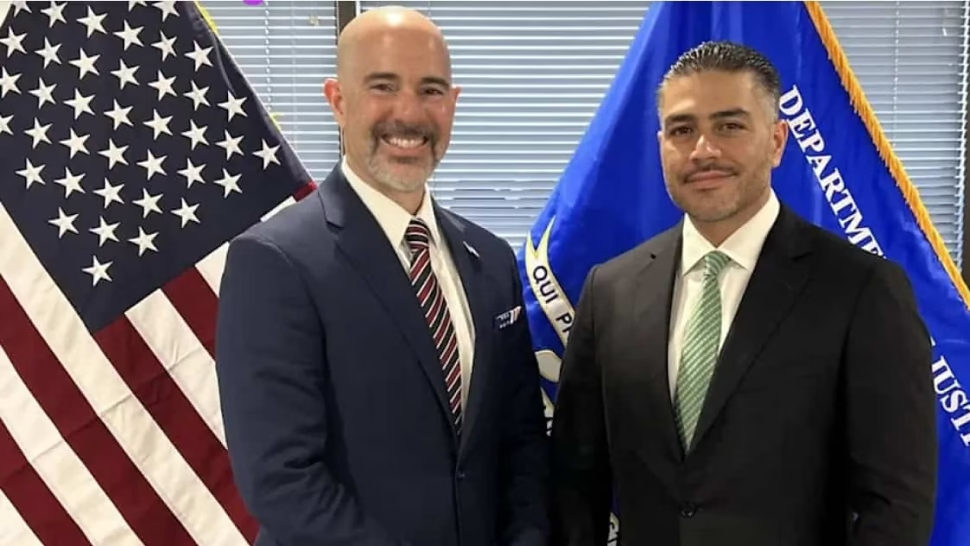
CNDH demands clarification of deaths of Mexican migrants in ICE custody

The organization asks to investigate deaths of compatriots in US detention centers.

The National Human Rights Commission (CNDH) issued a condemnation for the deaths of Mexican migrants that occurred during operations and in detention centers of the United States Immigration and Customs Enforcement Service (ICE). The organization, chaired by Rosario Piedra Ibarra, demanded prompt, impartial and transparent investigations to clarify the facts and punish those responsible.

Concern about violations of fundamental rights

The CNDH described these cases as “most serious”, since they involve possible violations of the right to life, personal integrity, health, due process and dignified treatment. He expressed his concern about the immigration policies applied in the United States and recalled that the protection of human rights must be guaranteed regardless of nationality or legal status.

Consular assistance and accompaniment

The organization highlighted the need for Mexico to maintain consular assistance, legal accompaniment and humanitarian support for compatriots deprived of their liberty for immigration reasons, as well as for their families. He also reiterated that any death in state custody must be reviewed with the utmost rigor.

The CNDH requested that the investigations allow for determining responsibilities and guaranteeing truth, justice and comprehensive reparation for the victims.

Continue reading

Sheinbaum rejects accusations by the director of the DEA about links to crime

The head of the DEA pointed out an alleged alliance between authorities and cartels. Sheinbaum described it as unsupported.

Diplomatic tension due to DEA statements

The statements of the director of the DEA, Terry Cole, have caused friction in the bilateral relationship with Mexico. The official recently stated that the Mexican government and the cartels maintain a “deadly connection.” He said that combating this alleged alliance is a priority for his agency.

President Claudia Sheinbaum rejected the accusations. He described them as “unfortunate, unsupported and baseless.”

It is not Cole’s first controversy towards Mexico. Since taking office in 2025, his appointment has been questioned. Newspaper reports link him to the leak of sensitive information in 2011 that led to the civilian tragedy in Allende, Coahuila, attributed to the criminal group Los Zetas.

Cole has also supported measures by the Trump administration. Supports classifying Mexican cartels as Foreign Terrorist Organizations. In addition, he has defended the possibility of covert operations by US agencies inside Mexico.

In his most recent statements, Cole pointed to the case of Sinaloa. He suggested that Mexican officials may have collaborated with criminal groups. Sheinbaum insisted that there is no evidence and that his statements damage bilateral cooperation.

Continue reading

SEP publishes 2026-2027 school calendar with 185 school days

2026-2027 calendar published: 185 days of class, vacations and key dates.

Beginning and end of the school year

The Ministry of Public Education (SEP) published the calendar for the 2026-2027 cycle in the Official Gazette of the Federation. Classes will begin on August 31, 2026 and end on July 9, 2027, with 185 days effective for preschool, primary and secondary school. Normal schools will have 190 days and will end on July 13.

Relevant dates

The agreement, signed by Secretary Mario Delgado, includes an awareness day on sexual abuse and child abuse on September 7. There will be eight sessions of the School Technical Council on September 25, October 30 and November 27, 2026, in addition to January 29, February 26, March 26, May 28 and June 25, 2027.

The suspensions of teaching work will be on September 16, November 2 and 16, 2026, as well as February 1, March 15 and May 5, 2027. The winter holidays will run from December 21, 2026 to January 8, 2027. The Easter period will run from March 22 to April 2, 2027.

Pre-registration and tickets

The pre-registration process for the 2027-2028 cycle will be from February 2 to 13, 2027. The delivery of evaluation slips will occur from November 23 to 26, 2026, from March 22 to 25, 2027 and on July 12 and 13, 2027.

The agreement complies with the General Education Law, which requires between 185 and 200 class days. An additional week of recess is maintained in August for teachers, in recognition of their work and President Claudia Sheinbaum’s commitment to teaching. The SEP reiterates that only it can establish school calendars at the national level. The agreement comes into force the day after its publication and repeals the previous one, which regulated the 2025-2026 cycle.

Continue reading