Government prepares occupation of 77 properties for the AIFA-Pachuca Train

The federal government activates a legal mechanism to take control of 77 private properties and accelerate the mega railway project.

A Decree that Will Change the Destiny of the Region

In a movement that seems taken from a high-voltage political thriller, the Federal Government is preparing to execute a masterstroke: the immediate temporary occupation of no less than 77 privately owned properties. The setting is the vibrant land of Hidalgo and the strategic State of Mexico, where the whistle of progress announces the arrival of the colossal AIFA-Pachuca Interurban Train. This is not a simple transportation project; It is the heartbeat of a nation that refuses to stop, a bold bet that promises to redefine mobility and connect destinations with the strength of a titan.

President Claudia Sheinbaum herself has the decree ready on her table, a document loaded with power and consequence. For the first time, his administration unleashes this legal figure, a weapon introduced in the Expropriation Law by former President Felipe Calderón and that was sleeping in the books, waiting for its moment. An instrument that in the previous six-year term awakened for the Mayan Train and that now reemerges with renewed strength. The government does not need the labyrinthine procedures of a total expropriation; This mechanism grants you instant control over the 21.8 hectares that the destination has chosen for the passage of progress.

RelatedCDMX-AIFA train concludes civil works this year

The Territories of Tomorrow

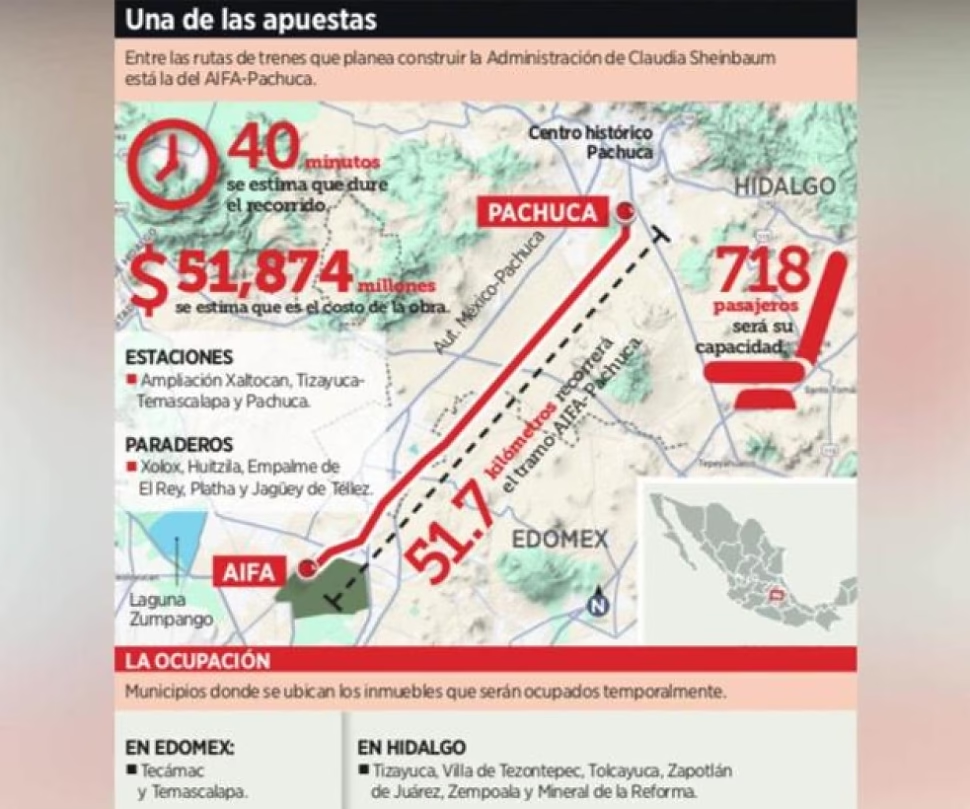
The drama unfolds in eight municipalities that will become eternal witnesses of this epic. In the State of Mexico, eyes are focused on Tecámac and Temascalapa. In Hidalgo, the plot is woven in Tizayuca, Villa de Tezontepec, Tolcayuca, Zapotlán de Juárez, Zempoala and the crucial Mineral de la Reforma. Each square meter of these lands has been identified with surgical precision by the Secretary of Infrastructure, Communications and Transportation (SICT), as it has such a strategic and ideal location that its acquisition becomes a matter of manifest destiny.

The draft decree, a text that exudes determination, vehemently argues that, due to the monumental significance of the project and to avoid unnecessary economic losses to the treasury, it is imperative to strengthen technical feasibility during construction. The justification is clear, forceful, irrevocable. But every great story has its counterpoint, its conflict. The Rail Transport Regulatory Agency (ARTF) will be in charge of disbursing the compensation, a compensation at “market value” that the law mandates for the owners of these lands whose world is about to be transformed forever.

However, the script is not without suspense. Those affected, those whose properties will be the foundation of the future, have a recourse: the amparo trial. The decree itself is unappealable in the administrative sphere; Their battle will be judicial, a legal duel where the last act of this inauguration will be decided. It is the clash between collective interest and individual right, a dramatic dilemma that adds a deep layer of intrigue to this narrative.

And in the center of all this, the absolute protagonist: the AIFA-Pachuca Train. A 51.7-kilometer steel beast that will be the natural extension of the Suburban, linking Mexico City with the AIFA and beyond. It will have three stations, five stops and two viaducts of almost six kilometers that will stand as monuments to human ingenuity. The government estimates a colossal investment of 51,874 million pesos, a figure that eclipses any doubt about the magnitude of this company. But the mystery increases, since the works have been entrusted to the Secretary of National Defense (Sedena), an institution that operates with a veil of opacity, without revealing the contracting procedures or the intimate details of the project, fueling the mystery and expectation.

This is not just a train; It is the pulse of an ambition, a journey into the unknown where each rail laid is a promise, each occupied property is a sacrifice for the greater good, and each day that passes brings us closer to a climax that will redefine the geography and future of an entire region. Destiny is in motion, and nothing can stop it.

Do you think this project will transform the center of the country? Share this news on your social networks and join the conversation about the future of national infrastructure. Explore more content about megaprojects that are changing Mexico.


Former director of Pemex faces criminal proceedings in Atlacholoaya

Former director of Pemex claims fruit and judge orders medical attention in Atlacholoaya.

Entry to the Atlacholoaya prison

Víctor Rodríguez Padilla, former director of Petróleos Mexicanos (Pemex), was admitted to the Observation and Classification Center of the Atlacholoaya prison after his arrest at the Benito Juárez mayor’s office in Mexico City. He is accused of family and vicarious violence, for attacking his wife in the presence of their youngest daughter.

During his first morning in the protection area for officials, he expressed dissatisfaction because they did not bring him fruit. The prison rule is that fruit is served only to those who are on a sick diet. Later they gave him pieces of melon, and other prisoners indicated that he probably paid for this benefit, a common practice in that area.

Rodríguez occupies a single cell, wears a beige uniform and plain tennis shoes. So far he has not received visits from family or friends. He also did not have companions at the accusation formulation hearing last Wednesday. Judge Consuelo Adriana Carrera Ortiz asked twice if there was any family member present, without receiving a response.

In that same hearing, the former official reported that he is undergoing treatment for a malignant tumor in the prostate. The judge ordered immediate medical attention.

“I am going to order that the corresponding letter be sent to the director of the Social Reintegration Center so that they can immediately provide medical attention and they must inform me within 24 hours,” said the judge.

Rodríguez tried to detail his medication, but the judge interrupted him: “I cannot order in this office that you be given these medications, because I am not a doctor; however, a doctor will determine if it is pertinent for you to take these medications.” Complaints have been registered in the prison about lack of medication.

Continue reading

Leak in Cereso de Sonora activates search operation

Three inmates escaped from the Hermosillo prison; Federal and state forces are looking for them.

Three people deprived of liberty escaped from the Social Reintegration Center (Cereso) Number 2, in Sonora. The incident occurred in the early hours of Saturday, July 11, and triggered a security operation in the area.

The absence of the inmates was detected around 5:30 a.m. during the roll call. The prison is located at kilometer 21 of state highway 100, on the Hermosillo-Bahía de Kino route.

Search operation

Corporations from the three levels of government reinforced surveillance in the area. Elements of the State Public Security Police, the Ministerial Criminal Investigation Agency (AMIC), the National Guard and the Mexican Army guard the main and rear entrances. They also carry out tracking tours in the surrounding area.

The Secretary of Public Security of Sonora confirmed the evasion through a statement. He noted that the State Penitentiary System immediately activated security protocols.

Investigations in progress

All authorities participate in the actions to recapture the fugitives. At the same time, investigations are being carried out to determine how the escape occurred. So far, the identity of the escapees and the exact circumstances of the escape have not been revealed.

The agency indicated that it will continue to report on the progress of the operation and the investigations.

Continue reading

Senate seeks to strengthen municipalities with international cooperation

Senate proposes multi-stakeholder cooperation to strengthen more than 2 thousand municipalities.

The Senate of the Republic promotes a reform to strengthen the more than 2,462 municipalities of the country in security, infrastructure and local development. Historically, these entities have faced abandonment.

Discussion on multi-stakeholder cooperation

Senator Mario Vázquez, president of the Municipal Development Commission, will lead this Tuesday, July 14, the discussion “The Strategic Role of Multi-stakeholder Cooperation as a Tool to Achieve the Sustainable Development of Mexico.” The event will bring together municipal presidents, legislators, international organizations, civil society and academia.

The objective: analyze mechanisms that allow municipalities to access new financing, training and collaboration tools to promote sustainable development projects.

International cooperation as an alternative

Mario Vázquez highlighted that municipalities are the level of government closest to citizens and require greater capabilities to respond to current challenges. He pointed out that international cooperation represents a strategic alternative to strengthen its management, attract investments and improve the quality of life.

During the discussion, experiences with organizations such as the Economic Commission for Latin America and the Caribbean (ECLAC), the Japan International Cooperation Agency (JICA), the Spanish Agency for International Development Cooperation (AECID), as well as representatives of the Embassy of Chile, the Citizen Observatory of Human Rights and the Transforming Our World TODAY Network will be discussed.

The senator stressed that the Municipal Development Commission will continue to promote spaces for dialogue that strengthen the autonomy and institutional capacities of city councils, promoting a development model based on cooperation, innovation and participation of all sectors.

Continue reading