Google Maps is transformed with artificial intelligence

Google Maps gets a makeover with AI to deliver conversational recommendations and immersive 3D navigation.

Google gives Maps a twist with its Gemini AI

Forget the static map. Google has just presented a profound renovation of Maps, and the engine that drives it now is artificial intelligence. Specifically, its Gemini model. The idea is that the service used by more than 2 billion people is more conversational and visual.

A new way to search: ‘Ask Maps’

The first big news is ‘Ask Maps’ (Ask Maps). Think of it as an assistant within the app. Instead of just searching for ‘coffee shop’, you can ask it for specific things: “places nearby to charge your phone” or “coffee shops with short lines now.”

Recommendations are based on a huge database: more than 300 million places and reviews from more than 500 million contributors accumulated over 20 years.

Google declined to comment on whether businesses will be able to pay to appear more in these suggestions. For now, the feature will first reach users in the US and India from the mobile app.

RelatedGoogle Gemini 3 redefines the limits of multimodal artificial intelligence

Navigating in 3D: the map comes to life

The other big change is in the driving directions. It’s called ‘Immersive Navigation’ and it uses Gemini to generate three-dimensional views of the road.

They’re not photos, they’re AI-generated recreations showing iconic buildings, road dividers, and terrain details. The goal is for you to orient yourself faster and better understand where you are at all times.

What is crucial here is Google’s confidence in its controls. They claim that their security barriers are already strong enough to prevent AI from “inventing” fake places, a common mistake known as hallucination.

This tool also promises to better explain the pros and cons of each route and even suggest the best places to park when you arrive. It will initially be available only in the US, both on mobile phones and in cars with CarPlay and Android Auto.

The total bet on Gemini

This update is not an isolated case. It is part of Google’s clear strategy to integrate its Gemini model into all its flagship products, after having also done so in Gmail and Chrome.

The company is doubling down on its Gemini 3 model, launched late last year, amid a fierce battle for AI dominance against rivals such as OpenAI and Anthropic. With Maps, they play a fundamental service in global daily life. The question now is whether users will actually notice the difference.

World Cup 2026: the technology that will transform how you watch football

Data, AI and 3D avatars will change the fan experience at the trinational tournament.

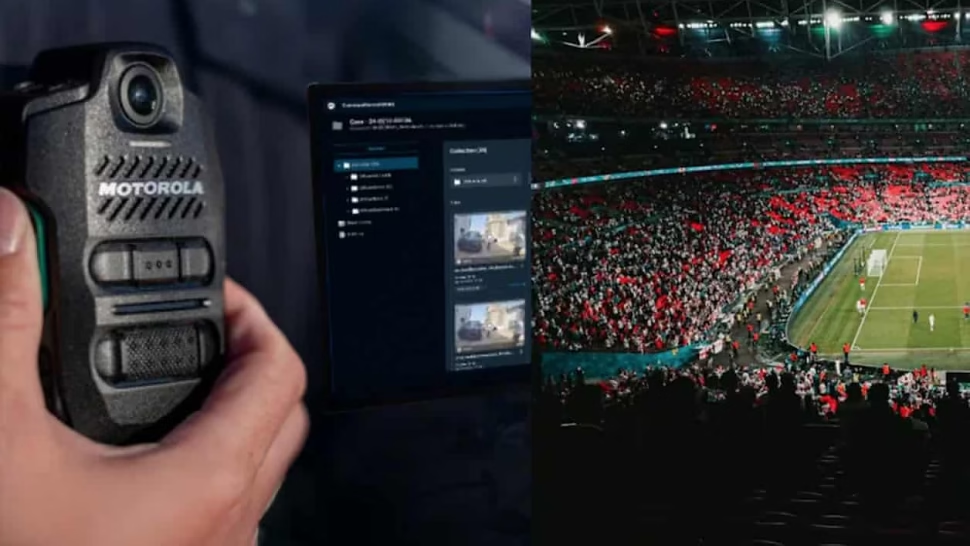
Almost 50 teams, three countries and more than one hundred matches. The 2026 World Cup will not only be the largest in history, but it will also transform the way we watch football from home. Artificial intelligence and advanced statistics will be the protagonists.

Tools like Football AI Pro, created with Lenovo, will help coaches prepare for matches and detect weak points. For the viewer, the data will be converted into graphs and summaries that explain what is happening on the court.

How the experience changes

In Qatar 2022, 12 cameras were already used to track the ball and 29 body points of each player 50 times per second. By 2026, that level of detail will be the norm. Stats will no longer be cold numbers: defensive lines, heat maps and movement patterns will be displayed.

In addition, the organization announced 3D avatars to recreate plays and referee decisions. Thus, tactical concepts such as high pressure or compact block will be visual and easy to understand.

The 2026 World Cup will maintain the excitement of goals and surprises, but with tools that allow us to better understand the game. Technology does not take away passion, but rather adds context.

Continue reading

Meta faces failures on Facebook, Instagram and WhatsApp

Users report intermittencies in Meta applications during the morning.

Failures in Meta services

Since this Wednesday morning, users of Facebook, Instagram, WhatsApp and Messenger reported interruptions in the operation of these platforms. The DownDetector site, which compiles crash reports, recorded an increase in complaints starting at 7:41 a.m.

According to the data, Facebook reached its peak of reports at 8:11 with 5,245 incidents. The main problems were concentrated in the application (47%), login (33%) and connection to the server (16%).

Messenger also had bugs. Its highest peak occurred at 7:48 with 260 reports. The most common difficulties were logging in (67%), the app (24%) and messaging (7%).

In the case of Instagram, reports increased until 8:20 with 326 complaints. 68% of users reported problems with the app, 14% with the connection to the server and another 14% with the login. The Tech Bit team confirmed difficulties when trying to publish stories, which could be related to the same bug.

WhatsApp, for its part, also suffered interruptions. 47% of the reports indicated problems with the web version, while 23% mentioned errors in the app and 16% in the login.

So far, Meta has not issued an official statement about the causes of these failures. Users are advised to stay tuned for updates.

Continue reading

Google integrates Gemini into Chrome for all of Latin America

Google expands its Gemini assistant in Chrome for users in the region.

Smart assistant comes to the browser

Google confirmed the expansion of Gemini, its assistant based on artificial intelligence, in Chrome for all of Latin America. Mexico is among the countries that already have access to this function, designed to simplify tasks within the search engine.

According to the company, Gemini helps users “understand information, stay organized, and complete tasks more easily.”

What does it allow you to do?

The integration eliminates the need to switch tabs to use the AI. In the upper right corner of Chrome the legend “Ask Gemini” appears.

With connections to Gmail, Maps, and Calendar, you can compose emails, check locations, and schedule meetings without leaving the current page. You can also compare products or summarize data from multiple open tabs. Google explains that “Gemini can understand the context between tabs and help you bring all the information together in one place.”

Additionally, Chrome incorporates AI-powered image editing tools, allowing you to transform photos directly from the browser with simple instructions.

Security and control

Google assures that these capabilities were “designed to always keep you in control” and developed with security as a priority. The models were trained to detect known threats, such as attempts to inject malicious instructions, in order to offer safer browsing.

The feature is now available for Chrome users in the region.

Continue reading