Federal government assists Querétaro after rains with emergency budget

The federal government deploys an unprecedented operation with thousands of brigade members to census and support the communities affected by the intense rainfall.

Government Response to the Emergency in the Sierra Queretana

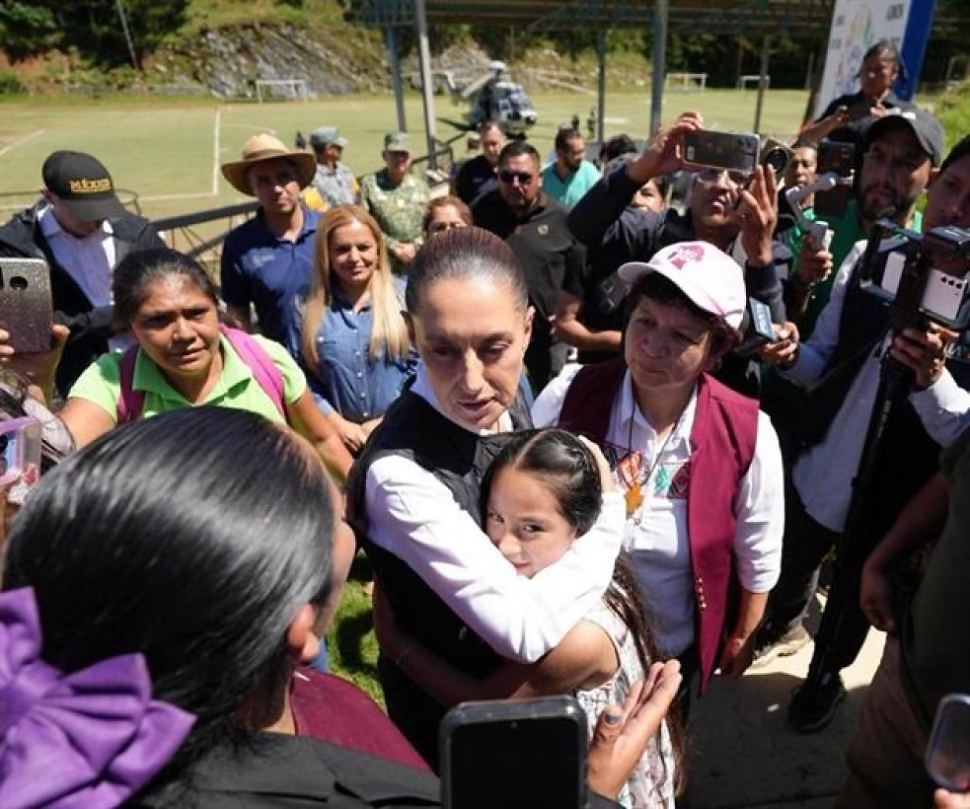
The President of Mexico, Claudia Sheinbaum Pardo, carried out a supervision and coordination visit in the municipality of Pinal de Amoles, Querétaro, one of the areas most impacted by the recent extreme rainfall that has affected several entities in the country. During her tour of the territory, the federal president transmitted a message of certainty and response capacity, emphasizing that the Government of Mexico has the necessary financial resources to address the contingency and assist the affected population.

The Chief Executive used her platforms on social networks to directly communicate the state of the situation: “In Querétaro we toured Pinal de Amoles, a community affected by the past rains. We are still in the territory; there is enough budget to support all families. We will move forward.” This statement underscores the federal administration’s commitment to maintaining a physical presence in disaster areas to assess damage firsthand and expedite humanitarian aid.

RelatedGovernment begins national census due to rain damage

National Emergency Response Strategy

In the framework of the morning press conference, called “The morning of the people”, President Sheinbaum detailed the logistical and operational strategy that is being implemented at the national level. His immediate agenda includes visits to the states of Querétaro and Hidalgo this Monday, October 13, with subsequent tours scheduled for San Luis Potosí and a new visit to northern Veracruz. These actions are part of a continuous evaluation and support operation, which began the previous day with visits to the states of Puebla and Veracruz, where work meetings were held with local inhabitants to coordinate relief efforts efficiently.

A fundamental pillar of this response is the specific budget allocation for contingency. For the current fiscal year, the federal government has allocated a global allocation of more than 19 billion pesos (mp) exclusively for emergency care. From this fund, approximately 3 billion pesos have already been used to address the serious damage caused by Hurricane Erick in the states of Guerrero and Oaxaca, which demonstrates the capacity for financial mobilization in the face of adverse natural phenomena.

Unprecedented Territorial Deployment

The operational phase of the government response was intensified with the massive deployment of specialized personnel in the most affected states. Starting this week, a contingent of 600 intervention brigades, made up of approximately 3 thousand public servants from the Ministry of Welfare, began an exhaustive household census in the states of Veracruz, Puebla, Hidalgo, Querétaro and San Luis Potosí.

This door-to-door evaluation methodology has the primary objective of accurately quantifying the specific needs of each family and the material damage to their homes. The information collected will allow resources to be focused and expedite the delivery of the first financial and in-kind support, which will begin to be distributed starting this week. This systematic procedure seeks to guarantee that aid reaches those who need it most in an orderly, transparent and priority manner, avoiding duplication of efforts and ensuring optimal distribution of resources.

The magnitude of this operation reflects a modern and proactive civil protection doctrine, which combines the technical assessment of damage with an immediate humanitarian response. The presence of the highest executive authority in disaster zones not only has symbolic value, but also facilitates inter-institutional coordination and on-site decision-making, streamlining bureaucratic processes that usually delay aid in critical situations. The combination of a substantial emergency fund and a human device deployed in the territory constitutes a comprehensive approach to disaster management, aimed at early recovery and reconstruction of the social and economic fabric of the impacted communities.

This care model, which prioritizes proximity to citizens and the efficient allocation of resources, seeks to set a precedent in comprehensive risk management in Mexico, transforming the traditional reactive response into a more resilient and people-centered system.

Do you know anyone in the affected areas? Share this information on your social networks to keep your community informed and help us make more people aware of the reconstruction efforts. Explore more news about government actions in our national section.

After four deaths, they call to avoid challenges in celebrations

Four dead after Mexican victory. Authorities issue warnings about risky behavior.

After the death of four people in the vicinity of the Angel of Independence after the victory of the Mexican National Team against Ecuador, the Secretariats of Security and Citizen Protection (SSPC) and Citizen Security (SSC) issued recommendations to prevent more tragedies.

Recommendations to avoid risks

Through a statement, the authorities warned about behaviors such as the “He wants to fly” challenge, jumping from bus stops or elevated structures, and simulated fights with traffickers. They also mentioned sudden crowds under expressions like “We will swim.”

They noted that collective euphoria, combined with alcohol or other substances, reduces the ability to identify risks and make timely decisions. This can lead to fractures, trauma, permanent injuries, or even death.

“It is recommended not to accept alcoholic beverages or any other type offered by unknown people, as they could be altered with substances that cause drowsiness, disorientation, memory loss or reduced reaction capacity.”

The SSPC and the SSC, with the support of the Cyber Police, also asked to avoid sharing content that normalizes dangerous behavior. Recommendations include:

  • Do not climb on bus shelters, pedestrian bridges or street furniture not designed to support people.
  • Refrain from games, pushing or fighting that could lead to injuries.
  • Celebrate responsibly, respect instructions and stay only in permitted areas.

Spreading these acts on social networks favors imitation, they warned. The authorities reiterated the call for caution during sporting events.

Continue reading

Plan Michoacán achieves historic low in intentional homicides

Federal strategy reduces homicides by 46% in Michoacán in eight months.

Eight months after its implementation, the Michoacán Plan for Peace and Justice shows concrete results. The federal government reported a sustained reduction in intentional homicides and other high-impact crimes in the state.

The strategy was launched after the death of the mayor of Uruapan, Carlos Manzo. During the morning conference, President Claudia Sheinbaum and the head of the Executive Secretariat of the National Public Security System, Marcela Figueroa, presented the figures.

Decrease of 46%

The daily average of intentional homicides went from 4.32 victims in January 2025 to 2.33 in June 2026. This represents a drop of 46%. Figueroa detailed that June 2026 was the month with the lowest incidence since 2015. Compared to June 2025, the reduction was 43%.

The annual trend is also positive. After reaching their highest level in 2021, homicides began to decline. The preliminary data for 2026 is the lowest in the historical series. Compared to 2025, the daily average went from 3.5 to 2.2, a reduction of 37%.

High impact crimes

The daily average of high-impact crimes fell 3% compared to 2025: from 18.1 to a preliminary figure for 2026. If the trend continues, this year would close with the lowest average in eleven years.

Beyond security

Governor Alfredo Ramírez Bedolla affirmed that the plan gives “very evident results” in security, education and infrastructure. He thanked the federal support and highlighted programs such as the Gertrudis Bocanegra scholarships and road works: the expansion to four lanes of the highway towards Lázaro Cárdenas and the export highway between Uruapan and Zamora.

“It is clear to us that we are not alone, we are well supported by our president,” said Ramírez Bedolla. Sheinbaum is on a two-day tour of Michoacán, which includes visits to communities like Cherán.

Continue reading

Mexico deploys humanitarian aid to Venezuela after earthquakes

Mexico sent more than 71 tons of supplies and rescue personnel to Venezuela after the June earthquakes.

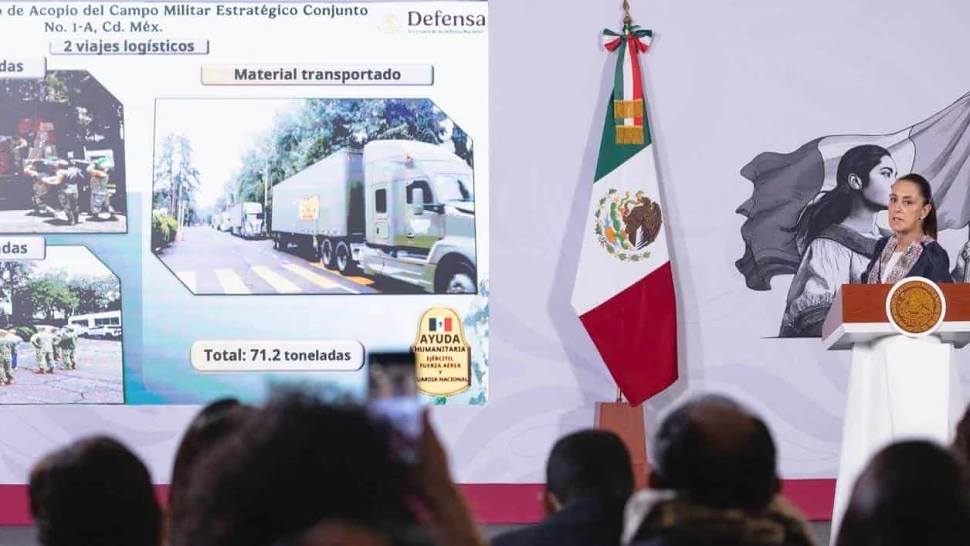
President Claudia Sheinbaum reported that the Government of Mexico, through the Ministry of Defense, has delivered 71.2 tons of supplies, eight electric power plants, 80 kilograms of Red Cross equipment and 13.1 million medications to the people of Venezuela. This, after the earthquakes that occurred on June 24.

Results of the rescue mission

Between June 26 and July 1, the Yumare Defense group rescued two people alive and recovered the remains of 40 deceased people. He also rescued a dog and provided 1,411 medical and first aid consultations. Sheinbaum added that a Navy ship will be sent tomorrow with more support.

On July 2, 28 tons of supplies were transported, consisting of non-perishable food and medicines, in response to the request of the Venezuelan government. On June 30, five power plants and 80 kilograms of Red Cross material were sent. On Wednesday, three more emergency plants with lighting systems were added.

“In total, eight plants with a lighting tower and solar panel have been transported, in addition to 80 kilograms of Red Cross material, in two logistics flights,” said the president.

Sheinbaum highlighted that the Mexican humanitarian aid team continues in Venezuela, coordinated with local authorities. He also advanced:

“A Navy ship is going to be sent, probably tomorrow, with supplies from different places to continue supporting Venezuela. This is the report.”

Assistance includes medical supplies, power plants, medications and personnel specialized in rescue and emergency care.

Continue reading