Livestock farmers demand closing the southern border due to screwworm plague

The livestock industry faces an unprecedented crisis as health tensions escalate between Mexico and the US.

A desperate cry from the heart of Chihuahua

In a dramatic turn that threatens to unleash chaos in the livestock industry, the producers of Chihuahua launched an urgent call to the Mexican government: Close the southern border! As if the fate of thousands of families hung in the balance, they accused the lack of coordination of the authorities and the shadow of negligence that hangs over the country. The invisible enemy, the fearsome screwworm, advances relentlessly, and with it, economic ruin and health risk.

The voice of despair

Álvaro Bustillos, leader of the Regional Livestock Union of Chihuahua, could not contain the indignation in his words: “It is the coup de grace to our industry!”. With the eyes of the world focused on this crisis, he denounced that ranchers are victims of a corrupt and ineffective system. “We are not bargaining chips,” he cried, while pointing an accusing finger towards the south, where the lack of health controls could trigger a national tragedy.

RelatedUS ranchers demand border closure due to screwworm risk

The drama intensifies: if action is not taken now, not only will livestock herds fall, but wildlife and even public health will be in danger. “All of Mexico will suffer,” Bustillos warned, his voice breaking with frustration. Will this be the beginning of the end for an industry that moves millions?

Betrayal and hopelessness

In a cruel twist of fate, fatteners—supposed allies—benefit while exporters give in under the weight of unfair prices. “They steal our future,” lamented Bustillos, revealing that cattle are sold at 35% less than their real value. But the betrayal does not end there: while some comply with rigorous health protocols, others ignore the rules, putting decades of effort at risk.

The livestock leader demanded a declaration of emergency, but the authorities seem deaf. Why doesn’t Mexico close its southern border if the United States did? The question hangs in the air, charged with anger and despair. “If they can, why can’t we?” Bustillos questioned, while remembering the devastating message from Brooke Rollins, US Secretary of Agriculture, who with a simple tweet sealed the fate of thousands.

The final battle

With time against them, ranchers are clamoring for an extension. “We invested everything… and this is our payment?” they wonder, while the ghost of the screwworm becomes a real nightmare. Bustillos swore that the northern cattle are free of the plague, but no one seems to listen. Will it be too late?

Meanwhile, the USDA maintains its position, and Mexico… remains silent. The question everyone is afraid to answer: Are we facing the collapse of an industry or is there still hope?

Share this story and demand action before it’s too late! Find out more about how this crisis affects millions in our animal health special.
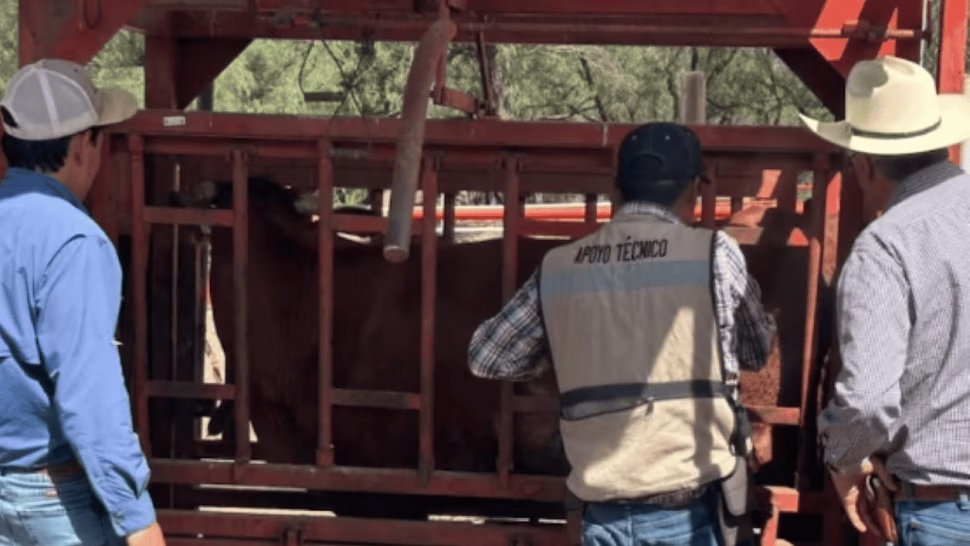
Chihuahua detects four cases of screwworm

Livestock farmers face mobility restrictions and receive federal support to contain the plague.

The Chihuahua Regional Livestock Union confirmed this Friday four cases of screwworm in the state. The outbreaks are located in the municipalities of Coronado, La Cruz, San Francisco del Oro and Parral.

Álvaro Bustillos, head of the union, explained that the only effective solution is to release fertile flies. Currently there are more than 100 million copies from Panama ready for distribution.

“Chihuahua at this moment has several issues; one is that a positive case appears and when positive cases appear, mobility in that area is limited; in this case, as happened with Parral, we bring challenges between states for the mobility of livestock,” said Bustillos.

To prevent spread, protocols similar to those for export are applied. Cattle entering Chihuahua from Coahuila and Durango must be free of the parasite and meet the same requirements as for sending them to the United States.

The livestock leader warned that the situation should not be stigmatized. The closure of borders has already affected the economy of the sector. “It is a priority that ranchers can market their livestock without limitations in areas where there are cases,” he said.

Containment measures

Since the first case appeared in Parral, two weeks ago, brigades from SENASICA and the State Government have been working in the focal and perifocal perimeter. In a radius of 20 kilometers, anti-larvicidal baths are carried out at no cost to producers.

The State Government has provided care kits to prevent the screwworm from spreading. The first case was detected on July 14 in Hidalgo del Parral.

Continue reading

Budget cut to agri-food health worries after false positive in the US

Agri-food sector asks for more budget for health after false positive in the US.

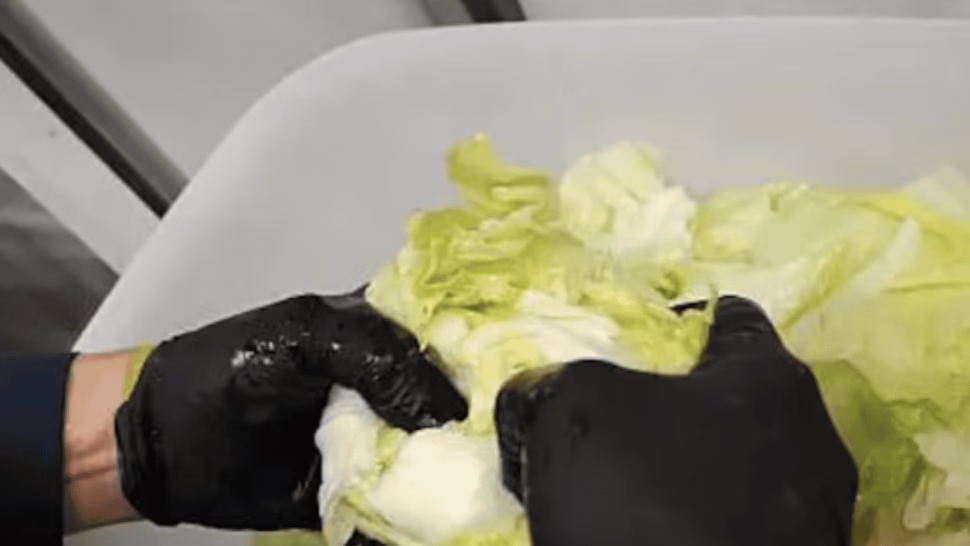
The false positive for Cyclospora in Mexican lettuce, reported by the FDA and later denied, revived the debate about the resources allocated to agri-food health in Mexico.

The budget of the National Agri-Food Health, Safety and Quality Service (Senasica) went from 6,884 million pesos in 2018 to 5,086 million in 2026. This represents a reduction of 26.1%, without considering inflation. The sector warns that this trend compromises the ability to respond to health alerts.

A week ago, the FDA flagged Taco Bell’s chopped lettuce, produced by Taylor Fresh Foods in Guanajuato, for allegedly containing Cyclospora. Hours later, he retracted it: the sample gave a false positive. Mexican lettuce exports—97% of 153 thousand tons annually go to the US—come mainly from Guanajuato, Zacatecas, Puebla, Aguascalientes and Sonora.

Authorities from the Ministry of Health and Senasica analyzed 14 samples of lettuce and water, and ruled out the presence of the parasite.

The Agricultural Market Consulting Group (GCMA) described the situation as worrying:

“While health risks, commercial exchange and international demands increase, the resources allocated to Senasica have been reduced.”

He added that health and safety should be treated as matters of national security, not subject to insufficient budgets.

Jorge Esteve, president of the National Agricultural Council, pointed out that in the last ten years the health budget was reduced by more than 50%, while agricultural and livestock production grew. “You cannot provide complete surveillance,” he stated.

The sector demands that health alerts be handled with rigor and proportionality to avoid harm to producers. Bilateral coordination based on scientific evidence made it possible to clarify this case, but the lack of resources remains a latent risk.

Continue reading

US General visits Veracruz to reinforce bilateral security

General Greg Guillot met with Mexican military commanders to discuss joint strategies.

Bilateral military cooperation in Veracruz

The US embassy confirmed that General Greg Guillot, commander of the North American Aerospace Defense Command and Northern Command, visited Veracruz on July 22. The objective of the meeting was to review strategic security issues.

During his stay, General Guillot met with the head of the Secretariat of National Defense, General Ricardo Trevilla, and with Admiral Raymundo Pedro Morales, Secretary of the Navy. Both sides hailed the meeting as a milestone in the bilateral defense relationship.

“The leaders addressed key strategic issues, such as specialized special operations and counter-cartel training, information sharing and force protection cooperation regarding unmanned aerial systems and the best ways to counter them,” the Northern Command said in a statement.

The North American Maritime Security Initiative and other regional initiatives were also reviewed. The Northern Command highlighted that senior commanders have transformed a professional collaboration into a personal bond that lays the foundation for expanding cooperation.

“The security of North America depends on the strength of alliances and our ability to operate with a common purpose,” declared General Guillot. “The meetings here in Veracruz demonstrate our deep mutual trust and our commitment to addressing complex regional challenges together with our Mexican partners.”

Both parties reiterated their commitment to strengthen cooperation to defend North America, with respect for sovereignty, territorial integrity, and shared and differentiated responsibility.

Continue reading