Formula E in Mexico: electric racing and a social mission

Formula E not only runs on electricity, but tries to save the world with donations and workshops. A race against the carbon footprint.

Ah, Formula E. That category where the cars hum like giant hair dryers and where, apparently, saving the planet is as important as winning pole position. Replacing gasoline with plugs sounds good, right? But of course, that would be too simple. The organizers are not satisfied with just not polluting the air while they run; They have to leave a deeper social mark than a tire in the wet. Because, what’s the point of being green if you don’t shout it from the rooftops?

The electric circus and its good deeds kit

So, how does this serial contribute to social sustainability? Well, prepare your cup of fair trade coffee. The event runs on 100% renewable energy, using something called Hydrogenated Vegetable Oil (HVO). Yes, you read that right: vegetable oil. Basically, it’s like racing is fed by a giant, ethical fryer. This reduces emissions by up to 90%, which is great, although you wonder how much energy is spent explaining to the public what the heck HVO is.

RelatedCFE applies record subsidy to stabilize electricity rates

Then there’s the Better Futures Fund, which sounds like something a millionaire superhero would invent. This fund renews its support for “El Caracol” in Mexico City, donating 25 thousand euros to prevent violence and protect minors. A noble cause, without a doubt. But it’s ironic to think that a sport historically associated with luxury and speed now funds “alternative educational routes.” Will the next scholarships be for drivers who prefer to go slow?

Community, cancer and girls in the pit lane

Community bonding doesn’t stop there. Formula E has also collaborated for years with “Con Ganas de Vivir” to combat cancer. Because nothing says “hope” like the quiet roar of an electric motor. Additionally, there are STEM programs for young people, because what better way to inspire future engineers than by showing them cars that don’t sound like cars?

The Community Tour received up to 400 participants, including recipients of these funds and university students. Imagine the scene: a group walking through the pit lane, accessing gaming areas and watching Free Practice 1. It’s like a field day, but with more tires and less grass.

And let’s not forget the support for women: 120 young people in the FIA Girls on Track program, with workshops and talks to promote empowerment in motorsports and engineering. 240 free tickets were distributed to participants and 800 more to those not selected. Because nothing says equality like a massive waiting list.

At a global level, Formula E reduces its logistical emissions by optimizing operations: from three planes to two and using more maritime transport. That is, now they pollute less… but more slowly. A progress worthy of an ecological turtle.

In short, Formula E in Mexico is a curious spectacle: electric cars running in circles while trying to fix deep social problems. Perhaps it’s a good reminder that even the most glamorous sports can have a hint of conscience… or at least a good PR campaign.

Are you surprised by this social facet of electric motorsport? Share this ironic note with your friends and discover more content about how sport tries to be part of the solution… or at least seem like it.
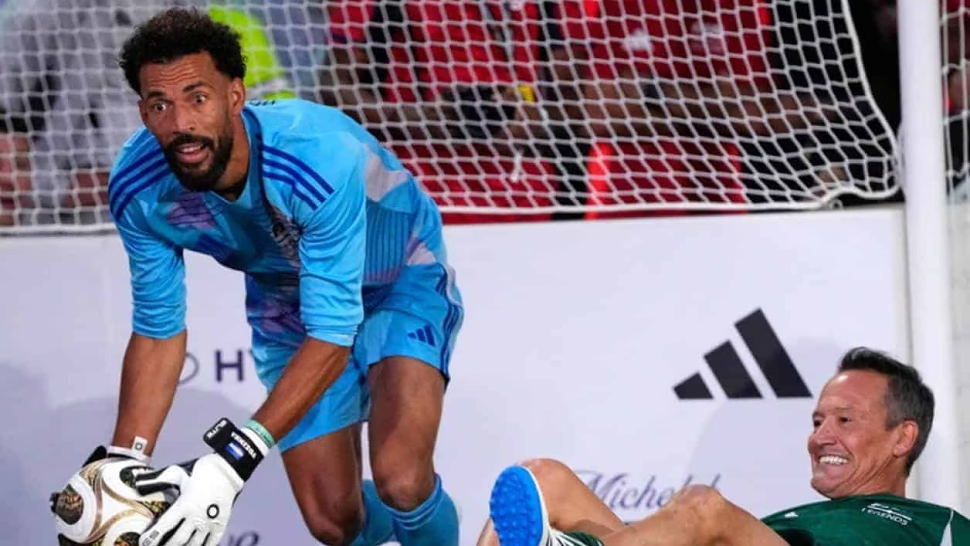

The World Cup sensation goalkeeper arrives in Colo Colo

The 40-year-old Cape Verdean goalkeeper joins the Chilean club after his great World Cup.

Vozinha, the goalkeeper who won the World Cup, arrives in Chile

The president of Blanco y Negro, Aníbal Mosa, confirmed the signing of the Cape Verdean goalkeeper Vozinha for Colo Colo. “In the next few days he will travel to Chile for the rigorous exams and then he will be presented at the Monumental Stadium,” he declared to the press.

Mosa stressed that the 40-year-old goalkeeper “meets the conditions” for the team and acknowledged that the operation “has marketing additives.” However, he stressed that Vozinha “has just had a very good World Cup” and that his arrival helps “place our club in the global orbit.”

Vozinha, whose real name is Josimar Dias, became a global figure on June 15, when Cape Verde drew 0-0 against Spain, the current European champion. It was the first World Cup match in the history of his team. They then tied 2-2 with Uruguay and 0-0 with Saudi Arabia. In the round of 32, they took Argentina to extra time.

The goalkeeper made his professional debut at the age of 25 with Progreso de Angola. Since then, he played in Moldova, Cyprus, Slovakia and Portugal. His last club was Chaves in the Portuguese second division, where he spent two years and retired with the pass in his possession.

In the national team since 2012, Vozinha confessed that he thought about leaving the national team, but “continued with this dream” of the World Cup. His nickname, which means “granny” in Portuguese, was given to him by older boys who bullied him on the field. Later he adopted it to differentiate himself from another player named Josimar.

After his performance against Spain, his followers on Instagram went from 50,000 to more than 2.4 million in a few days. Currently, the number exceeds 29.5 million.

Continue reading

Liga MX Femenil changes its tournament: two groups and fewer dates

The Liga MX Femenil implements a two-group format to alleviate the calendar and optimize FIFA dates.

The Liga MX Femenil is preparing for Apertura 2026 with a restructuring that modifies the traditional format. The new distribution seeks to reduce the load of matches and better adapt to international commitments.

New competition scheme

The 18 clubs will be divided into two groups of nine teams. Each squad will play 14 games: eight against rivals from the same sector and six against clubs from the opposite group. This eliminates double days and optimizes FIFA dates.

“We are making a reform, we are eliminating double days and connecting better with the fans,” declared Mikel Arriola, president commissioner of the FMF and Executive President of Liga MX.

Group distribution

  • Group A: Tigres, Rayadas, Toluca, Cruz Azul, FC Juárez, Atlético de San Luis, Querétaro, Atlante and Santos.
  • Group B: América, Chivas, Pachuca, Pumas, Tijuana, León, Atlas, Puebla and Necaxa.

The design seeks to balance the competition and facilitate the physical management of the soccer players. The board trusts that this model will benefit both the show and the players’ performance.

Continue reading

Mexico U-20 debuts against Antigua and Barbuda in the Concacaf Championship

Mexico begins its journey in the Concacaf U-20 Championship with its sights on the World Cup and Los Angeles 2028.

Debut with an obligation to win

The Mexican U-20 National Team begins its participation in the Concacaf Championship this Friday. The tournament, which is held between Puebla and Mexico City, not only grants tickets for the World Cup of the category, but also for the 2028 Los Angeles Olympic Games.

Under the direction of Alex Diego, the Tricolor faces Antigua and Barbuda at the Cuauhtémoc stadium. The team arrives with the label of favorite, backed by its history and the quality of its squad. The match is scheduled for 5:00 p.m. and will be broadcast on ESPN 3.

Mexico is in Group B along with Guatemala, Costa Rica and Antigua and Barbuda. One of its key figures is Hugo Camberos, a Chivas forward with experience in Liga MX. He is expected to be an offensive leader in the pursuit of international goals.

The national team has the obligation to start with a victory to advance to the next round. The contest represents an opportunity to measure the development of Mexican youth soccer against rivals in the region.

Continue reading