Five clandestine graves discovered in BCS during Holy Week

Shocking discovery in BCS reveals the persistent crisis of disappearances during emblematic dates.

Finding of clandestine graves in Baja California Sur

During the weekend corresponding to Holy Week in 2025, relatives of disappearance victims confirmed the discovery of five clandestine graves in a property located in La Paz, Baja California Sur. This discovery joins a series of locations carried out in the region, evidencing a recurring problem in terms of security and human rights.

Coordination between groups and authorities

The Search Collective for La Paz, in collaboration with the State Commission for the Search of Persons and the Prosecutor’s Office Specialized in Forced Disappearances, managed to identify the sites during a day of tracking. Gabriel Manríquez, representative of the group, highlighted that the area had already yielded positive results in previous searches. The authorities maintained the security of the place to guarantee the integrity of the evidence.

RelatedCollectives discover eleven clandestine graves with human remains in Sinaloa

So far, five bones have been recovered, which will be delivered to their families once the legal and forensic processes are concluded. In addition, the group announced that it will manage financial support to cover funeral expenses of the affected families, including complex cases such as the repatriation of remains, as recently happened with a young Colombian identified in 2024.

Context and worrying figures

The groups carry out weekly search days in different areas of the state, focusing on municipalities such as La Paz, where in recent months more than twenty human remains have been located. These efforts reflect the magnitude of the crisis of forced disappearances in Mexico, particularly in regions with high crime incidence.

Are you interested in learning more about this problem? Share this information to make the work of the groups visible and help us amplify their fight. Explore other related content on our platform.
Train to AIFA adds 1.5 million users; Sheinbaum calls it successful

More than 1.5 million users on the Buenavista-AIFA train. Travel time improved to 46 minutes.

Buenavista-AIFA Train Operation: figures and challenges

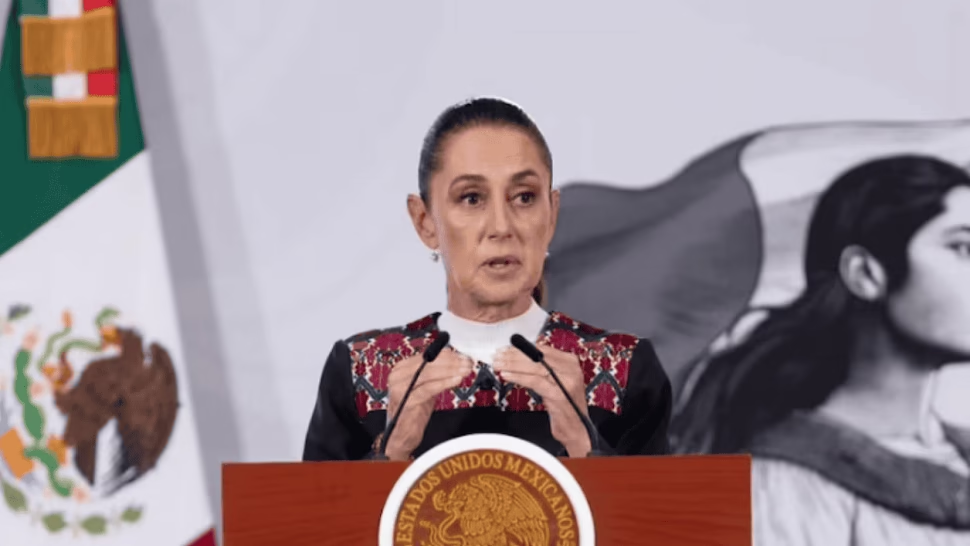
President Claudia Sheinbaum assured that the Train from Buenavista to the Felipe Ángeles International Airport (AIFA) has operated “superbly” since its inauguration, weeks ago. The support was given during the morning conference on June 25, where the head of the Trains and Integrated Public Transport Agency, Andrés Lajous, presented details.

“Users have shown their satisfaction. And how have they shown it? By using it. Right now there are more than 1.5 million users who have used the service,” Lajous reported.

The official reported that a “peak of users” was recorded during the start of the World Cup, with national and international tourists arriving at the AIFA. He highlighted that the departure frequency is every 30 minutes from the terminals, and that the travel time dropped from 52 to 47-46 minutes.

Three stations concentrate the greatest influx: Prado Sur, Lechería and Jaltocan. Lajous also mentioned that walkways are pending at three stations, although he did not detail deadlines.

The official balance is positive, although complementary works persist. The route connects Buenavista with the AIFA and seeks to be an efficient alternative to vehicular traffic.

Continue reading

Mexico needs indicators beyond GDP, says Sheinbaum

President proposes measuring well-being with other indicators in addition to economic growth.

Sheinbaum questions GDP as the only measure

President Claudia Sheinbaum noted that her administration prefers to evaluate the economy with broader indicators than the Gross Domestic Product. During his morning conference on Thursday, he said:

“We prefer that it not only be the GDP, but that it be many other indicators that tell us about how Mexico is developing.”

Sheinbaum framed this position within Mexican humanism, in contrast to the neoliberal period. He recalled that in previous six-year terms, 2% growth did not translate into social well-being.

“Some six-year periods could grow at 2%, but poverty increased, inequality increased. So, who were the beneficiaries of 2% growth?”

The president clarified that economic growth continues to be relevant, but it is not enough. GDP, he said, is a very aggregate indicator that does not reflect the distribution of wealth or access to rights.

In addition, he highlighted that his government has promoted public works without resorting to debt. The strategy, as he explained, seeks to combine development with fiscal responsibility.

Sheinbaum insisted that measuring Mexico’s progress requires looking at inequality, poverty and other social factors. “That is a different vision from neoliberalism,” he concluded.

Continue reading

Audi Mexico and union reach 19.5% salary agreement

Audi workers in Puebla approve a global increase of 19.5% in salary and benefits by 2026.

Salary agreement at Audi Puebla

Audi México and the Independent Union of Audi México Workers (SITAUDI) closed the salary and benefits review for 2026. The pact was approved by the majority of workers by vote.

The agreement includes a global increase of 19.5% between salary and benefits. It is the result of negotiation between the company and the union representation. Both parties indicated that the process seeks to maintain labor stability and operational continuity at the plant located in Puebla.

Audi México thanked the staff for their participation in the consultation and highlighted the joint work with the union. He stressed that the agreement provides certainty to working conditions.

For its part, the Secretariat of Economic Development and Labor of Puebla indicated that the agreement strengthens stability in one of the main automotive hubs in the country. The automotive industry represents a strategic sector for employment and investment in the region.

Continue reading