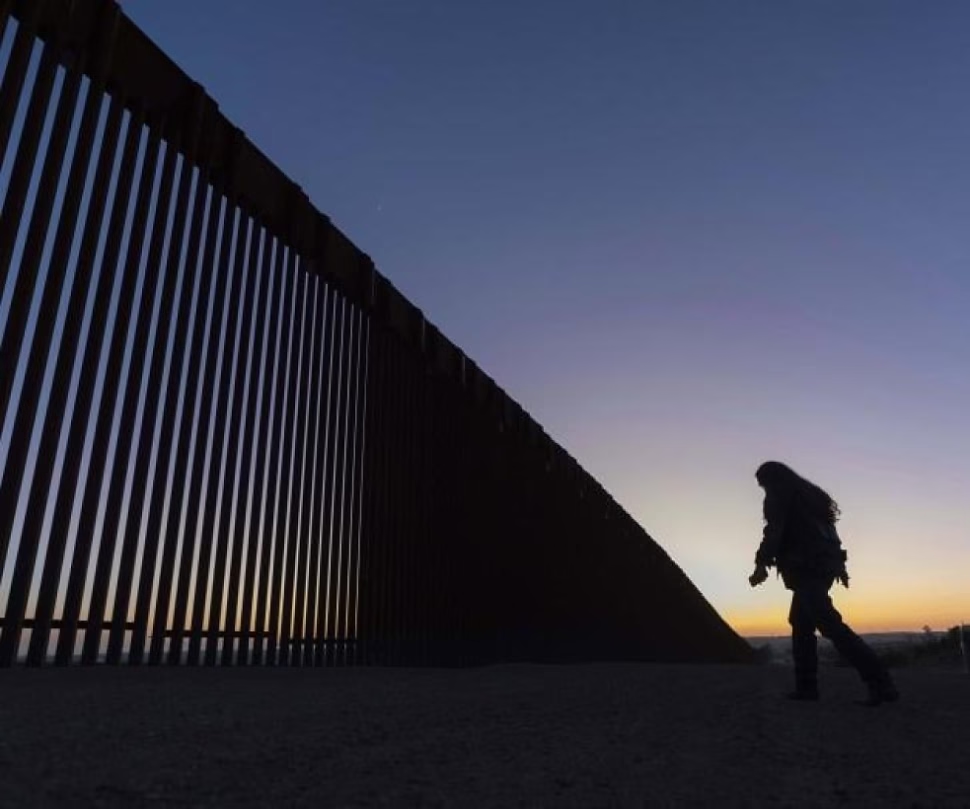
Federal judge blocks Trump order restricting asylum at border

A federal judge challenges Trump's controversial asylum order, marking a crucial shift in immigration policy.

A verdict that shakes the foundations of immigration policy

In a dramatic turn that could alter the fate of thousands of desperate souls, a federal judge has challenged the president of the United States himself. Donald Trump’s order, which sought to seal the asylum doors on the southern border as if it were an insurmountable wall, has been declared illegal. Yes, illegal! Judge Randolph Moss, with a pen sharper than the sword of justice, has made it clear that neither the Constitution nor the immigration laws grant the president absolute powers to deny refuge to those fleeing the horror.

A fleeting respite for migrants

But, be careful! The destiny is not yet written. Moss, in a gesture that mixes clemency and strategy, has postponed the effects of his ruling for two weeks. The reason? Give the Trump administration one last chance to appeal, as if it were a villain clinging to its last resort. The Department of Homeland Security, in deafening silence, has not said a word, but everyone knows that the legal battle is far from over.

RelatedMexico defends its political asylum in the face of Peruvian breakup

On January 20, Trump had declared in epic tones that the southern border faced an “invasion”, and with a decree worthy of a monarch, he suspended access to asylum. But now, his plan is faltering. Moss, appointed by Barack Obama, has made clear in a 128-page ruling—128 pages of pure justice!—that the president cannot ignore the laws of Congress, no matter how much he shouts “invasion” from the rooftops.

Lee Gelernt, the brave lawyer of the American Civil Liberties Union, has raised his voice like a hero in the midst of the storm: “This decision means protection for those fleeing unimaginable dangers.” His words resonate like an echo of hope in a world where power seems to corrupt everything.

A decrease in crossings, but the war continues

Meanwhile, the numbers paint an intriguing picture: Border arrests have plummeted. In June, the Border Patrol recorded only 6,070 arrests, 30% fewer than in May. And on June 28, only 137! A figure that pales in comparison to the more than 10,000 daily arrests at the end of 2023. Is this a temporary victory for Trump or the prelude to a new wave?

The government insists it faces “enormous challenges” and an “overwhelming backlog” in asylum applications. But Judge Moss is not intimidated: the laws are above presidential whims. Will the administration be able to reverse this ruling, or will it be remembered as the beginning of the end of a draconian immigration policy?

The clock is ticking, appeals are being prepared and the fate of thousands hangs in the balance. The next legal battle promises to be as epic as the one that has just been fought.

Are you passionate about this topic? Share this story on your social networks and join the conversation about one of the most crucial debates of our time. Explore more related content and stay informed!
The United States and Iran intensify attacks; oil rises

New attacks between Washington and Tehran raise tension and affect energy markets.

Escalation between the United States and Iran

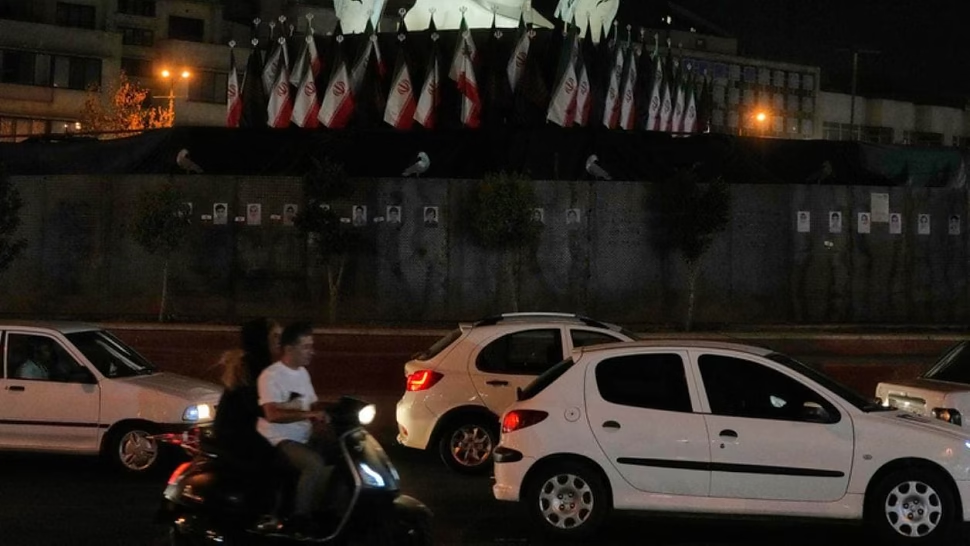
The United States launched a new round of airstrikes against Iran at the beginning of the week, hours after confirming the death of another American soldier. Iran responded with offensives against Kuwait, Jordan and Bahrain, where the US Navy’s Fifth Fleet is located.

The provisional ceasefire agreement signed last month has fallen apart. Maritime traffic in the Strait of Hormuz, a vital route for global energy, is practically paralyzed. Both sides have attacked civilian infrastructure on which millions of people depend.

Impact on energy markets

The violence sent oil prices soaring. Brent crude oil surpassed $88 per barrel, and regular gasoline in the US rose to $1.05 per liter, putting pressure on consumers ahead of the November legislative elections.

The US Central Command said its ninth consecutive night of strikes targeted Iranian command centers, anti-aircraft batteries and surveillance facilities. The IRNA agency reported at least one death near Tabriz. Other locations were also reached.

The British Maritime Trade Operations Center reported a second ship attacked in the Strait of Hormuz, which was left adrift and on fire. The Iranian Revolutionary Guard claimed responsibility for attacks on oil tankers in the area.

Tehran also attacked countries allied with the US. Kuwait said its anti-aircraft defenses fired against an incoming barrage. Jordan reported that it shot down three Iranian missiles without damage. Bahrain condemned Iranian drones against its air traffic system.

Yemen’s Houthis, backed by Iran, announced a maritime embargo against Saudi Arabia in the Red Sea, an alternative route for crude oil exports.

Diplomatic efforts

Pakistan intensified efforts to revive the truce. Iran’s Interior Minister Eskandar Momeni arrived in Islamabad for talks with Prime Minister Shehbaz Sharif. His Pakistani counterpart, Mohsin Naqvi, expressed optimism: “God willing, we will have good news.”

Secretary of State Marco Rubio said the US remains open to negotiating with Iran, but “it has to be real.” He noted that the door to diplomacy would be if those who want something productive for Iran take control.

Iranian authorities reported at least 50 deaths and 517 injuries in recent rounds of US attacks. Since the conflict began on February 28, 17 US service members have died.

Continue reading

Hamas elects Khalil al-Hayya as new political leader

The Palestinian movement appoints Sinwar's dolphin in an internal vote.

The new leadership of Hamas

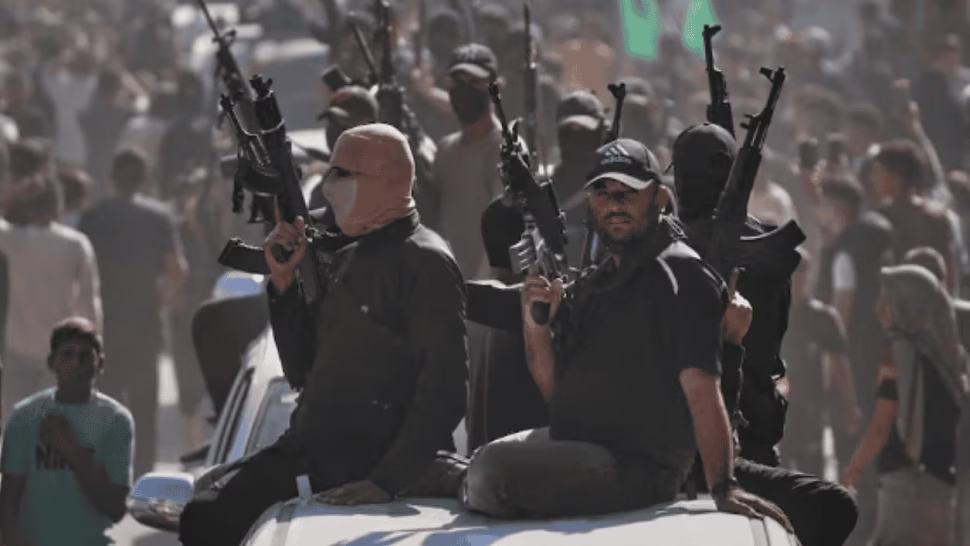
The Palestinian organization Hamas announced the election of Khalil al-Hayya as head of its political office. The position had been vacant since October 2024, when Yahya Sinwar was killed in an Israeli operation in Rafah.

Al-Hayya prevailed over Khaled Mashal in an internal vote that the organization described as “highly complex and secret for security reasons.” Representatives of Palestinians detained in Israeli prisons also participated.

According to internal sources cited by agencies, Al-Hayya won “by an overwhelming majority.” However, the Qatari newspaper Al-Araby reported that the difference was “barely one vote,” citing another movement source.

Continuity in the political line

The appointment of Al-Hayya implies continuity with the strategy of Sinwar and the previous leader, Ismail Haniyeh, who also died in an Israeli operation in Tehran in July 2024. Both maintained alignment with the so-called “axis of resistance” led by Iran, despite the fact that Hamas has a Sunni majority.

His arrival reinforces Gaza as the central axis of the Palestinian cause, in contrast to the current of Mashal, born in the West Bank and considered closer to Qatar and Turkey. During his leadership until 2017, Mashal broke with Syrian President Bashar al Assad, distancing the movement from the Iranian axis.

At the same time, Hamas has reinforced its presence in its headquarters in Istanbul, to the detriment of its center in Doha.

Impact on negotiations with Israel

Al-Hayya, 64, is a founder of Hamas and was Sinwar’s top deputy in Gaza. Before October 7, he left the Strip on instructions from Sinwar to direct affairs from abroad. According to The New York Times, in July 2023 he discussed attack plans with a general in the Iranian Revolutionary Guard.

He has survived several attacks attributed to Israel, including one in Doha in September 2025 where his son Hamman died. Three other children also died in Israeli attacks.

Currently, Al-Hayya is Hamas’ main negotiator in indirect contacts with Israel, which last October led to a ceasefire agreement and the release of hostages. He has met personally with US envoys Steve Witkoff and Jared Kushner.

In the talks that continue in Cairo, Al-Hayya maintains an inflexible position and rejects the disarmament of Hamas. According to various assessments, the stalemate could lead to a new Israeli offensive on the Strip.

Continue reading

The US accuses Cuba of historical infiltration and espionage

The US accuses Cuba of decades-long infiltration of its government. Havana denies it.

Washington’s accusations against Havana

The United States Department of State has denounced that Cuba carried out an espionage campaign for decades. According to the official report, Havana managed to infiltrate the highest levels of the US government.

“Cuba infiltrated the highest levels of the US government, recruited and trained generations of activists, and supported an unprecedented wave of left-wing political violence on US soil,” the document states.

The report calls the operation “one of the most protracted and damaging foreign intelligence infiltrations in U.S. history.” He adds that the Cubans developed a model of attrition based on espionage, sabotage and networks of allies.

Secretary of State Marco Rubio reiterated these accusations in a meeting with officials from more than 60 countries. “The intelligence and ideological networks of the Cuban regime helped build the extreme left in our country and in the hemisphere,” he stated.

Context of political pressure

The accusations are part of the growing pressure from Donald Trump’s administration against Cuba. In May, President Trump issued an executive order calling the island an “unusual and extraordinary threat” to US national security, expanding sanctions.

Cuba faces its worst economic crisis in decades and has vigorously rejected the accusations. Cuban authorities insist that the country does not represent a threat to the United States.

Tensions between both countries date back to the triumph of the Castro revolution in 1959. Since then, Washington imposed sanctions, there were attempts to attack Fidel Castro and Havana supported guerrilla movements in Latin America and the Caribbean. The current report revives that history of confrontation.

Continue reading