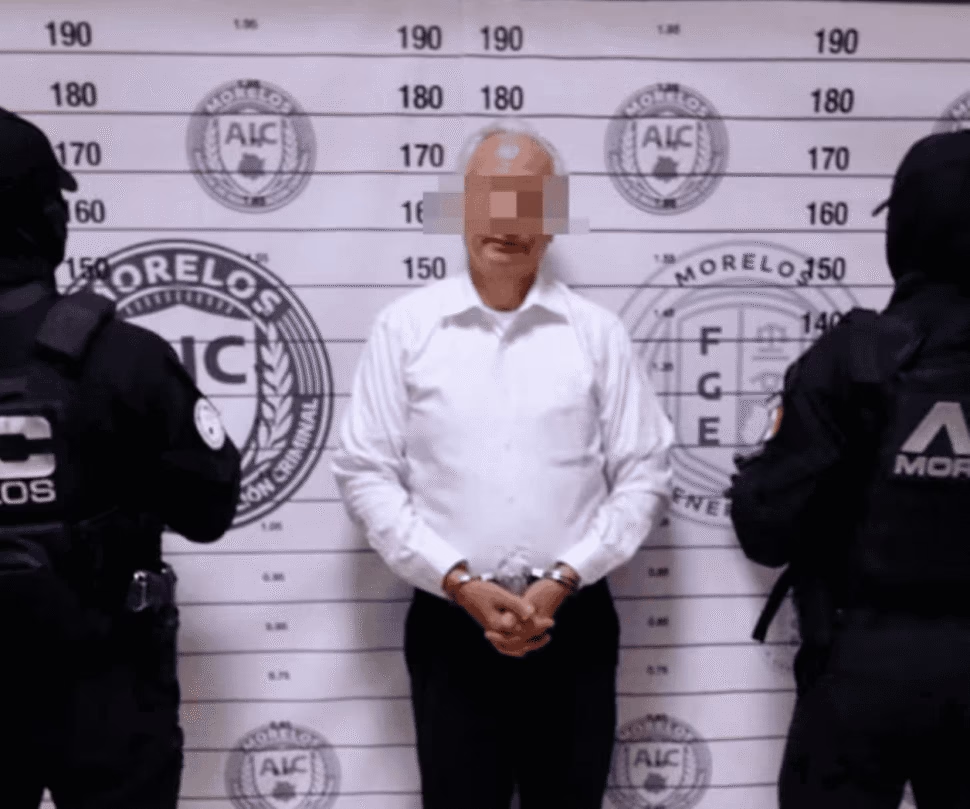
Former director of Pemex faces trial for family violence

The judge linked the former director of Pemex to the trial, but the victim's forgiveness opens the door to an alternative solution.

The specialized Control judge, Adriana Correa, issued an order to bring proceedings against Víctor Rodríguez Padilla, former director of Petróleos Mexicanos (Pemex), for the crime of family violence to the detriment of his wife, María Felicia Jiménez Lavie, and his minor son.

Forgiveness without legal value

The case took an unexpected turn: the defense presented a document signed by the victim in which he granted forgiveness to Rodríguez Padilla and requested not to continue with the process to seek reconciliation. However, the judge rejected the document, considering that it has no probative value, since the crime is prosecuted ex officio and the signature is not legally certified.

RelatedVíctor Rodríguez, former director of Pemex, arrested for family violence

Imputation for vicarious violence dismissed

The judge dismissed the charge of vicarious violence. He argued that the evidence did not prove that the former official tried to abduct or retain his son. On the contrary, it was proven that he lived with the minor days after the attack against his partner.

Next steps

The defense requested the conditional suspension of the process, which would allow Rodríguez Padilla to remain free. The judge considered the request viable, but conditioned its admissibility on the victim appearing personally to ratify the pardon. For this reason, he summoned a new hearing for this Tuesday at 8:15 a.m.

In addition, he instructed the Prosecutor’s Office to interview María Felicia Jiménez to explain the legal implications of her request. The intermediate hearing, where the evidence from both parties will be analyzed, was set for October 13.

Defense questions evidence

During the hearing, the former director’s lawyers questioned the authenticity of the video of the attack—without audio—and pointed out that there are no eyewitnesses. The judge rejected those arguments: she considered the video as relevant evidence and recalled that family violence usually occurs in private.

Edomex reports a 56% drop in intentional homicides

56% decrease in intentional homicides and 40% in high-impact crimes in Edomex.

The State of Mexico registered a 56% reduction in intentional homicides between September 2024 and June 2026, reported Marcela Figueroa Franco, head of the Executive Secretariat of the National Public Security System (SESNSP).

In the morning conference of President Claudia Sheinbaum in Toluca, Figueroa detailed that the daily average went from 6.6 to 2.8 cases. A 40% drop in high-impact crimes was also highlighted, going from 181.2 to 109 crimes per day.

Impact of the Comprehensive Plan

The official attributed these results to the unified command of the Comprehensive Plan for the Eastern Zone, implemented in 15 municipalities since March 2025.

“There is a 56% decrease in the daily average in intentional homicides, going from 6.6 intentional homicides per day in September 2024 to 2.8 in June 2026,” he stated.

In addition, he pointed out that the graph shows “a visible decrease, particularly since the implementation of this Eastern Plan.”

The figures reflect the state government’s commitment to improving security in the region through targeted strategies. The SESNSP continues to monitor the crime incidence to sustain the downward trend.

Continue reading

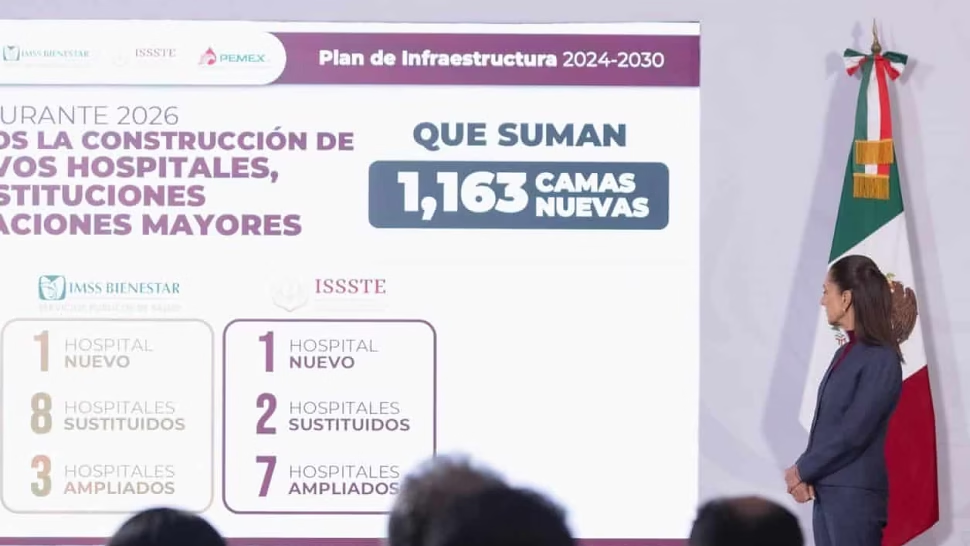
Government will build 50 new hospitals by 2030

National plan adds 9 thousand beds in six years with an investment of 181 thousand million pesos.

Historic growth in hospital beds

President Claudia Sheinbaum announced that the National Hospital Infrastructure Plan—with 181 billion pesos—will allow the number of beds to go from 96,966 to 106,105 in six years. It is the largest increase since records began.

The plan includes 152 projects: 50 new hospitals, 47 expansions and 55 replacements or major improvements. The IMSS will have 13,300 new beds, which seeks to reverse the backwardness of the neoliberal period, when in 36 years only 4,300 beds were built.

Eduardo Clark, Undersecretary of Sectoral Integration, explained that 30 projects with 1,474 beds in operation have already been completed: seven IMSS hospitals, 19 from IMSS Bienestar and four from ISSSTE. During 2026, 33 more projects will be added, with 1,163 beds, reaching 29 percent of the six-year goal.

Progress by institution

The director of ISSSTE, Martí Batres, reported that 20 hospitals will be rehabilitated during the six-year period. Four have already been inaugurated; nine are in process, including the General Hospital of Tampico (98 percent progress) and the Regional High Specialty Hospital of Oaxaca (55 percent).

Zoé Robledo, from the IMSS, pointed out that by 2030 47 hospitals will be operational. Seven are already operating and 21 are under construction; of these, ten will open in the next ten months.

Alejandro Svarch, from the IMSS Bienestar, detailed an investment of 46.8 billion pesos for 87 projects: 43 hospitals—eight new and 35 replacements—21 rehabilitated and 23 expanded health centers. In addition, 8,483 units will be modernized with the “The Clinic is Ours” program.

Sheinbaum added that the Universal Health Service will be implemented to guarantee care regardless of eligibility, along with the hiring of more specialist doctors.

Continue reading

Senate reform seeks safe reception for deported migrants

Morena's initiative proposes a clear protocol to receive returnees, especially minors.

Immigration reform in the Senate

The Senate is analyzing a proposal to guarantee an orderly and safe reception of Mexicans repatriated from the United States. The initiative – promoted by Senator Olga Patricia Sosa (Morena) – seeks to prevent thousands of people, including children and adolescents, from reaching the border in vulnerable conditions.

According to the text, the National Migration Institute (INM) must issue a certificate of reception and safe channeling when receiving repatriated, returned or foreigners readmitted by Mexico. The goal is to establish a clear protocol that protects your well-being.

The proposal arises in a context of increase in migratory flows. Minors are the main focus of the measure, due to their special vulnerability. With this reform, the Senate seeks to mitigate the risks and ensure adequate reintegration in the country.

Continue reading