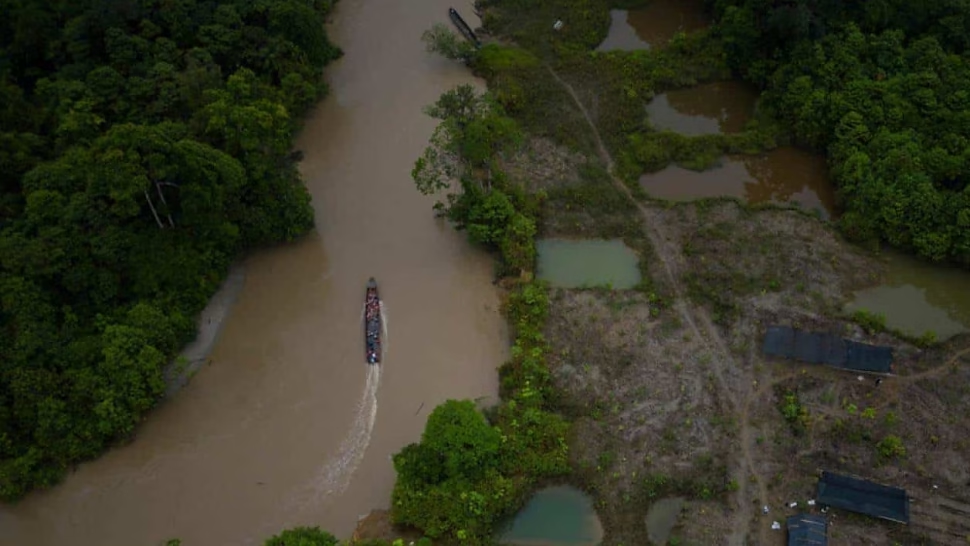
The United States intensifies anti-drug offensive with attacks in the Pacific

An unprecedented day marks the highest point of the controversial military strategy, generating strong reactions among regional allies.

An Unprecedented Day in the Anti-Drug Offensive

In an announcement that marks a turning point in the security strategy, the Secretary of Defense of the United States, Pete Hegseth, revealed this Tuesday the execution of three consecutive military operations in the eastern Pacific Ocean. These interventions, directed against four suspected drug trafficking vessels, resulted in the death of fourteen alleged drug traffickers and one survivor, constituting the deadliest day since the beginning of the controversial campaign of President Donald Trump’s government against drug trafficking in South American waters.

This is the first time that multiple actions have been reported in a single day, representing a significant escalation in the pace and intensity of the attacks. The campaign, which spans almost two months along with an increase in the US military presence, has generated increasing diplomatic tension with traditional allies in the region and has fueled speculation about whether the ultimate goal of these measures is to bring about the overthrow of Venezuelan President Nicolás Maduro, whom Washington has publicly accused of narcoterrorism.

RelatedThe United States carries out its first anti-drug attack in the Pacific off Colombia

Coordination and Controversy in the Response

According to a Pentagon statement provided by an official who spoke on condition of anonymity, the strikes were carried out on Monday off the coast of Colombia. After neutralizing one of the boats, US forces spotted a person alive in the water, clinging to the remains of the boat. Immediately, the Army transmitted the precise location of the survivor to the United States Coast Guard and a Mexican military aircraft that was operating in the area, according to the source.

Secretary Hegseth stated that the Mexican authorities “assumed responsibility for coordinating the rescue” of the individual, although he refrained from specifying whether the person had already been rescued, whether he would remain in Mexican custody or whether he would be transferred to the United States for interrogation or legal processing.

However, the Mexican Navy Secretariat (Semar) reported on Tuesday, a day after the operations, that it was still carrying out a search and rescue operation. These new attacks unleashed a new wave of criticism from this regional ally. The Mexican president, Claudia Sheinbaum, expressed her disagreement with these actions in her morning press conference and revealed that she had instructed the Secretary of Foreign Affairs and the Navy to meet with the US ambassador in Mexico. “We want all international treaties to be respected,” the president stressed.

Semar, through its official account on the social network

An Increasingly Tense Diplomatic Panorama

The military offensive has also deteriorated relations with other historical partners such as Colombia, a country whose intelligence is essential for United States counternarcotics operations in the region. In a growing confrontation between the Republican president and Colombia’s first leftist leader, the Trump administration last Friday imposed sanctions on President Gustavo Petro, his family and a member of his cabinet, accusing them of participating in the global drug trade.

President Petro openly criticized the attacks on social network X, arguing that they represent a disproportionate use of force, turning “casualties into murders.” From Saudi Arabia, the Colombian president questioned whether the true objective of the United States is the seizure of cocaine and suggested that in reality an “invasion is intended, which is also absurdly illegal and aims more at oil than at defending North American society from illicit drugs.”

To support the actions, Hegseth published audiovisual material of the attacks on his social networks, where two speed boats can be seen moving at high speed, one of them visibly loaded with a large number of bales. Both boats suddenly explode and are engulfed in flames. A third attack appears to show a pair of nearly empty boats, with at least two people moving around in them moments before an explosion consumes them. The Secretary of Defense added that “the four boats were known to our intelligence apparatus, traveling along known drug trafficking routes and transporting narcotics.”

However, the Trump administration has so far not presented public evidence to support its claims about the connection of these ships to drug trafficking groups or about the identity of the people killed in these operations, which began in early September and until now occurred several weeks apart.

Interested in understanding how global events impact geopolitics and the economy?Share this analysis on your social networks and explore more content on international relations and security on our site to stay informed.

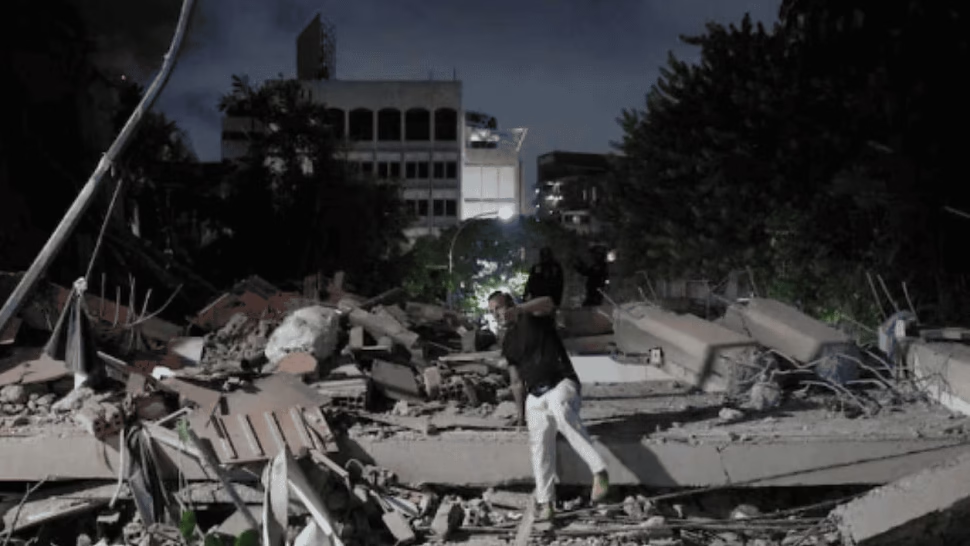
Double earthquake in Venezuela leaves 164 dead

Two earthquakes of magnitude 7.2 and 7.5 hit the north of the country with serious damage.

Earthquakes in Venezuela: more than 160 dead and international call

Two earthquakes of magnitude 7.2 and 7.5 shook northern Venezuela on Wednesday afternoon, leaving at least 164 dead and nearly a thousand people injured, according to President Delcy Rodríguez. The most affected region is the state of La Guaira, with “dozens” of collapsed buildings.

“We can say that the state of La Guaira is a true tragedy and is becoming a disaster zone,” declared Rodríguez.

The United States Geological Survey (USGS) estimates that the final number of victims could be between 10,000 and 100,000, with a 42% probability. It warns that aftershocks of magnitude greater than 6 are almost certain to occur. Economic damages could reach between $10 billion and $100 billion.

US Secretary of State Marco Rubio said the immediate priority is to clear debris and rescue possible survivors in the first 48 hours.

“We are sending search and rescue teams from Virginia and Los Angeles. Others will join,” he said from Bahrain.

Rubio added that the Venezuelan airport suffered severe damage, so the Department of Defense must coordinate the sending of humanitarian aid. Countries such as Qatar, Chile and El Salvador have already offered support.

Local authorities continue rescue efforts as the country faces one of the worst natural disasters in its recent history.

Continue reading

SRE rules out Mexicans affected after earthquakes in Venezuela

SRE reports that there are no Mexicans affected by earthquakes in Venezuela.

The Ministry of Foreign Affairs (SRE) reported that, as of this Wednesday afternoon, there were no reports of Mexican people affected by the earthquakes registered in Venezuela.

No effects reported

Through a statement, the Foreign Ministry expressed its solidarity with the Venezuelan people and regretted the damage that had occurred.

“The Ministry of Foreign Affairs expresses all its solidarity with the Venezuelan people and deeply regrets the damage and harm caused,” said the agency headed by Roberto Velasco.

The Mexican embassy in Venezuela remains attentive to the development of the situation. So far, there are no compatriots who have required assistance.

Support channels

For those who need consular protection, the Mexican representation has enabled the emergency number: +58 412 2524675. The authorities recommend staying calm and following local instructions.

The international organization continues to monitor possible aftershocks. For now, no changes are expected in travel recommendations for Mexicans in the region.

Continue reading

Colombia and the Amazon: a turn towards extractive development

De la Espriella's triumph in Colombia raises questions about the future of the Amazon rainforest in the region.

Abelardo de la Espriella’s victory in Colombia’s presidential elections marks a possible change in environmental policy in the region. The businessman, backed by Donald Trump, defeated Iván Cepeda by just 251,000 votes, according to official results.

What will happen to the Amazon?

The Amazon rainforest, which absorbs carbon dioxide and slows climate change, faces a new scenario. Around 40% of Colombian territory is in the Amazon basin. During the government of Gustavo Petro, the country positioned itself as a defender of the jungle. De la Espriella promises to reactivate the oil sector, support fracking and further exploit natural resources.

Elizabeth Dickinson of the International Crisis Group noted that many governments now believe that economic development and conservation can move forward together. However, environmentalists warn that expanding fossil fuel production could increase pressure on sensitive ecosystems.

Peru and Brazil also join this trend. Keiko Fujimori, close to winning in Peru, supports mining. In Brazil, the election between Flávio Bolsonaro and Lula will define the direction of deforestation. Cristiane Mazzetti of Greenpeace Brazil said: “The elected administration sets budget priorities and regulates exploitation. The result is measurable, as shown by the rate of deforestation.”

Illegal gold mining is one of the biggest drivers of destruction in the Amazon. Dickinson added: “It’s very hard to disagree with going after illegal mining, one of the most damaging industries.” But he warned that governments often focus on seizing equipment, without dismantling criminal networks.

Julio Cusurichi, indigenous leader in Peru, stated: “Biodiversity and our territories can help climate change. In our territories we do governance for the planet.” Indigenous organizations denounce that governments do not adequately consult them before approving extractive projects.

Analysts such as Sergio Guzmán indicate that environmental concerns will compete with economic ones. “Many emissions concerns will take a backseat to energy self-sufficiency,” he said. He also mentioned that aerial fumigation of coca crops could resume, affecting Amazonian communities.

In Leticia, the Ticuna indigenous Arnaldo Rufino expressed his fear: “That means cutting down the trees that allow humanity to breathe.” The future of the Amazon will depend on the decisions made by the new governments in the region.

Continue reading