The Senate defines the economic future of Mexico

The fate of taxes and the national budget is decided this week in the Senate. Everything is at stake.

The Week in which the Senate Plays with Our Money

Attention, attention, people. Get ready for another season of that series we all love to hate: “The Circus of National Politics”. This week, in the Senate of the Republic, our beloved legislators will put on their overalls (figuratively, we hope) to fix the country’s finances. Or, at least, that’s what they say they will do. The main plot revolves around four supersexy documents: the minutes of the Economic Package 2026. Basically, it’s the script that will dictate how the government is going to collect and spend our wool next year. Spoiler alert: it probably won’t end with a tax cut for everyone.

At the center of this bureaucratic whirlwind is Laura Itzel Castillo Juárez, the president of the Board of Directors, who with the elegance of an influencer announcing a collaboration, informed us through social networks that an intense week awaits us. And no, it does not refer to a marathon of a series on Netflix. Between the tax paperwork, they will also find time to blow out the candles for the 80th anniversary of the UN. Because nothing says “international celebration” like sandwiching it between debates about gasoline taxes and excise duties. It’s the government equivalent of having to do your homework right in the middle of a party.

RelatedSenate begins analysis of the Economic Package for 2026

The Protagonists of the Fiscal Function

And what are they really going to “discuss and vote”? Let’s get technical for a second, which I know you love. These are the draft decrees to reform the Federal Tax Code (the Treasury’s instruction manual), the Federal Law of Rights and the Special Tax Law on Production and Services (those laws that make your beer and gasoline cost what they cost). The icing on the cake is the project to issue the Income Law of the Federation for 2026. In Christian terms: they are deciding where to get the money from and what to spend it on. A minor detail, right?

While ordinary citizens debate between paying the rent and deciding whether ordering food at home is a necessity or a luxury, the Senate has in its hands the analysis and approval of the income of the entire nation. It is a sobering reminder that, while we make budgets with cell phone apps, they do so with laws and decrees that affect millions. Senator Castillo Juárez, in a plot twist that no one expected, confirmed that between Tuesday and Wednesday these four minutes will be removed. Cross your fingers that you don’t get distracted by a meme in the middle of the session.

So you already know. This week, Mexico’s economic future is decided between marathon sessions, historical commemorations and, with a little luck, the occasional speech for the archive. A high-budget drama live and direct from the Upper House.

Are you curious about how these decisions will affect your portfolio?Share this note and let’s make this important topic reach more people. And if you want to keep up with today’s snarkiest breakdown, explore more of our content.
Imports of Mexican cattle to the US resume

Following a health agreement, the US will reopen the port of Douglas, Arizona, for Mexican cattle.

President Claudia Sheinbaum reported that the United States will resume importing Mexican cattle starting the last week of August. The decision came after an official communication from the US Secretary of Agriculture, Brooke Rollins.

Reopening schedule

The reopening will begin at the border port of Agua Prieta, Sonora, linked to the Douglas crossing, Arizona. August 24 will be the first date of operation. Later, two additional points will be enabled in Chihuahua, subject to compliance with the Joint Action Plan against screwworm.

Sheinbaum instructed federal agencies to accelerate coordination with US authorities. He highlighted the work of the Secretary of Agriculture, Julio Berdegué, and the director of Senasica, Columba López, to strengthen health measures.

  • The animals will enter with complete inspections to verify that they do not show signs of the plague.
  • Later, the opening of the ports of Santa Teresa and Columbus, in New Mexico, will be evaluated.

The president described the news as positive for Mexican ranchers, who for months contained the spread of the screwworm. He appreciated Rollins’ willingness to maintain an institutional relationship.

Rollins, for his part, stated that the protection of the US livestock industry remains a priority and that the temporary closure of crossings was necessary to reduce risks. The reopening is possible thanks to binational collaboration.

Continue reading

More than eight million apocryphal cigarettes seized in Manzanillo

Joint operation in Manzanillo detected shipment of counterfeit cigarettes.

Operational in the port of Manzanillo

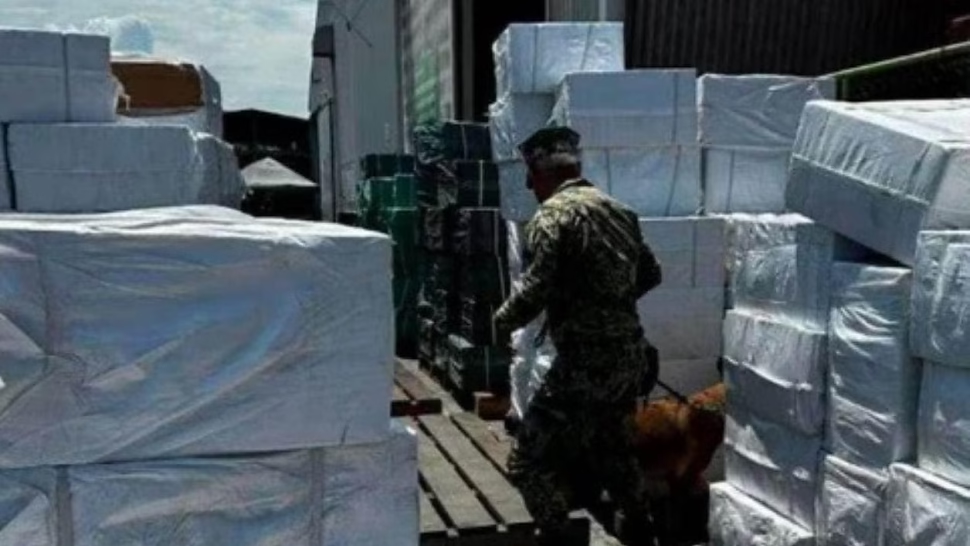
Federal authorities seized more than eight million allegedly apocryphal cigarettes in the port of Manzanillo, Colima. The operation was coordinated by agencies of the security cabinet and the National Customs Agency of Mexico (ANAM).

Personnel from the ANAM and the Administrative Unit of the Manzanillo Customs detected inconsistencies in an operation to import cigarettes from abroad. This led to a specialized review.

As a result of the inspections, the authorities located 8 million 436 presumably counterfeit cigarettes. The merchandise was insured with the support of the Secretary of the Navy (Semar).

The ANAM reported that this type of operations are part of the permanent mechanisms of operational intelligence, risk management and strategic analysis. The objective is to strengthen security in foreign trade operations and detect documentary irregularities or goods of illicit origin.

The comprehensive analysis of the operation made it possible to reinforce documentary traceability, operational review and validation of commercial profiles. The authorities maintain surveillance at entry points into the country to combat illegal trade.

Continue reading

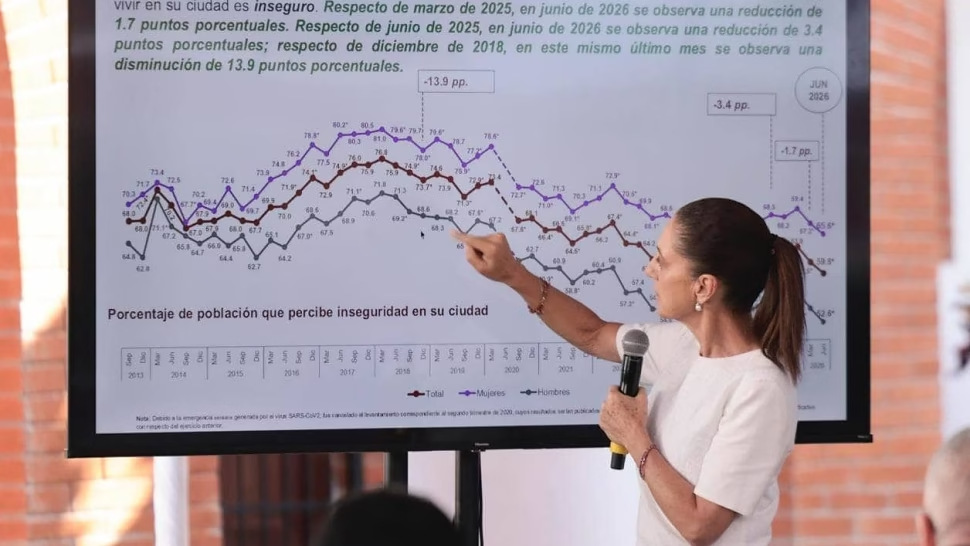
Perception of insecurity drops to 59.8%: Sheinbaum

Perception of insecurity in Mexico drops to 59.8%, the lowest figure since 2018.

ENSU results

President Claudia Sheinbaum reported that the perception of insecurity in urban areas fell to 59.8% in June 2026, according to the National Urban Public Security Survey (ENSU) of the INEGI. In December 2025 it was 63.8%, which represents six consecutive months of decline.

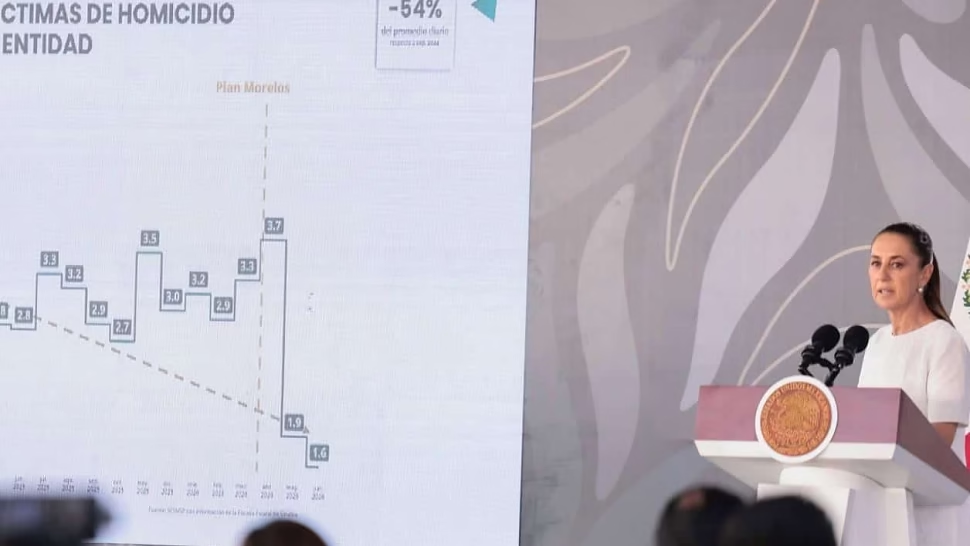
“The important thing here is that we are giving results in the security indicators and people are beginning to notice this decrease,” he said during the morning conference in Cuernavaca, Morelos.

Historical comparison

Sheinbaum recalled that in December 2018, under the government of Andrés Manuel López Obrador, the perception of insecurity was 73.7%. The previous lowest point was reached in September 2024 at 58.6%. The president attributed the improvement to the National Security Strategy.

The ENSU measures citizens’ feeling of insecurity in their environment. Recent data reflects a positive trend, although the challenge remains to maintain the reduction in crime. The authorities continue to implement actions to consolidate these results.

Continue reading