The peso plummets after the US attack on Iran

The Mexican peso falters while the world awaits Iran's next move after the US attack.

The Mexican peso: collateral victim of the geopolitical drama

Ah, Monday. That day when we all come back to reality after a weekend of pretending the world isn’t on fire. And today, the Mexican peso decided to add to the drama with a depreciation of 0.28%, closing at 19.23 per dollar, because what better way to start the week than with a financial roller coaster?

According to Bloomberg (those wise men with numbers), the Mexican currency reached a maximum of 19.29 units before plummeting, as if it were the rating of a Netflix series after a weak third season. The reason? The escalation of tensions in the Middle East after the United States attack on Iran’s nuclear facilities. Because, of course, what could go wrong?

RelatedThe Mexican peso plummets amid the global financial storm

The dollar puts on the crown (again)

While the peso cries in a corner, the dollar index appreciates 0.58%, because the greenback always finds a way to win, like that friend who always arrives late but still gets a table at the restaurant. The euro and the pound, on the other hand, are like us after paying the rent: in free fall (0.49% and 0.43%, respectively).

But not everything is tragedy. bitcoin, that cryptocurrency we all love to hate and hate to love, rose 0.4%, proving once again that it is more resilient than our excuses for not going to the gym.

Wall Street and the rest of the world: a controlled disaster

Global stock markets are more confused than us choosing what to stream. With a negative bias after the attack on Iran, the Dow Jones fell by 0.03%, while in Europe the Euro Stoxx 600 fell by 0.37%. Asia, for its part, closed mixed: the Nikkei lost 0.13%, but the Han Seng rose by 0.67%, because someone had to oppose it.

And speaking of being contrary, WTI oil (that liquid that moves the world and our gasoline bills) fell 0.5%, because the fear of a supply interruption fades faster than our motivation in January. Of course, industrial metals rise, while precious metals fall, because in this economy even gold has bad days.

What’s next? More uncertainty, of course

Investors are as attentive to Iran’s response as we are to the next chapter of our favorite series. Will they close the Strait of Hormuz? Will there be more attacks? Will oil go up? These are the questions that keep the markets more nervous than an influencer without filters.

Meanwhile, on Wall Street futures point to a mixed opening, because in this game no one wants to fully commit. And you, have you already reviewed your portfolio or do you prefer to continue pretending that money does not exist?

Did you like this meme-flavored financial summary? Share it on your networks and continue exploring more content that explains the economic chaos without boring you to tears. #SurvivingMonday
SRE rules out Mexicans affected after earthquakes in Venezuela

SRE reports that there are no Mexicans affected by earthquakes in Venezuela.

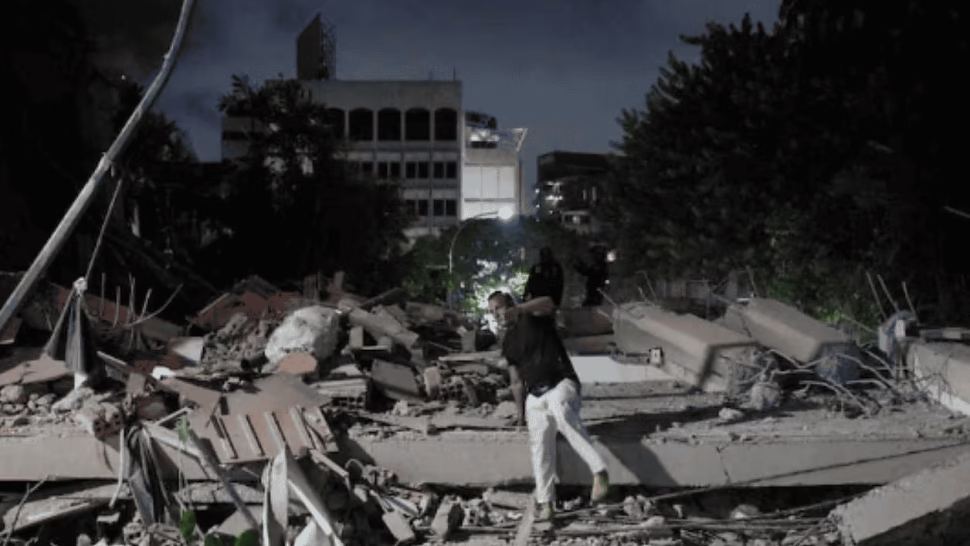
The Ministry of Foreign Affairs (SRE) reported that, as of this Wednesday afternoon, there were no reports of Mexican people affected by the earthquakes registered in Venezuela.

No effects reported

Through a statement, the Foreign Ministry expressed its solidarity with the Venezuelan people and regretted the damage that had occurred.

“The Ministry of Foreign Affairs expresses all its solidarity with the Venezuelan people and deeply regrets the damage and harm caused,” said the agency headed by Roberto Velasco.

The Mexican embassy in Venezuela remains attentive to the development of the situation. So far, there are no compatriots who have required assistance.

Support channels

For those who need consular protection, the Mexican representation has enabled the emergency number: +58 412 2524675. The authorities recommend staying calm and following local instructions.

The international organization continues to monitor possible aftershocks. For now, no changes are expected in travel recommendations for Mexicans in the region.

Continue reading

Colombia and the Amazon: a turn towards extractive development

De la Espriella's triumph in Colombia raises questions about the future of the Amazon rainforest in the region.

Abelardo de la Espriella’s victory in Colombia’s presidential elections marks a possible change in environmental policy in the region. The businessman, backed by Donald Trump, defeated Iván Cepeda by just 251,000 votes, according to official results.

What will happen to the Amazon?

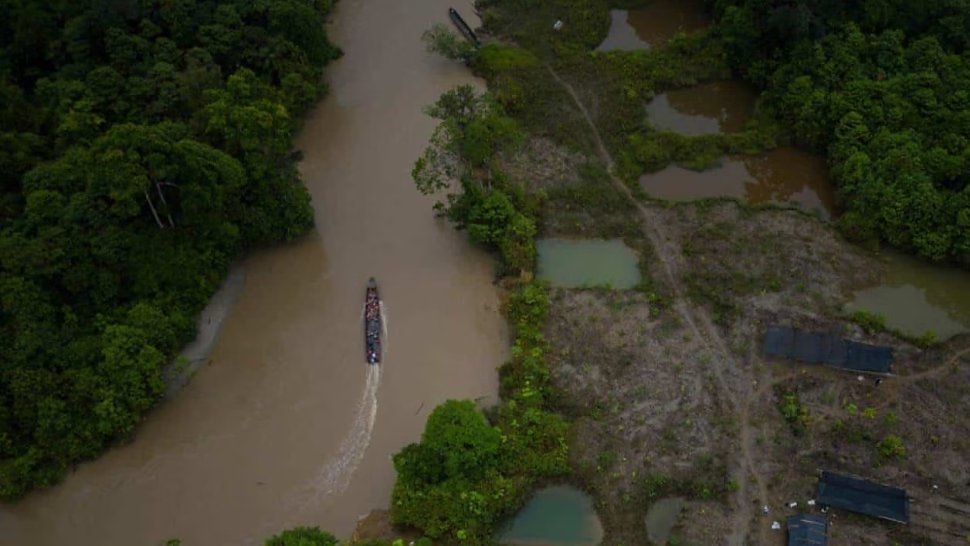
The Amazon rainforest, which absorbs carbon dioxide and slows climate change, faces a new scenario. Around 40% of Colombian territory is in the Amazon basin. During the government of Gustavo Petro, the country positioned itself as a defender of the jungle. De la Espriella promises to reactivate the oil sector, support fracking and further exploit natural resources.

Elizabeth Dickinson of the International Crisis Group noted that many governments now believe that economic development and conservation can move forward together. However, environmentalists warn that expanding fossil fuel production could increase pressure on sensitive ecosystems.

Peru and Brazil also join this trend. Keiko Fujimori, close to winning in Peru, supports mining. In Brazil, the election between Flávio Bolsonaro and Lula will define the direction of deforestation. Cristiane Mazzetti of Greenpeace Brazil said: “The elected administration sets budget priorities and regulates exploitation. The result is measurable, as shown by the rate of deforestation.”

Illegal gold mining is one of the biggest drivers of destruction in the Amazon. Dickinson added: “It’s very hard to disagree with going after illegal mining, one of the most damaging industries.” But he warned that governments often focus on seizing equipment, without dismantling criminal networks.

Julio Cusurichi, indigenous leader in Peru, stated: “Biodiversity and our territories can help climate change. In our territories we do governance for the planet.” Indigenous organizations denounce that governments do not adequately consult them before approving extractive projects.

Analysts such as Sergio Guzmán indicate that environmental concerns will compete with economic ones. “Many emissions concerns will take a backseat to energy self-sufficiency,” he said. He also mentioned that aerial fumigation of coca crops could resume, affecting Amazonian communities.

In Leticia, the Ticuna indigenous Arnaldo Rufino expressed his fear: “That means cutting down the trees that allow humanity to breathe.” The future of the Amazon will depend on the decisions made by the new governments in the region.

Continue reading

7.1 magnitude earthquake shakes Venezuela and raises alerts

7.1 tremor shakes Venezuela; tsunami warning in Puerto Rico.

7.1 tremor in Venezuela activates tsunami alert

A 7.1 magnitude earthquake was recorded this Wednesday in Venezuela, according to the United States National Oceanic and Atmospheric Administration (NOAA). The earthquake occurred at 22:04 GMT with the epicenter located 21 kilometers east of Morón, in the state of Carabobo.

The depth of the earthquake was 9.6 kilometers, which increased its perception on the surface. NOAA issued a tsunami warning for Puerto Rico and the Virgin Islands, although so far no major damage has been reported in those areas.

Aftershocks and affected areas

The tremor unleashed scenes of alarm in Caracas, where residents took to the streets after feeling the movement. It was also noticed in several cities in Colombia, such as Bogotá, Barranquilla and Bucaramanga, although without serious consequences.

Local authorities evaluate possible effects. Venezuela is located in an area of ​​moderate seismic activity, and events of this magnitude are rare. No casualties or significant structural damage have been reported as of press time.

Continue reading