Pope Francis reappears in style at Easter after overcoming pneumonia

The pontiff surprises with his energy after a critical recovery, while the world celebrates the holiday.

The pontiff returns through the front door (and in a popemobile)

After spending more than a month playing hide-and-seek with death due to bilateral pneumonia, Pope Francis decided that Easter was the perfect time for his great re-entry. And boy did he do it: he appeared in St. Peter’s Square as if he were the protagonist of a viral comeback, blessing babies and riding around in his popemobile as if nothing had happened. The crowd, excited, shouted “Long live the Pope!” as if it were a Taylor Swift concert, but with more incense and less Bad Blood.

A peace speech (and a political cameo)

The pontiff, who delegated the mass but not the drama, appeared on the balcony to give his blessing Urbi et Orbi (that is, “for Rome and the world”, because Latin sounds more elegant). Among flowers donated by the Netherlands (did someone say tulip-mania?), Francis called for peace in Gaza, Ukraine and other places where humanity seems to have forgotten the “thou shalt not kill” manual. In addition, he had time for an express meet & greet with the vice president of the United States, JD Vance, because even in the Vatican you have to do networking.

RelatedCelebrities say goodbye to Pope Francis with emotional messages

Although it was still noticeable that he was having a harder time breathing than a millennial after going up three floors without an elevator, his voice was louder than it had been in weeks. Clear priorities: if you are going to reappear, let it be with style. And if you ask for world peace in the process, even better.

Were you surprised by his recovery? Share this note and celebrate that even dads have second chances.

Double earthquake in Venezuela leaves 164 dead

Two earthquakes of magnitude 7.2 and 7.5 hit the north of the country with serious damage.

Earthquakes in Venezuela: more than 160 dead and international call

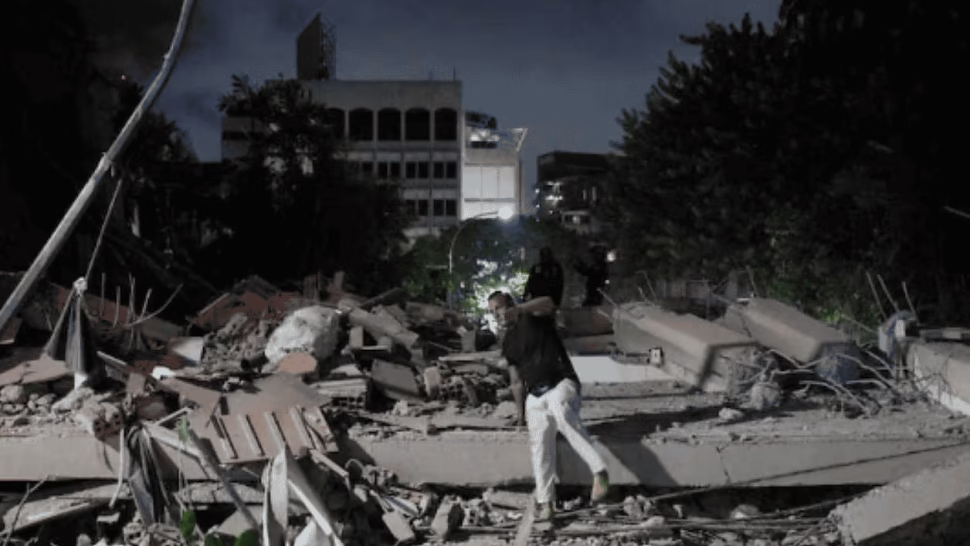
Two earthquakes of magnitude 7.2 and 7.5 shook northern Venezuela on Wednesday afternoon, leaving at least 164 dead and nearly a thousand people injured, according to President Delcy Rodríguez. The most affected region is the state of La Guaira, with “dozens” of collapsed buildings.

“We can say that the state of La Guaira is a true tragedy and is becoming a disaster zone,” declared Rodríguez.

The United States Geological Survey (USGS) estimates that the final number of victims could be between 10,000 and 100,000, with a 42% probability. It warns that aftershocks of magnitude greater than 6 are almost certain to occur. Economic damages could reach between $10 billion and $100 billion.

US Secretary of State Marco Rubio said the immediate priority is to clear debris and rescue possible survivors in the first 48 hours.

“We are sending search and rescue teams from Virginia and Los Angeles. Others will join,” he said from Bahrain.

Rubio added that the Venezuelan airport suffered severe damage, so the Department of Defense must coordinate the sending of humanitarian aid. Countries such as Qatar, Chile and El Salvador have already offered support.

Local authorities continue rescue efforts as the country faces one of the worst natural disasters in its recent history.

Continue reading

SRE rules out Mexicans affected after earthquakes in Venezuela

SRE reports that there are no Mexicans affected by earthquakes in Venezuela.

The Ministry of Foreign Affairs (SRE) reported that, as of this Wednesday afternoon, there were no reports of Mexican people affected by the earthquakes registered in Venezuela.

No effects reported

Through a statement, the Foreign Ministry expressed its solidarity with the Venezuelan people and regretted the damage that had occurred.

“The Ministry of Foreign Affairs expresses all its solidarity with the Venezuelan people and deeply regrets the damage and harm caused,” said the agency headed by Roberto Velasco.

The Mexican embassy in Venezuela remains attentive to the development of the situation. So far, there are no compatriots who have required assistance.

Support channels

For those who need consular protection, the Mexican representation has enabled the emergency number: +58 412 2524675. The authorities recommend staying calm and following local instructions.

The international organization continues to monitor possible aftershocks. For now, no changes are expected in travel recommendations for Mexicans in the region.

Continue reading

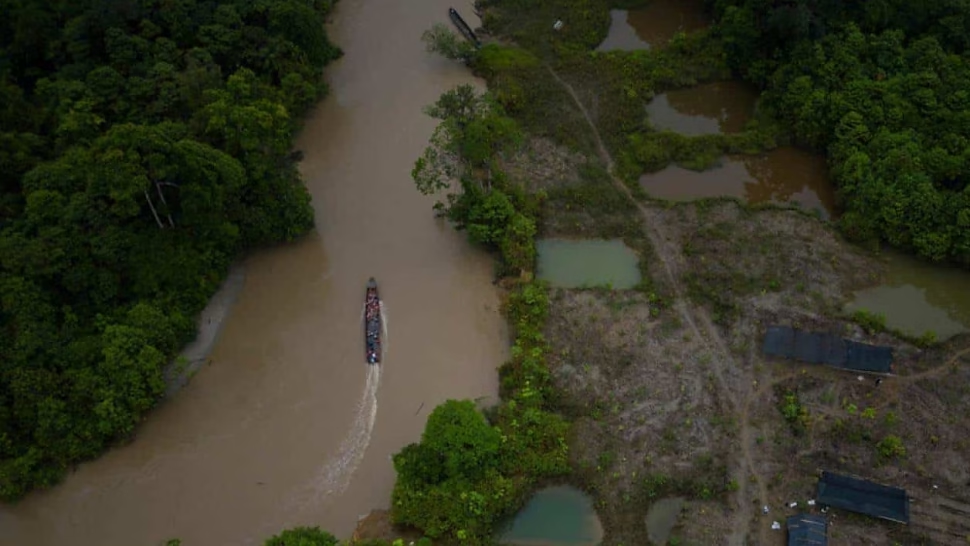
Colombia and the Amazon: a turn towards extractive development

De la Espriella's triumph in Colombia raises questions about the future of the Amazon rainforest in the region.

Abelardo de la Espriella’s victory in Colombia’s presidential elections marks a possible change in environmental policy in the region. The businessman, backed by Donald Trump, defeated Iván Cepeda by just 251,000 votes, according to official results.

What will happen to the Amazon?

The Amazon rainforest, which absorbs carbon dioxide and slows climate change, faces a new scenario. Around 40% of Colombian territory is in the Amazon basin. During the government of Gustavo Petro, the country positioned itself as a defender of the jungle. De la Espriella promises to reactivate the oil sector, support fracking and further exploit natural resources.

Elizabeth Dickinson of the International Crisis Group noted that many governments now believe that economic development and conservation can move forward together. However, environmentalists warn that expanding fossil fuel production could increase pressure on sensitive ecosystems.

Peru and Brazil also join this trend. Keiko Fujimori, close to winning in Peru, supports mining. In Brazil, the election between Flávio Bolsonaro and Lula will define the direction of deforestation. Cristiane Mazzetti of Greenpeace Brazil said: “The elected administration sets budget priorities and regulates exploitation. The result is measurable, as shown by the rate of deforestation.”

Illegal gold mining is one of the biggest drivers of destruction in the Amazon. Dickinson added: “It’s very hard to disagree with going after illegal mining, one of the most damaging industries.” But he warned that governments often focus on seizing equipment, without dismantling criminal networks.

Julio Cusurichi, indigenous leader in Peru, stated: “Biodiversity and our territories can help climate change. In our territories we do governance for the planet.” Indigenous organizations denounce that governments do not adequately consult them before approving extractive projects.

Analysts such as Sergio Guzmán indicate that environmental concerns will compete with economic ones. “Many emissions concerns will take a backseat to energy self-sufficiency,” he said. He also mentioned that aerial fumigation of coca crops could resume, affecting Amazonian communities.

In Leticia, the Ticuna indigenous Arnaldo Rufino expressed his fear: “That means cutting down the trees that allow humanity to breathe.” The future of the Amazon will depend on the decisions made by the new governments in the region.

Continue reading