Analysis of the New Colombian Fiscal Proposal
The Government of Colombia, in a predictable fiscal maneuver given the economic situation, formally presented to the Congress of the Republic this Monday a new tax reform project. This legislative initiative has the primary objective of guaranteeing the financing of the nation’s general budget for the year 2026, responding to the pressing fiscal problems that currently affect the public treasury, which are attributable to a significant contraction in national income.
The Minister of Finance, Germán Ávila, in precise statements to the media, emphasized that the proposal transcends mere immediate collection. “What we are structuring is a proposal that guarantees not only that we finance 2026, but that we are providing macroeconomic stability in the medium term,” said the official, outlining a strategic vision that seeks to cement the country’s financial foundations beyond the short term.
Collection Mechanisms and Impacted Sectors
The articles of the bill focus on the generation of income for an estimated amount of 26.3 trillion pesos, equivalent to approximately 6.3 billion dollars. The analysis of the distribution of the tax burden reveals a deliberate focus on specific economic sectors and population segments with high purchasing power. The proposed collection mechanisms include:
• An increase in tax burdens applicable to online games of luck and chance.
• Adjustments in taxes levied on fossil fuels.
• The elimination of tax exemptions for religious entities (churches).
• An increase in taxes on alcoholic beverages (liqueurs).
• The implementation of additional taxes for the financial establishments sector.
• Modifications to the income tax and the creation of a tax on high net worth.
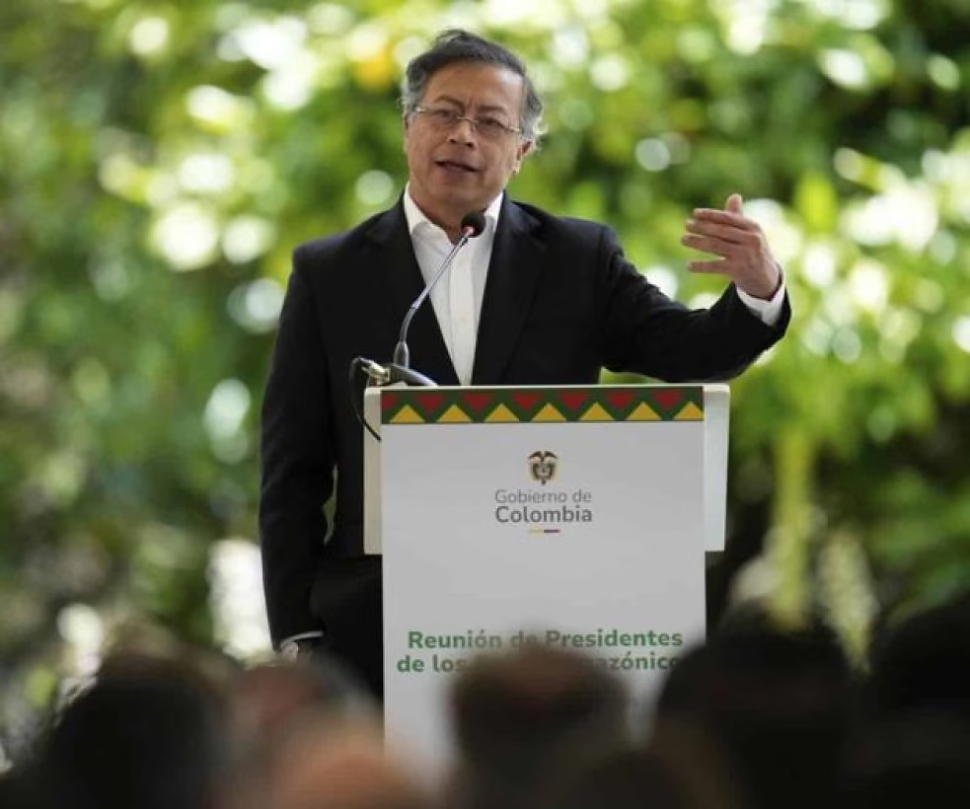
At the same time, the initiative proposes a dual policy: on the one hand, increasing taxes on the exploitation of large-scale coal, and on the other, granting tax incentives for investments in clean and renewable energy. This measure is consistently aligned with the government’s energy transition policy, a fundamental pillar of President Gustavo Petro’s agenda.
Historical Context and Political Strategy
A crucial aspect to understand the architecture of this reform is the recent historical context. In 2021, a tax reform proposal presented by the then government of Iván Duque, which included taxes on basic family basket products, was perceived as deeply unfair by large sectors of the population. This perception triggered massive demonstrations and a national strike of historic proportions, finally forcing the withdrawal of the project.
Aware of this precedent, the current government has built a diametrically opposed narrative and tax structure. Minister Ávila was emphatic when pointing out: “Items from the basic family basket are not being touched… we seek to avoid touching the lower and middle strata of the population so that the tax effort is on the high income profiles.” This declaration underlines a clear political intention to avoid social conflict and learn from past mistakes.
The technical justification for the search for these new resources is based on specific data provided by the Ministry of Finance. During 2024, an unexpected drop in the nation’s total income equivalent to 2.2 percentage points of the Gross Domestic Product (GDP) was recorded. This fiscal gap creates unsustainable pressure on public finances, requiring immediate and structural corrective action.
For President Gustavo Petro, the first left-leaning president in Colombia’s recent history, the approval of this reform is fundamental. It represents the cornerstone to finance the budget of his last year of government, a four-year period that has been characterized by the ambition to implement profound social transformations through labor, pension and health reforms.
However, the legislative path is not without significant obstacles. The government faces the challenge of negotiating and convincing a Congress of the Republic where it does not have guaranteed majorities. This same legislative body, in December of last year, denied a previous fiscal initiative with which the executive intended to partially finance the general budget for state entities in 2025. The ability to lobby and build consensus will, therefore, be determining elements for the final destination of this proposal.
Do you find it crucial to understand the impact of tax decisions on the economy? Share this analysis on your social networks to encourage informed discussion and explore more content on economics and national politics.