The government announces a historic tax reform for soft drinks and customs

The government is preparing a historic fiscal offensive that will shake the foundations of industry and foreign trade.

A Fiscal Earthquake Looms on the Horizon of 2026

The room, charged with almost palpable suspense, witnessed a revelation that promises to forever alter the nation’s economic landscape. In a plenary meeting that seemed more like the prelude to a revolution, the legal advisor of the Executive, Ernestina Godoy, unleashed the perfect storm before the attentive eyes of Morena’s federal deputies. With the solemnity of someone announcing a point of no return, he announced that the Economic Package 2026, that document destined to set the course of the country, will contain tectonic modifications in taxes aimed directly at the heart of the gigantic soft drink companies. The business world shudders before the imminent onslaught.

His words, spoken with the conviction of a moral and economic crusade, resounded like thunder in the expectant silence. “In the Economic Package, surely, they are going to have a lot of lobby,” he declared with a smile that barely hid the ferocity of the battle that is coming, “because some important things are coming, especially with soft drinks.” It was a clear warning, a warning shot to industry titans who for years have navigated less turbulent waters. The tension could not be more dramatic.

RelatedGovernment proposes historic increase in taxes on drinks and cigarettes

A National Crusade for Health and the Treasury

This bold move doesn’t come out of nowhere; It is the direct consequence, the strategic masterstroke, after the epic announcement by President Claudia Sheinbaum on August 27. In a speech that moved the nation, he proclaimed a national campaign to discourage the consumption of soft drinks, painting a gloomy picture where “excess sugar represents a high health risk, and is associated with diabetes and hypertension.” It wasn’t just public policy; It was a declaration of war against a silent enemy that lurks at every table, in every home. Public health and tax revenue are intertwined in a narrative of monumental consequences.

But the drama doesn’t end there. The legal advisor, in a plot twist that left everyone breathless, revealed a second time bomb. The reform to the Customs Law that Sheinbaum will send is destined to cause an annoyance of epic proportions. Godoy, with the gravity of a general before the battle, urged the legislators: “Look at it very carefully, analyze it, it is a reform of great significance, it will cause a lot of pain in some.” His words predicted an inevitable conflict, a fierce fight against opacity and vested interests.

“But it seems to us that it is time,” he proclaimed with overwhelming passion, “when we have to tighten everything that has to do with imports and exports, and also ensure that there is no corruption.” It was a call to arms, a sacred mission to purge the system. He announced the arrival of a legion of lobbyists, of customs agents mobilizing, of lobby groups that will transform the corridors of power into a battlefield. Each point of the reform promises to be disputed with an intensity that will mark a before and after in contemporary economic history.

The stage is set. The government moves forward with iron determination, challenging powerful consortia and embarking on a profound transformation of the tax and customs system. The fate of millions of pesos in taxes and the health of an entire nation hang in the balance, in a saga where each chapter will be loaded with clandestine negotiations, unimaginable pressures and a suspense that will keep the entire country on the edge of its seat. The 2026 Economic Package is not just a document; It is the script of a monumental drama that is about to unfold.

Do you think these measures will impact your daily life?Share this news on your social networks and tag those who should be informed.Explore more on our site to stay ahead of economic news.
84% of gas stations comply with the diesel cap, reports Profeco

Eight out of ten gas stations comply with the diesel cap. The average price is close to the goal of 27 pesos.

Compliance with diesel prices

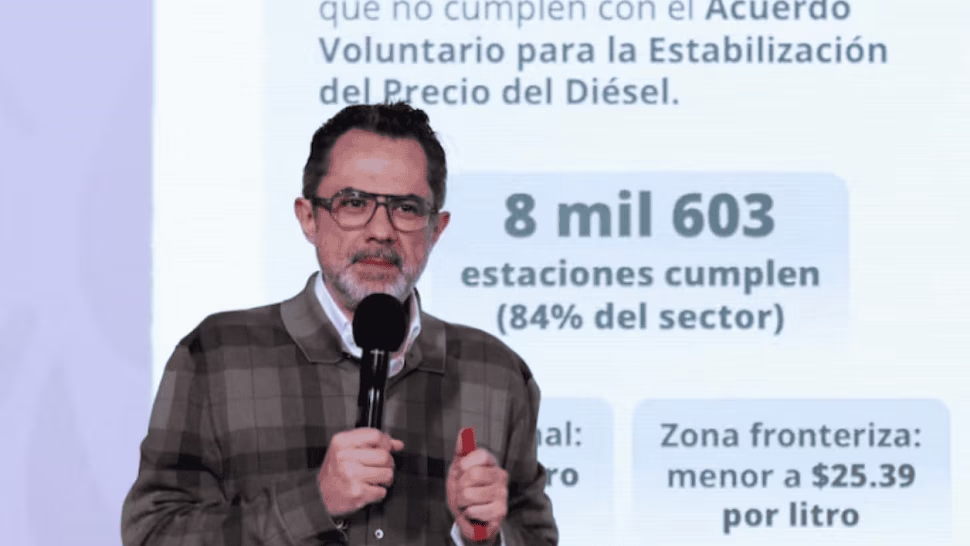
The head of the Federal Consumer Prosecutor’s Office (Profeco), Iván Escalante, reported that 84% of the gasoline sector abides by the voluntary agreement to keep diesel below 27 pesos per liter. In the morning conference of President Claudia Sheinbaum, Escalante detailed that about 8,600 stations already meet the goal.

“We have the goal of being less than 27, right now we have the average price at 27 pesos and five cents,” he reported. Profeco has a map to locate the stations and their prices in real time.

Prices of the basic basket

Regarding the basic basket of 24 products, the attorney pointed out that the goal is 910 pesos for families: “we are doing very well, we have very good results.” Regarding specific products, he indicated that whole chicken is sold on average at 39.66 pesos per kilo.

The official highlighted that continuous monitoring makes it possible to adjust actions and maintain pressure on prices. The agreement, of a voluntary nature, seeks to stabilize the cost of fuel without coercive measures.

Continue reading

Employment in Mexico grows by 412 thousand people in six months

Employed population increases in Mexico during the first half of the year.

Occupancy figures on the rise

The Ministry of Labor and Social Welfare (STPS) reported that, according to the National Occupation and Employment Survey (ENOE), the employed population in Mexico grew by 412 thousand people between January and June of this year.

At the end of the sixth month, the Economically Active Population (EAP) reached 61.9 million people. The unemployment rate was 2.9 percent.

The Mexican Social Security Institute (IMSS) registered 22 million 779 thousand 704 jobs, the highest figure for the month of June.

Youth employment also rebounds

The agency highlighted that the young employed population—from 18 to 29 years old—increased by 204 thousand people in annual comparison. This data reflects an improvement in the labor insertion of young people.

The figures, based on the ENOE and IMSS records, show a positive trend in the Mexican labor market during the first half of the year.

Continue reading

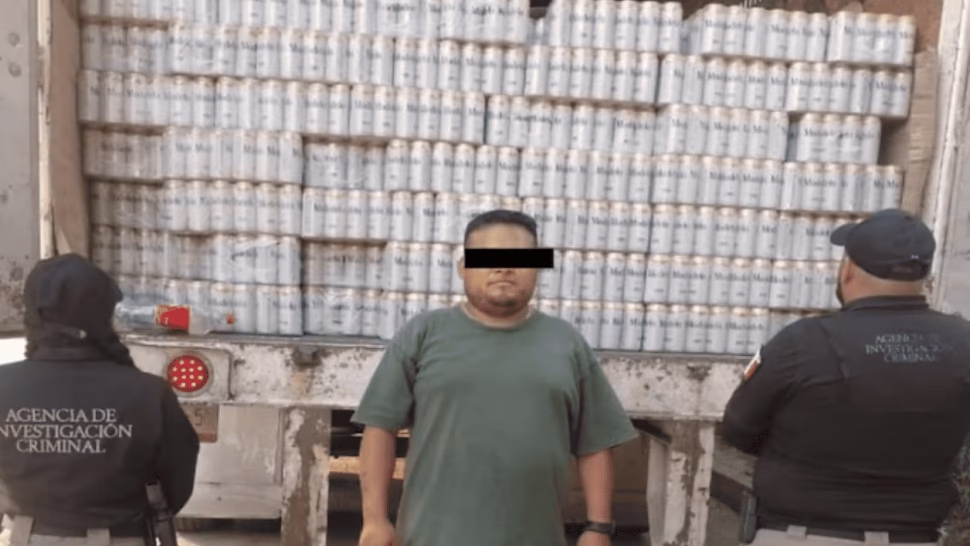
Seizure of 48 thousand cans of illegal beer in Tabasco

Seizure of 48 thousand cans of beer without documentation on the Raudales-Malpaso highway.

Federal and state security elements seized a tractor-trailer with approximately 48 thousand cans of beer of dubious origin in Tabasco. The driver was placed at the disposal of the authorities.

The operation occurred on the Raudales-Malpaso highway, in the municipality of Huimanguillo. The security forces acted following an anonymous complaint, which allowed strategic investigation work to begin.

At the scene they stopped an International tractor-trailer coupled to a dry box. During the inspection, they located two thousand plates of beer of various brands.

Due to the fact that the driver did not present the required documentation to prove the legal possession and transportation of the product, he was detained.

The detainee, the unit and the shipment were at the disposal of the Public Ministry of the Federation. An investigation folder will be opened to determine responsibilities.

The Attorney General’s Office highlighted the importance of the exchange of operational intelligence to prevent the circulation of illegal merchandise on the country’s roads.

Continue reading