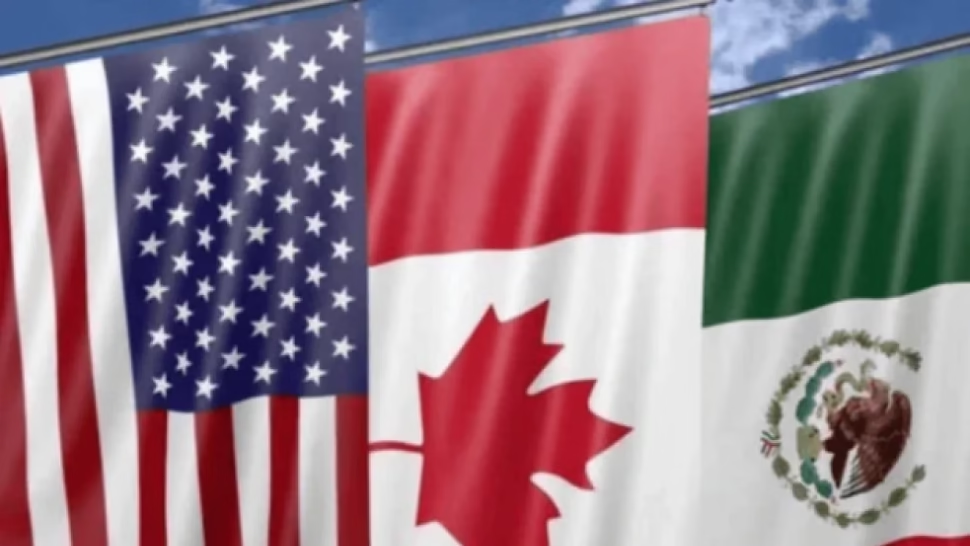
Edomex declares war on thirst with an army of pipes

An epic battle against thirst with tankers as protagonists. Discover the final destination of millions of liters.

The epic aquatic crusade of the State of Mexico

It seems that in the State of Mexico they have discovered warm water, literally. After what they have baptized with the pompous name of Operation Caudal (it sounds like a low-budget spy movie, but it’s actually about… wait… water), the Mexican government has achieved the feat of distributing 710 pipes of the precious liquid. The quantity? A modest figure of almost 8 million liters which, to give us an idea, is enough to fill approximately… well, many, many Olympic swimming pools. A titanic effort so that hospitals and prisons do not become post-apocalyptic scenes from Mad Max, but with thirst instead of gasoline.

The Water Commission of the State of Mexico (CAEM), in a display of efficiency that leaves us all speechless, coordinated this parade of tanker trucks with the laudable intention of interrupting the illicit trade of the resource. Because, of course, on the black market what is most valued now is not weapons or data, but H₂O. Thanks to this logistical feat, more than 143 thousand souls, including health personnel, patients and temporary residents of the prison system, can now hydrate themselves without having to resort to a pond. What a relief.

RelatedGiant freshwater aquifer discovered under the Atlantic Ocean

The great water tour: Who was lucky enough to get the jet?

Between the end of October and the beginning of November 2025, these modern water carriers made their thirst route. The lucky recipients included the Hospital of the Americas in Ecatepec (because the thirst is as continental as the name of the hospital), the Regional General Hospital No. 196 (what happened to the previous 195?), and the Hospital for Chronic Diseases Dr. Gustavo Baz Prada in San Martín de las Pirámides, an ideal place to remember that, While some ancient civilizations built pyramids, we are content with carrying water in trucks.

But the liquid party did not end there. Supply was also guaranteed in several penitentiary centers, such as those in El Oro, Otumba and Almoloya de Juárez. Because, let’s be honest, if there is a place where you definitely do not want water to be lacking for hygiene, it is in a prison. The alternative is too horrifying to contemplate. A masterstroke to maintain social peace, or at least the smell of clean.

The impact of the operation: Saviors or a patch on a bottomless barrel?

The state government, in a fit of hydrological poetry, assures us that every liter recovered is a liter that returns to homes. A statement as profound as it is obvious, which makes us wonder: and where the hell would I go if not, to Mars? The commitment to guarantee the human right to water is commendable, without a doubt. But one can’t help but think that if a military-appointed operation is needed to bring water to hospitals, maybe, just maybe, the underlying problem is a little bigger than what a few pipes can solve. It’s like trying to put out a forest fire with a water gun. Of course, very good for the 7.96 million liters. Someone had to do it.

Are you surprised or do you find this monumental distribution of water insufficient? Share this note and let’s make the topic flow on social networks. If water management is your thing, explore more content related to the water crisis and the solutions, or lack thereof, in our environment section.

Merlin the duck faces an impediment to enter the stadium

The famous duck was invited to a match, but stadium and FIFA rules prevent it.

Merlin the duck, the most viral mascot of the 2026 World Cup, received an invitation from Banco Azteca to watch the Mexico vs Czechia match from the Azteca Tribune. However, the regulations of the Mexico City Stadium prohibit the access of animals of any species.

The regulatory dilemma

The stadium security standard applies to mass events. In addition, the FIFA Code of Conduct also restricts the entry of wildlife, with exceptions only for assistance animals such as guide dogs. Merlin’s presence would require an extraordinary authorization that has not yet been confirmed.

While the mystery is resolved, their owners will be able to attend, included in the World Cup courtesy. The Peking breed bird became famous when it appeared with the Tricolor shirt at the Angel of Independence and was named ambassador of Mexico City. His popularity grew rapidly during the World Cup, making him a social media phenomenon. The invitation from Banco Azteca was a symbolic gesture, but the reality of the regulations could prevent access.

Continue reading

Sheinbaum rejects participation of transnationals in oil exploitation

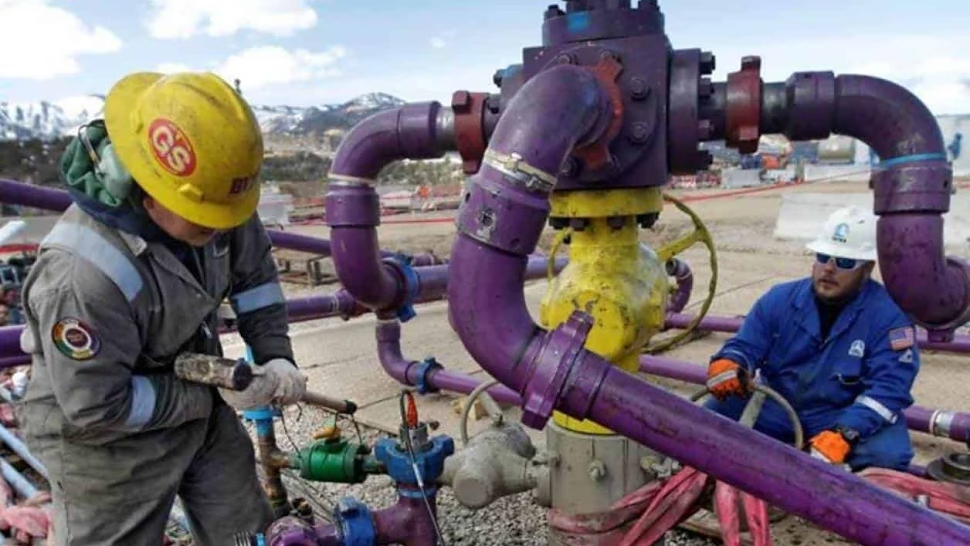
Sheinbaum rules out delivering oil to transnationals and announces consultations to evaluate fracking.

President Claudia Sheinbaum was forceful in ruling out foreign companies exploiting oil in Mexico, within the framework of the review of the T-MEC and the government analysis on fracking.

“How do you think that we, who have fought so hard, are going to hand over the oil to transnational companies! Well, we are not Calderón, we are not Peña!”

Sheinbaum acknowledged that foreign technologies could be used, but stressed that natural resources will not be handed over abroad. He insisted on reducing the United States’ dependence on unconventional gas.

Consultations with communities

The president highlighted the energy sovereignty project and announced that the type of consultation prior to the exploitation of shale gas will be evaluated.

“We have to see if it is a national consultation or if it is a consultation in the area where this exploitation may occur, because in the end the communities will be affected.”

Sheinbaum noted that he will maintain a responsible stance, listening to environmental groups that oppose hydraulic fracturing. He assured that past mistakes will not be repeated and that the communities will have a voice in the process.

The government will prioritize sustainability and respect for local populations before any decision on fracking.

Continue reading

Sheinbaum rules out risk for the T-MEC due to trade tensions

Sheinbaum assured that the treaty has legislative support and highlighted Canadian investment in Altamira.

Sheinbaum defends validity of the T-MEC

President Claudia Sheinbaum ruled out that tensions between Canada and the United States put the Treaty between Mexico, the United States and Canada (T-MEC) at risk. He pointed out that any profound change would require the approval of the congresses of the three countries, so he considered it unlikely that any would seek to exclude another.

“We do not believe that this is either Canada’s position, nor the United States’ position, nor our position,” he said during his morning conference.

Sheinbaum announced that a communication on the continuity of the treaty and possible revisions is expected at the beginning of July. The context is marked by the protectionist trade policy of US President Donald Trump. Currently the negotiations are carried out separately, although Mexico has insisted on tripartite dialogues. He highlighted that the T-MEC continues to be a key tool against China.

Canadian investment and security

As an example of the strengthening of ties, Sheinbaum mentioned an upcoming Canadian investment in the port of Altamira, Tamaulipas, which will increase maritime exchange. In security, he assured that Mexico offers conditions for foreign investment and that reported cases are attended to. Regarding accusations against Canadian mining companies, he indicated that they must be formalized before authorities and that the security cabinet is investigating two cases. He required these companies to comply with environmental standards.

The president defended the advances in security: intentional homicides were reduced by 46% in 20 months. He also highlighted the positive image of the country during the Soccer World Cup, pointing out that “Mexico is in the world’s view today” for the hospitality of its population.

Regarding the meeting with the United States, Sheinbaum described the second round of talks led by Marcelo Ebrard as “very good.” He reported that on July 1 there will be a trilateral virtual meeting and between July 15 and 16 there will be a face-to-face meeting in Mexico.

Continue reading