Comprehensive Review and New Legal Framework for Water Management
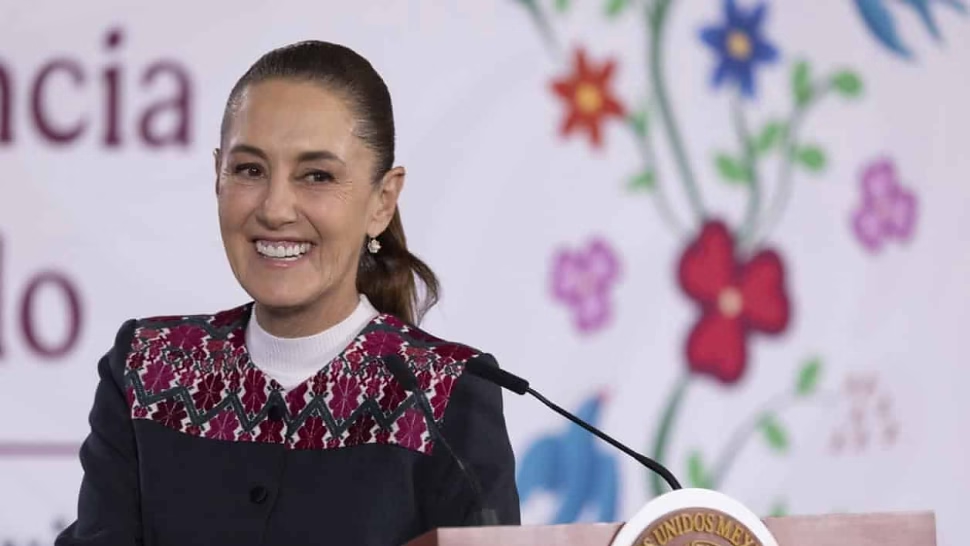
The government of Mexico, through President Claudia Sheinbaum Pardo, announced the imminent presentation of modifications to the National Water Law. This legislative initiative represents a structural change in the country’s water policy, with the central objective of reaffirming the State’s stewardship over a strategic resource. The fundamental premise is clear: water is an asset of the nation and a human right, not a commodity subject to the laws of the market.
The most significant modification lies in the regulation of concessions. As of the entry into force of the new regulations, the Mexican State will be the only entity empowered to authorize concessions, eliminating the possibility of these being transmitted or sold between individuals. This measure seeks to put an end to documented irregular practices, such as the sale of water rights by those who do not use them, or the transfers of titles that were only notified to the authority without a thorough review.
The president explained that, during the neoliberal period, the legislation was modified to allow such transfers, which led to an informal market and distortions in the distribution of the resource. “There are cases of those who have a water concession for irrigation who do not pay anything to Conagua, do not use it within a certain time and sell it to another individual, or there are cases where a transfer of a concession title was made to another, only by notifying the authority,” said Sheinbaum Pardo. The new principle will be: “Water that is not used, water that returns to the Mexican State as national water, as established in the Constitution, so that it can again be concessioned based on the criteria defined by Conagua.”
Concrete Actions and Combating Irregularities
This paradigm shift occurs in parallel with an unprecedented technical review of the list of current concessions. The general director of the National Water Commission (CONAGUA), Efraín Morales López, explained that the actions focus on solving historical problems such as hoarding, over-concessioning, the deterioration of hydraulic infrastructure and the inequitable distribution of water in the national territory.
The audit process, led by the deputy director general of Water Administration, Mauricio Rodríguez Alonso, has advanced significantly. To date, 482,000 concession titles have been reviewed, which represents 90% of the total. This exercise has allowed us to identify 58,938 inconsistencies. The most frequent irregularities include:
Titles without legal certainty on the effective date, alleged falsification or duplication of documents, use of the water resource different from that stipulated in the original concession and erroneous location coordinates that prevent correct inspection.
Rodríguez Alonso highlighted a particularly relevant finding: “Agricultural titles do not pay for water because they produce food; however, we found that some titles that are identified as agricultural, today are industrial complexes, spas, golf clubs and there is also the issue of the sale of pipes.” This situation shows the urgency of regularizing and updating the registry to guarantee that the concessions are used for the authorized purposes.
Citizen Participation Mechanisms and Tangible Results
CONAGUA’s strategy is complemented by a strong component of transparency and social participation. The new National Water Registry will be public, facilitating citizen surveillance. Likewise, the complaints system has been strengthened through the portal app.conagua.gob.mx/podan, where the population can report anonymously or identified irregularities such as:
Water extractions without concession, contamination of national water bodies, irregular sale of the resource and impacts on national assets administered by the Commission, such as beaches, channels and riverbanks. To date, this scheme has allowed for 3,912 inspection visits and 490 closures to establishments that operated outside the regulations.
A tangible result of this policy has been the recovery of 4,000 million cubic meters of water, a volume equivalent to the capacity of several large dams. This achievement is a direct consequence of the support of producers, irrigation districts and industries that, within the framework of the new vision, have returned to the State concessions that they were not using.
President Sheinbaum also announced that federal authorities will file formal complaints against former officials who, in the past, have delivered concessions irregularly. These legal actions will be presented to bodies such as the Anti-Corruption and Good Government Secretariat and the Attorney General’s Office of the Republic, in order to sanction acts of corruption and set a precedent of accountability.
The implementation of a single window for digitalized procedures and the simplification of procedures seek, in addition to combating corruption, to facilitate processes for users, especially for small farmers who can now access documents that make it easier for them to obtain subsidies, for example, in the electricity sector.
This reform to the National Water Law is not only a legal adjustment; is the reconfiguration of water governance in Mexico. By recovering the powers of the State and prioritizing the human right to water over private interests, the federal government lays the foundations for a more fair, sustainable and transparent management of a vital resource for the future of the country.
Do you think this reform is crucial for Mexico’s water security? Share this analysis on your social networks and help us spread the importance of responsible water management. Explore more content about sustainability and public policy on our site.