Congress accelerates, the field lights up
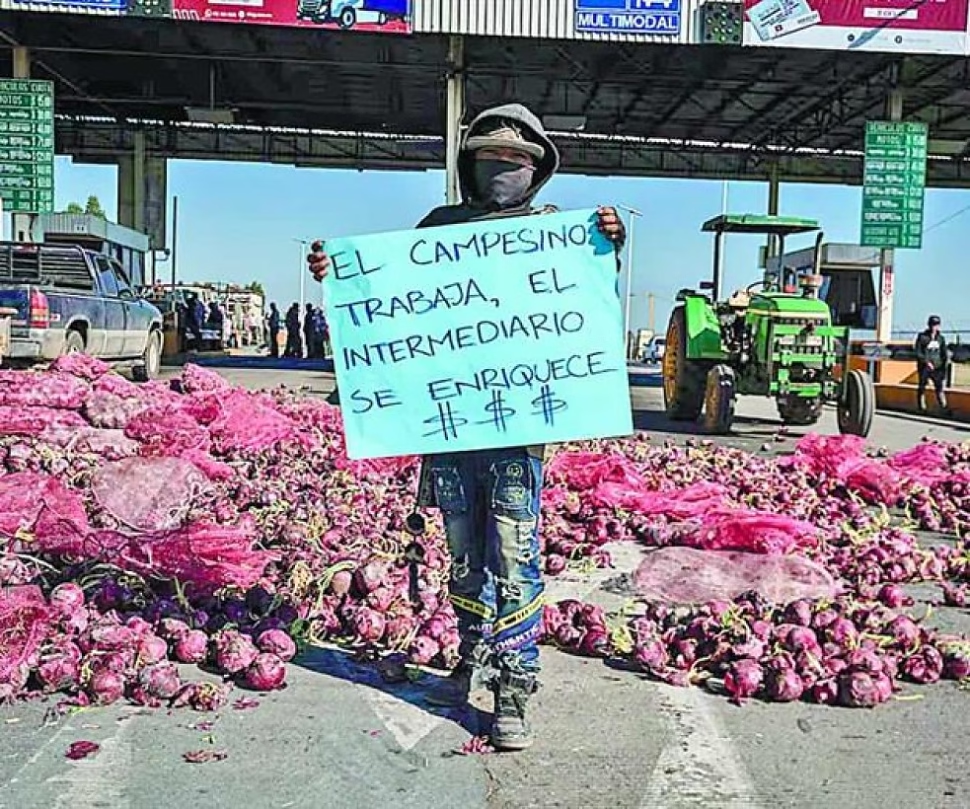
It seems that in the Mexican Congress they discovered the turbo button and have pressed it with an enthusiasm worthy of a better cause. It turns out that there is a sacred mission: to approve a brand new Water Law before the year ends and, who knows, maybe before the ideas dry up. Promoted by President Claudia Sheinbaum, this legislative gem has achieved the unthinkable: uniting agricultural and livestock organizations in a new and vibrant chorus of discontent, just when we all thought that the corn price drama had been the spectacle of the month. As expected in this fascinating national reality show, the farmers, those eternal protagonists of infinite patience, decided that the best thing was to block roads in 20 states. And in case anyone didn’t get the message, this Sunday they threatened to close roads, businesses and even border crossings. Because what better way to say “we disagree” than by paralyzing the country? All this because Morena and his cronies insist on rushing the legislative process, as if the law were going to evaporate after December 15.
The heart of the matter: Goodbye to the inheritance?
Here is the pearl, the detail that makes everyone jump out of their chairs: water concessions can no longer be transmitted between individuals. Imagine, no longer passing on the plot of land with its respective water rights to your child, as if it were a grandfather clock. No, gentlemen. Now the permit must return to the State, specifically to the bureaucratic arms of the National Water Commission (CONAGUA), so that they, in their infinite wisdom and efficiency, can reassign it. The official justification is to put an end to the illegal concessions market, a business as clandestine as an elephant in a china shop. The farmers, with a logic that seems taken from common sense, argue that this will prevent them from inheriting or selling their land, because, surprise!, a piece of land without water is basically an ornament. Eraclio Rodríguez, former congressman and farmer from Chihuahua, sums it up with the elegance of someone who sees the apocalypse: “It is a regressive law that strips us of the rights we have gained… it puts the stability of our families at risk.” Come on, according to him, this is not just a law, it is the end of agrarian civilization as we know it.
A little history: When water becomes a commodity
To understand this circus, we must go back to the 90s, in the six-year term of Carlos Salinas de Gortari, when the National Water Law was promulgated. These regulations allowed water rights to pass from private hands without the public Administration even blinking. The result, as was predictable, is that today Conagua does not have the slightest idea of how much water users use or for what. There is so much volume of concessioned extraction that Conagua cannot give more permits, which has led individuals to an “alegal” buying and selling market. With the new law, an unused concession returns to Conagua for reassignment. Does it sound like a game of musical chairs where water is the prize? Well that’s how it is. An academic study, “The millionaires of water” This new regulation is not just a patch; It’s a complete change. It includes an initiative for a new General Water Law and a draft decree that reforms the National Water Law. Let us remember that in 2012 the Constitution elevated the human right to water to constitutional status and gave one year to enact a general law. Of course, as in Mexico the deadlines are more like suggestions, during the six-year terms of Enrique Peña Nieto and Andrés Manuel López Obrador attempts sank more times than a paper boat in a hurricane. Now, the proposal seeks to ensure access to water as a right and prioritize, in times of scarcity, domestic use over industrial or agricultural use. Beatriz Olivera, from the group Cambiémosla Ya, defends the ban on transfers as something positive to end a market where concessions are treated as a commodity. But, surprise, he also suggests reviewing the case of peasants and small landowners. Because, of course, exceptions are always welcome when the drama is served. And if that were not enough, the new law conditions the volumes of water to have a sustainable and savings infrastructure, which represents a colossal expense for small producers. Thus, while large agribusiness companies can invest without problems, farmers are left up in the air, wondering if the future of water will only be for those who can pay the entrance ticket. Don’t you think it’s a story worthy of a soap opera? If you liked this analysis full of sarcasm and uncomfortable data, share it on your social networks and explore more content related to water management and agrarian rights. Because, in the end, water belongs to everyone, but the law seems to want to decide who deserves it most.The implications: Who wins and who loses?