El Chapo’s former lawyer takes over as criminal judge in Chihuahua

The former lawyer of the most feared boss takes an unexpected turn in her career, unleashing controversy and unanswered questions.

A twist of fate that shakes the foundations of justice

The universe of law and order in Chihuahua was shaken to its core when Silvia Rocío Delgado García, the same woman who once defended tooth and nail the fearsome Joaquín “El Chapo” Guzmán, received among applause and murmurs the constancy that accredited her as a criminal judge. What irony of fate! The one who fought for the rights of the king of drug trafficking would now have the scales of justice in her hands.

A designation shrouded in shadows and suspicions

Governor Maru Campos, with a bold—or reckless?—movement, proposed her name for Judicial District 5. But not everyone celebrated. The Defensorxs organization raised its voice, claiming that her past made her ineligible. Was it not an indelible stain to have been the legal representative of the man who spread terror in Mexico? However, the State Electoral Institute, with a cold and bureaucratic gesture, delivered the document. The system had spoken.

RelatedCandidate for judge in Chihuahua linked to El Chapo generates controversy

The journalists, like vultures sniffing blood, cornered her: “How do you explain your relationship with the Sinaloa Cartel?.” She, serene as a marble statue, blurted out: “I did my job.” That’s all! As if defending the most wanted monster on the planet was as trivial as signing a contract. He demanded that it not be called “linkage“, but rather “representation“. A play on words or a desperate attempt to clear his name?

Secrets behind bars: the defense that moved a boss

Court files reveal chilling details: in 2016, he joined the team that fought to prevent the extradition of El Chapo. Not only that. In December, in an act that some would call “compassionate” and others “complicit“, he presented a protection for his client to receive… an extra blanket! He argued that the cold of Cefereso 9—that prison now closed, as if the state wanted to erase its history—affected his “well-being.” Since when did a drug trafficker deserve such delicacy?

And it didn’t end there. In January 2017, he reported that a guard harassed the capo. The same man who ordered massacres was now the victim! Together with the lawyers José Refugio Rodríguez Núñez and Andrés Granados Flores, he wove a network of legal resources. She, they say, was the liaison between the monster and its defenders, reviewing protections and keeping it informed. Was it just “technical support” or something more obscure?

Justice under the magnifying glass: redemption or conflict of interest?

In the face of criticism, Delgado García hid behind professional ethics: “Every person deserves defense.” He admitted seeing him only at a hearing—when the power went out, what a coincidence!—and at Cefereso 9. But can someone who breathed the same air as El Chapo impartially judge other accused of drug trafficking? The legal community is divided between those who see an “example of improvement” and those who whisper “conflict of interest“.

Today, his career takes an epic turn. He promises to help the community, but the ghost of his past haunts every courtroom. Will she be the judge that Chihuahua needs… or a reminder that justice has cracks?

What do you think of this unexpected turn? Share this story and discover more cases that challenge the boundaries between law and controversy. #JusticiaEnLaMira #ElChapo
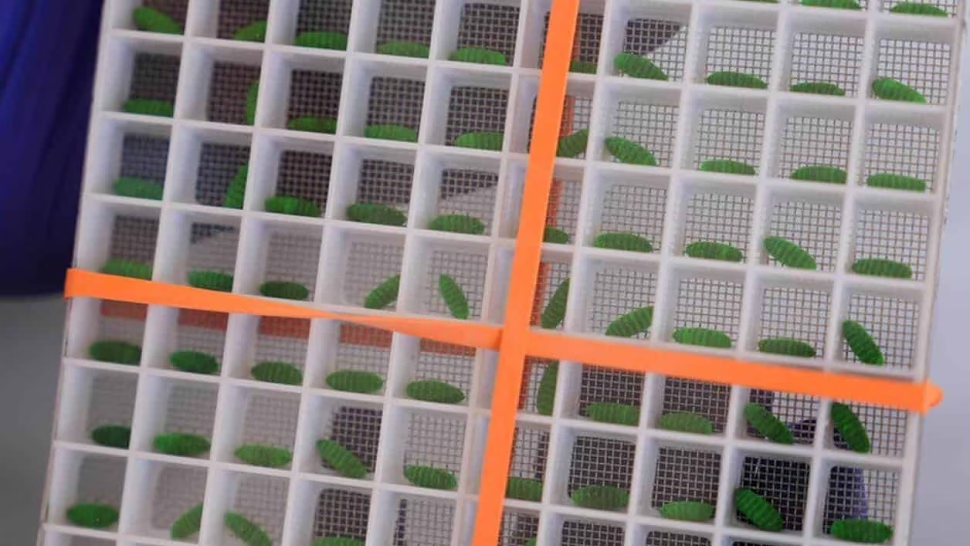
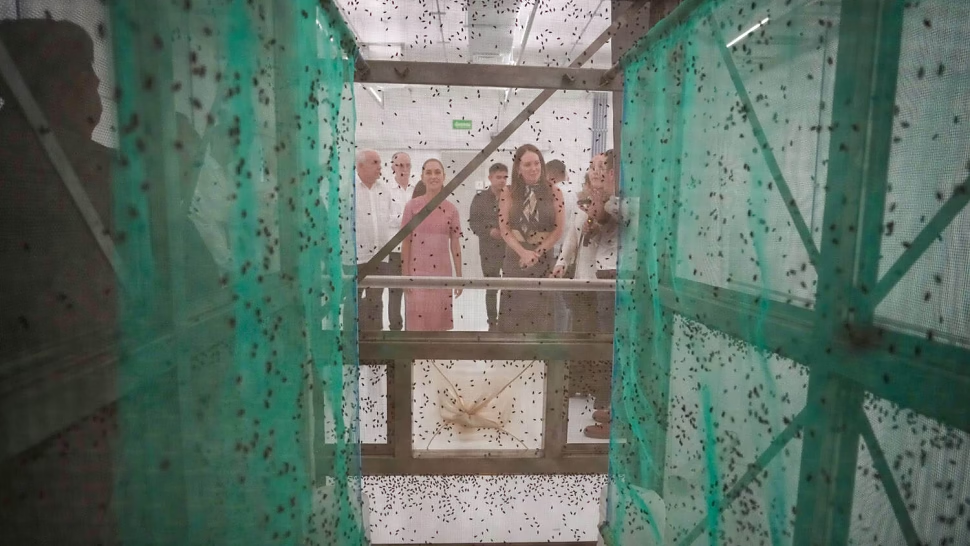
Sterile fly plant reopened in Chiapas to combat plague

Mexico and the US reactivate a plant in Chiapas to produce sterile flies and stop a plague that affects livestock.

Binational cooperation against screwworm

The governments of Mexico and the United States launched a plant on Saturday in Chiapas to produce sterile flies, with the aim of stopping the advance of the screwworm. The plague has affected binational trade and raised alarms in both countries.

The complex is activated after the first case of the parasite was detected in the United States more than three weeks ago. So far, 20 infections have been confirmed in the United States, which motivated Donald Trump’s government to approve an additional $83.8 million to combat it.

The center is in Metapa de Domínguez, Chiapas. It represents the most recent effort in a collaboration that began last year. Mexico accumulates 1,907 active cases of screwworm.

The plant replaces one that closed in 2013, when Mexico was declared free of the pest and a binational agreement in force since 1972 ended. It now produces sterile flies as a biological control: it interrupts the reproductive cycle of Cochliomyia hominivorax, whose larvae invade tissues of warm-blooded animals, including humans.

During the reopening, President Claudia Sheinbaum stated:

“It is the conviction that development cooperation produces results. Animal diseases, pests and food security challenges know no borders. The best response is to add capabilities, share experience and build solutions.”

Also present were the Secretary of Agriculture of the United States, Brooke Rollins, and Ambassador Ronald Johnson, who announced the additional $83.8 million to reproduce more sterile flies in Mexico and reinforce prevention.

The joint investment to convert the old plant was 61 million dollars. It will produce 100 million sterile flies weekly, according to Senasica. Currently, Mexico is supplied from Panama, and another plant is being built in Texas that will begin operating next year.

Livestock farmers consider that the reopening is late. The first outbreaks emerged almost two years ago and the estimated production could be insufficient. Omar Ornelas, a rancher from Tuxtla Chico—a neighboring municipality—has an infested animal:

“I hope that now with the inauguration of the plant there will be support for the livestock area, because we have closed the United States border for the export of livestock and it affects the price of beef.”

To treat his cattle he has used homemade recipes, from veterinary products to diesel and lime.

The commercial impact is severe. On June 9, after infections in Texas, Mexico suspended the import of cattle, horses, sheep, goats and other species from the United States. In the last 18 months, the US closed the passage to Mexican cattle on three occasions. The most recent closure occurred on July 9, after locating an infected cattle in Ixhuatlán de Madero, Veracruz.

Continue reading

Sterile fly plant inaugurated in Chiapas; key binational cooperation

New binational plant will produce 100 million sterile insects per week to protect livestock.

Strategic plant against livestock pest

President Claudia Sheinbaum inaugurated the Production Plant for Sterile Livestock Screwworm Flies (GBG) in Metapa de Domínguez, Chiapas. The project is binational between Mexico and the United States.

The facility will produce 100 million sterile insects each week. The objective: control the pest and strengthen animal health in both countries.

Sheinbaum highlighted that international cooperation generates results in the face of phytosanitary challenges that do not recognize borders. He thanked President Donald Trump and the US authorities for their financial and technical contribution.

Investment and results

The US ambassador to Mexico, Ronald D. Johnson, announced an additional investment of 83.8 million dollars. The resources will be used to intensify the fight against the pest, increase the production of sterile flies and strengthen preventive strategies.

The US Secretary of Agriculture, Brooke L. Rollins, described the achievement as an example of the success of coordinated work.

For her part, the Secretary of Agriculture and Rural Development, Columba Jazmín López Gutiérrez, explained that the plant was built in 12 months. As part of the containment actions, 5.3 million heads of cattle have been inspected, more than 84 thousand commercial shipments have been verified and 7 billion sterile flies have been released with the support of specialists.

The bilateral relationship, Sheinbaum stressed, must continue on mutual respect, constant dialogue and sovereignty.

Continue reading

Former Pemex director investigated for alleged assault on his wife

The Morelos Prosecutor's Office is investigating Víctor Rodríguez Padilla for alleged assault on his wife.

Investigation in progress

The Attorney General’s Office of the State of Morelos initiated an investigation file against Víctor Rodríguez Padilla, former director of Petróleos Mexicanos, after the dissemination of a video in which he is seen allegedly attacking his wife, María Felicia Jiménez. The recording, which circulates on social networks, shows Rodríguez Padilla repeatedly hitting the victim inside a home in the municipality of Emiliano Zapata, adjacent to Cuernavaca. According to the metadata of the video, the attack occurred on March 15.

The state agency reported that since Friday it has been exchanging information with the Women’s Secretariat of the Government of Mexico to guarantee the protection of the victim.

“The Attorney General’s Office of the State of Morelos initiated an investigation folder for the probable criminal acts derived from the dissemination of a public complaint through a video, where an act of violence against a woman is seen,” cited the FGE.

Protection actions

The Morelos Prosecutor’s Office specified that the investigation was opened in full respect for the rights of women, girls, boys and adolescents. The statement indicates that the events probably occurred on March 15 inside a home in Emiliano Zapata, with the alleged participation of a former federal official.

The institution assumed the commitment to exhaust all measures to determine responsibilities and guarantee a life free of violence for the victim. So far, no precautionary measures have been reported against Rodríguez Padilla, and the investigation is still ongoing.

Continue reading