Operation kills leader of the Chapo Isidro Cartel

Arsenal and synthetic drugs seized after confrontation. The criminal network suffers a hard blow with arrests and dismantling of infrastructure.

Dismantling of a Criminal Cell in Sinaloa

In a high-impact joint operation, elements of the Secretariat of the Navy, the Secretariat of Security and Citizen Protection and the Attorney General’s Office carried out two searches in homes linked to Pedro Inzunza Coronel, alias “El Pichón”, a prominent leader of the criminal faction known as “Chapo Isidro”. This intervention is part of a comprehensive national security strategy to weaken the operations of drug trafficking groups in the region.

During surveillance and reconnaissance tours, the naval troops were attacked with direct fire from the buildings under surveillance. Faced with the imminent threat to their physical integrity, the military personnel repelled the attack in a proportional and controlled manner, neutralizing the hostility and securing the perimeter. The result of this confrontation was the death of the ringleader Pedro Inzunza Coronel, the capture of Adelemo Pérez Hernández, “Lemu”main logistics operator of the organization, and the arrest of Miguel Ángel Villalba Castillo, a hitman of the same cell. At the scene, three short weapons, a fragmentation grenade and a bag containing one kilogram of fentanyl pills were seized.

RelatedThe US recognizes the Mexican operation that killed Pedro Inzunza Coronel

Findings in Clandestine Properties and Laboratories

The authorized searches in the municipalities of Guasave and Ahome allowed the discovery and dismantling of a significant criminal infrastructure. Among the seized assets were two high-powered firearms, four vehicles presumably used for logistical and criminal activities, and two cell phones that will be subjected to forensic analysis to extract intelligence. The most relevant discovery was that of two clandestine laboratories equipped for the manufacture of synthetic drugs. In these facilities, an assault rifle, multiple useful cartridges, a truck, 1,425 kilograms of methamphetamine (crystal), one kilogram of powdered fentanyl, 600 liters of chemical precursors essential for the synthesis of narcotics, an industrial chemical reactor and a variety of containers and processing utensils.

This case has a crucial international dimension. In May 2025, the United States Department of Justice filed an indictment for the crime of narcoterrorism against Pedro Inzunza Noriega, alias “Sagittarius”—former leader of the Beltrán Leyva Cartel—and his son, the now deceased Pedro Inzunza Coronel, “The Pigeon”. The US federal indictment establishes that, if found guilty, the defendants would face a sentence of life imprisonment, with a minimum of 20 years of inescapable confinement, in addition to a financial fine of $20 million.

Extension of the Operation and Capture in Spain

In a parallel line of investigation, the result of international cooperation and intelligence work, Alejandro Reynoso Jiménez was identified, a member of a network specialized in the collection and supply of chemical precursors. This cell was dedicated to supplying essential inputs to laboratories in Mexico for the production of synthetic narcotics destined for the illegal markets of Europe and United States. Thanks to an exchange of information in real time, it was established that Reynoso Jiménez traveled to Madrid, Spain, where he was detained by agents of the Spanish National Police in compliance with a request for international collaboration.

Simultaneously, in Guadalajara, Jalisco, a search was carried out on a property related to Alejandro Reynoso. At this location, personnel from the Navy, the SSPC and the FGR seized metal drums, containers with controlled substances and chemical precursors, as well as specialized laboratory equipment for the manufacture of fentanyl and MDMA (ecstasy). The evidence confirms that the site functioned as a smaller-scale production plant for the production of these highly addictive substances.

This coordinated operation represents a strategic blow to the finances and operational capacity of one of the most violent drug trafficking factions, directly impacting its supply chain of synthetic drugs, a global public health problem. The seizure of precursors and equipment prevents the manufacture of millions of lethal doses.

Share this important security achievement on your social networks and explore more analysis on the fight against organized crime on our platform.


Abate Marina líder criminal El Pichón facción chapo

UNAM and IMSS launch strategy against HIV

UNAM and IMSS offer preventive treatments against HIV to students and workers.

HIV prevention program for university students

The National Autonomous University of Mexico (UNAM) and the Mexican Social Security Institute (IMSS) signed an agreement to provide preventive treatments against HIV to their community. The objective is to reduce the risks of infection among students, teachers and administrative staff.

As part of the strategy, Pre-Exposure Prophylaxis (PrEP) will be made available. This medication, when used properly, reduces the chance of contracting the virus by up to 99%. It is intended for those seeking additional protection before possible exposure.

Also included is Post-Exposure Prophylaxis (PEP), an emergency treatment that must be started within the first 72 hours after a risk situation, such as a condom breaking or sexual violence. The scheme lasts 28 days under medical supervision.

Authorities noted that prevention requires a comprehensive approach. The program includes periodic HIV testing, distribution of condoms, care for sexually transmitted infections and vaccination against the Human Papillomavirus (HPV) and hepatitis B.

This agreement strengthens the health tools available to the university community, combining institutional resources to confront HIV from prevention.

UNAM e IMSS lanzan estrategia contra...

Continue reading

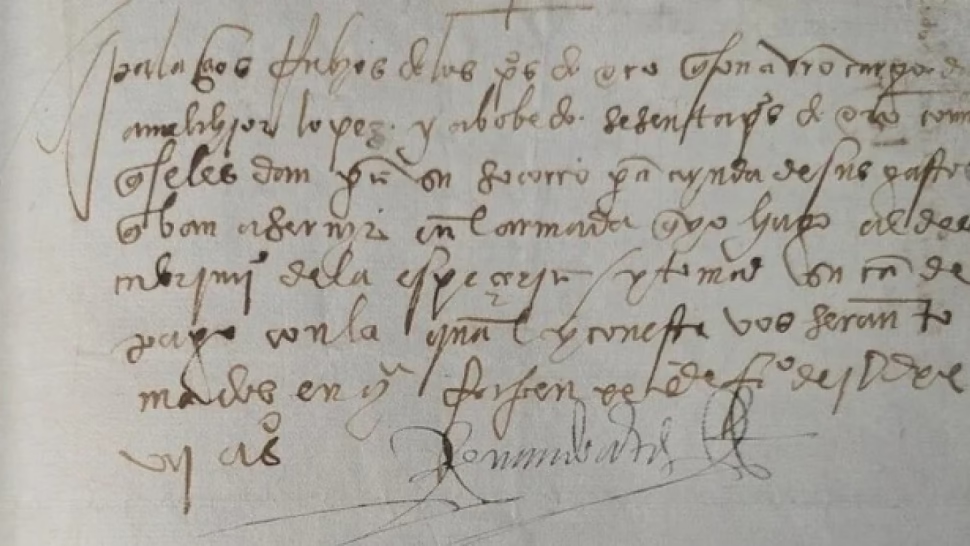
FBI returns to Mexico historical document signed by Hernán Cortés

A document signed by Hernán Cortés in 1527 returns to Mexico after three decades of searching.

The Federal Bureau of Investigation (FBI) of the United States delivered to Mexico a document from the 16th century with the signature of Hernán Cortés. The piece was stolen from the country more than 30 years ago and is now under the protection of the General Archive of the Nation (AGN).

Recovery after an auction in the US

The Ministry of Foreign Affairs (SRE) reported that it is a payment order dated February 20, 1527. It belongs to the Hospital de Jesús fund of the AGN, which contains several folios with signatures of the conqueror.

The recovery process began in 2022. Mexican authorities received information about the sale of the document in a US auction house. After gathering evidence of its origin and belonging to the national heritage, Mexico filed a complaint with the Attorney General’s Office of the Republic.

The document, of incalculable value, is already in Mexican territory. The collaboration between the FBI and the Mexican authorities allowed his return, which concludes a long process of investigation and diplomatic management.

FBI devuelve a México documento histórico...

Continue reading

The US occupies last place in G7 trade openness

The ICC places the United States at the bottom of the ranking of open markets among the seven powers.

Trade openness ranking in the G7

The United States was positioned as the economy with the lowest level of trade openness among the G7 countries, according to the 2026 Open Markets Index of the International Chamber of Commerce (ICC). It earned a grade of 3.3 points, the lowest of the group.

The study was presented during the G7 annual meeting. It points out that the bloc’s economies face the effects of volatility in their opening policies and the gaps between the rules and their practical application.

In contrast, the United Kingdom topped the list with 4.7 points. They were followed by Canada (4.5), Germany (4.4), France (4.3), Japan (4.2) and Italy (3.9). The United States closed the table.

The index evaluates factors such as trade openness, exchange policies, foreign direct investment, digital services and the stability of trade measures. The ICC attributed the differences between countries to the size of their economies, their integration into global trade and internal restrictions.

The organization recommended reducing uncertainty in trade policies, strengthening digital trade and improving legal certainty to attract foreign investment. He also urged progress on reforms within the World Trade Organization to guarantee more open markets.

EE.UU. ocupa el último lugar en...

Continue reading