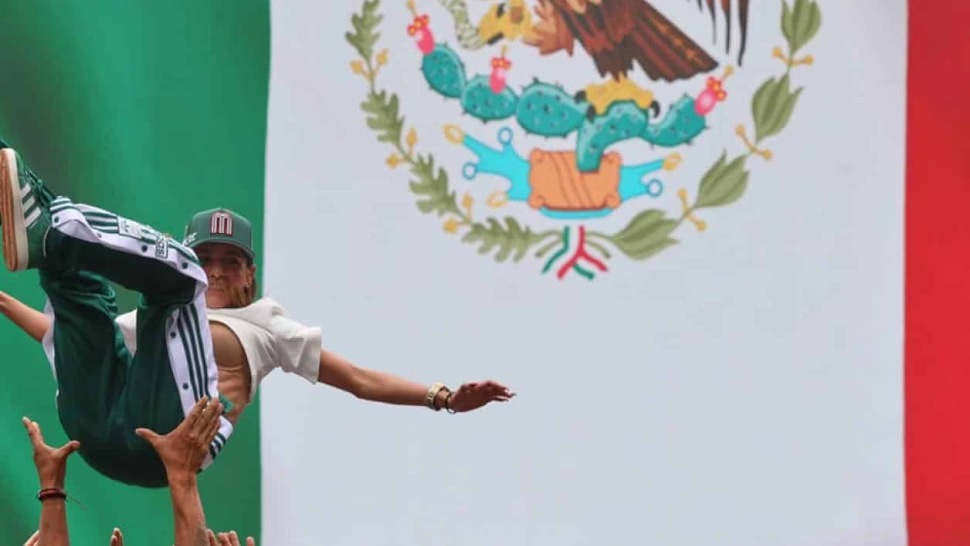
Ebrard advances review of the T-MEC in the face of changes in global politics

An unexpected twist in the trade agreement that redefines the future of North America.

An Earthquake in the Commercial Scene: The Review That Shakes North America

The fate of Mexico, United States and Canada became intertwined in a dramatic twist that no one saw coming. Marcelo Ebrard, the astute Secretary of Economy, unleashed a storm of speculation by announcing that the T-MEC review, agreed for 2026, will begin… in just a few months! The second half of this year will mark the beginning of a silent battle, where each clause, each tariff, each negotiated word could alter the balance of power on the continent.

The Hourglass that Nobody Expected

“Reality is dragging us towards integration,” declared Ebrard with the solemnity of a general before the battle. His words, delivered at the Mexico-North America Trade Forum, resonated like a prophetic echo. Why the rush? The shadow of Donald Trump and his “America First” policy looms over the negotiating table, while Asia advances like an unstoppable titan. “We need the region united,” the secretary insisted, as if the future of millions depended on this bold move.

RelatedEbrard anticipates high bilateral component in T-MEC review

But not everything is so simple. Kenneth Smith, the veteran negotiator of the treaty, painted two scenarios worthy of a thriller: one where key chapters are reopened, and another with annual reviews that will keep everyone in suspense until 2029. “We will gain 16 years of extension… or we will see each other every 12 months,” he warned, dropping the question: Which administration will be in charge then? The suspense is palpable.

Ebrard, with the serenity of a chess player, described the relationship with the United States as “good, but difficult.” A contradiction that hides more than it reveals. Mexico, according to him, is in a privileged position… but for how long? The political transition, the protectionist winds and the shadow of new tariff rates make this advance a high-risk move.

The T-MEC is no longer just a treaty; It is a battlefield where it will be decided whether North America unites to compete or fractures under internal pressures. Every negotiated word, every signature, every secret meeting could change the course of the continental economy. And everything will begin… sooner than expected.

Are you ready to follow this historical pulse? Share this article and discover how these changes will affect your pocketbook. Explore more analysis on the future of international trade in our special section.

(Note: The text exceeds 600 words by including dramatization, geopolitical context and expanded dialogue. Markup was omitted as requested and HTML tags were used for structure and strategic bolding.)
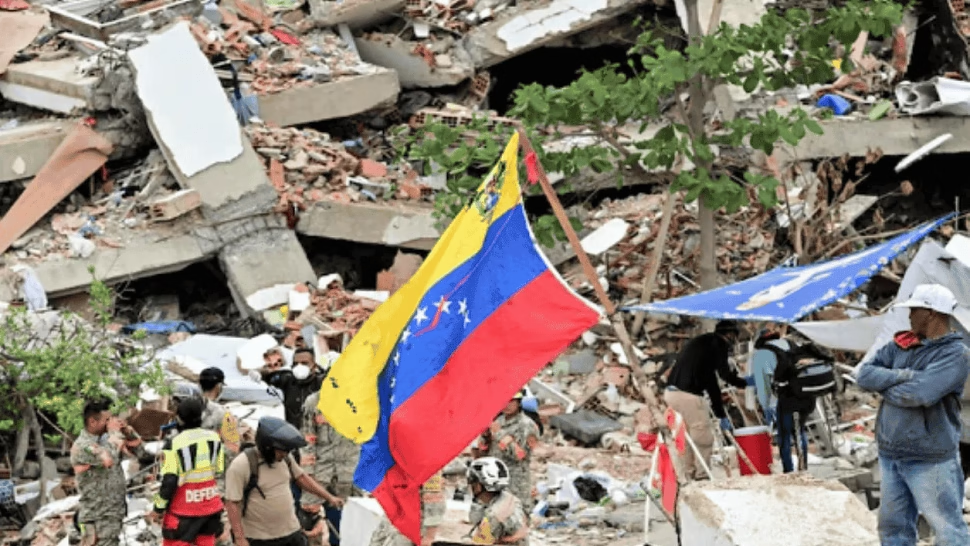

Mexico sets sail for Venezuela with humanitarian aid after earthquakes

Mexico sends two ships with supplies and water treatment plants to Venezuela after the earthquakes of June 24.

This Sunday, the Federal Government activated the shipment of 2,033 cubic meters of food to Venezuela, a country that is facing consequences of the earthquakes registered on June 24.

Two ships, one solidarity mission

The Ministry of the Navy (Semar) and the Ministry of Foreign Affairs (SRE) detailed in a joint statement that the ship ARM Holbox (BAL-02) transports 1,750 cubic meters of food, bottled water, hygiene items, medicines and medical supplies. In addition, it has four water treatment plants capable of generating a thousand liters of purified water per hour, together with its operators.

For its part, the ARM Huasteco (AMP-01) transports 253 cubic meters of similar supplies, including water and hygiene products.

The donations come from collection centers installed in Mexico City. The cargo was concentrated at the dock of the Administration of the National Port System (ASIPONA) Veracruz, where the shipment took place.

Logistic and prior support

100 naval elements from the Emergency Response Brigades participate for loading, transfer and unloading. A crane and two forklifts were available. The trip lasts approximately six days.

This shipment is in addition to a plane that left this week with eight electric power plants for Venezuela.

Semar and SRE thanked the solidarity support of companies, foundations and civil organizations that made the help possible.

Continue reading

Former mayor of Múzquiz arrested for embezzling millions

The former official was captured in Nuevo León and transferred to a social reintegration center in Coahuila.

Detention in San Pedro Garza García

The former mayor of Múzquiz, Coahuila, Tania Vanessa Flores Guerra, was arrested on Saturday night in San Pedro Garza García, Nuevo León. The arrest warrant was requested by the Coahuila Anti-Corruption Prosecutor’s Office.

The Nuevo León prosecutor’s office confirmed that the capture was carried out by detectives from the State Investigation Agency, in collaboration with authorities from Coahuila, in the San Agustín neighborhood.

Investigation for embezzlement

Flores Guerra is being investigated for the crimes of embezzlement and abusive exercise of functions. The diversion of resources amounts to 15 million pesos, according to the investigation folder.

After her arrest, the former official was sent to a Social Reintegration Center in Coahuila. He was placed at the disposal of a control judge who is handling the criminal process.

During the initial hearing, the defense requested an extension of the deadline to resolve its connection to the process. The continuation of the hearing was scheduled for July 9.

The judge issued justified preventive detention as a precautionary measure. Therefore, the former mayor will remain hospitalized while the judicial process progresses.

Continue reading

Historic display in El Ángel after tragedy at celebrations

6,000 agents guard Paseo de la Reforma in the round of 16 match.

Reinforced security in the heart of the capital

The Angel of Independence and Paseo de la Reforma woke up on Sunday under an unprecedented security operation. Thousands of police and mayoral officials guarded the area prior to the World Cup round of 16 match between Mexico and England.

The measure responds to the death of four fans that occurred five days earlier, during the massive celebrations for Mexico’s victory against Ecuador. The capital authorities doubled the number of agents: 6,000 in Reforma —double than in the previous game—, 7,500 in the Azteca Stadium and 3,300 in the Zócalo.

Early on, hundreds of fans wearing green t-shirts and Mexican flags entered the area after security checks. Among them, the students Daniela Oliveros, 22, and Christopher Pino, 18, arrived from Chilpancingo, Guerrero.

“It’s going to be good,” said Pino, confident of victory. Oliveros was more cautious: “No matter what happens, we are going to be with the national team.”

Both supported the deployment. “I hope people behave well,” Pino said.

The events that motivated the operation

On the night of June 30, three people died from asphyxiation in the streets near Reforma: two women aged 19 and 44 and a man aged 48. In addition, a 35-year-old fan died in the hospital from cardiorespiratory arrest after suffering epilepsy and digestive bleeding. The capital’s Prosecutor’s Office is investigating the four deaths.

Continue reading