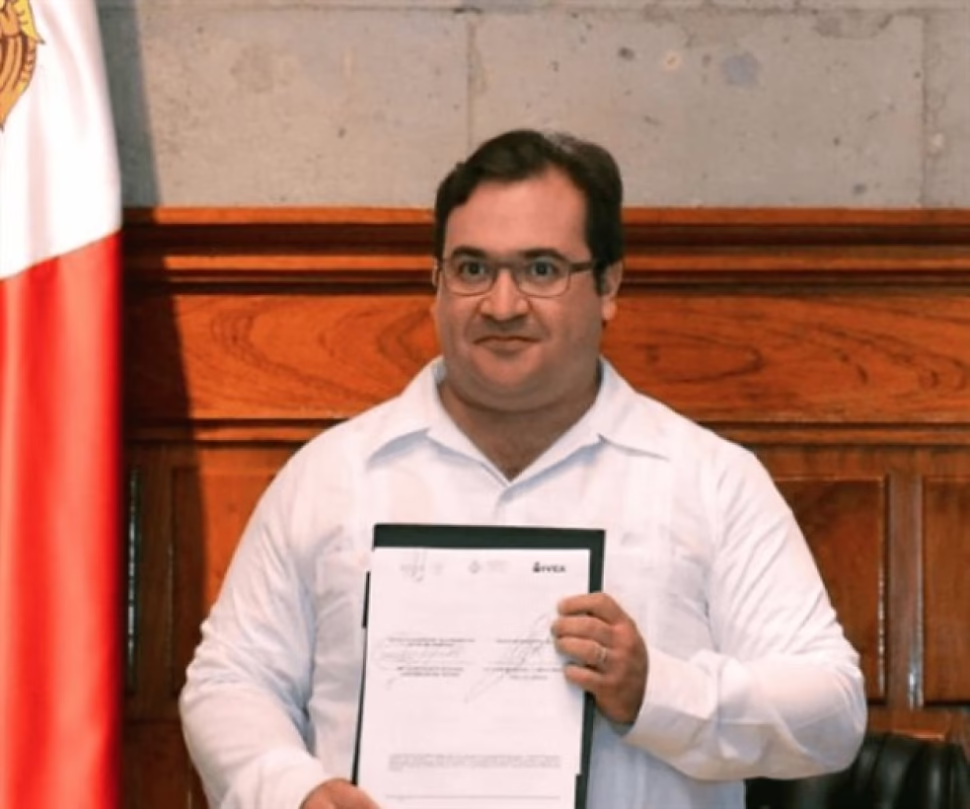
Duarte accuses his successors from prison for the floods

A message loaded with accusations from prison reveals a political battle that, according to its author, explains the tragedy that the state is experiencing.

A Battle Cry from the Shadows

In the midst of the aquatic devastation that has plunged Veracruz into a blanket of mud and despair, where the rivers have become rampaging beasts destroying everything in their path, a voice emerges from the very depths of the confinement. It is not a voice of consolation, but a poisoned dart loaded with resentment and accusations. Javier Duarte, the former governor whose figure is torn between infamy and the defense of his own political legacy, has launched a message that resonates with the force of thunder in the already convulsed state panorama. From his cell, he has woven a narrative where he is the misunderstood visionary and his successors, the architects of the current ruin.

The Accusation: A Legacy Systematically Destroyed

With prose that mixes bitterness with an air of moral superiority, Duarte not only limits himself to observing; declare war. Pointing an accusing finger at Cuitláhuac García and Miguel Ángel Yunes, he places the ultimate responsibility for Veracruz suffering on them. In his story, it was not the unleashed fury of nature that was the true enemy, but rather a planned demolition of everything he, as he claims, successfully built. His message is not a mere complaint; It is a chronicle of what he denounces as deliberate incompetence and a thirst for excellence that ended up plunging the state into vulnerability.

RelatedJavier Duarte’s freedom is suspended for obstruction of justice

“One of the reasons why Veracruz is suffering… is that during the 2 years of Miguel Ángel Yunes’ mandate and the 6 of Cuitláhuac García’s mandate, the only thing they dedicated themselves to was destroying my legacy as a systematized way to stand out in the face of their ignorance,” wrote the former president, transforming the climate tragedy into the perfect scenario for a political reckoning of epic proportions.

The Golden Age vs. The Announced Collapse

Duarte paints his administration with the colors of a golden age in matters of Civil Protection. He talks about the creation of the state risk atlas as if it were a treasure map to save lives, and early warning as an always awake watchman. It boasts of having had “the best team of collaborators in this matter, well equipped and well trained,” an elite army ready to battle against the onslaught of hurricanes. According to his personal epic, during his mandate, despite facing cyclones of ferocious intensity, human losses were minimal, a testimony, in his vision, of effective and far-sighted management.

All this scaffolding, this supposed unbreakable fortress, would have collapsed like a house of cards under the yoke of its “useless successors”. In his dramatic story, the dismantling of his system has left the population defenseless, forcing the current governor Rocío Nahle to face a “titanic task” from scratch, carrying the weight of other people’s mistakes. Federal aid, which in its time came to bring the situation under control, is now perceived, in its narrative, as a late arrival to a disaster that could have been mitigated.

Populism: The Great Villain of Tragedy

But his criticism does not stop at specific people; rises to condemn a phenomenon that, in his eyes, is the cancer that eats away at true management: populism. He describes it with disdain as a “cult of personality”, a papier-mâché stage set up for the opportunistic photo. With a nod to his past, he states that “more than taking photos with water up to my waist… the important thing was to solve the problem, not gain popularity.” It is an argument that seeks to differentiate, at all costs, what he considers serious and technical management, from what he labels as pure empty spectacle. In his world, solutions are worth more than applause, although the official story tells a very different version of his time in power.

This message, launched from prison isolation, is not just an explanation; It’s a weapon. It is one man’s attempt to rewrite his place in Veracruz history, using current misfortune as proof of his innocence and the guilt of others. Every word is charged with the tension of a drama that is far from over, where flood waters mix with the murky waters of politics, creating a perfect storm of accusations, wounded pride and a battle for memory that defines the present and future of a state marked by tragedy.

Do you think Duarte’s criticisms are justified or are they an attempt to rewrite his legacy? Share this shocking story on your social networks and explore more content about the ins and outs of Mexican politics.
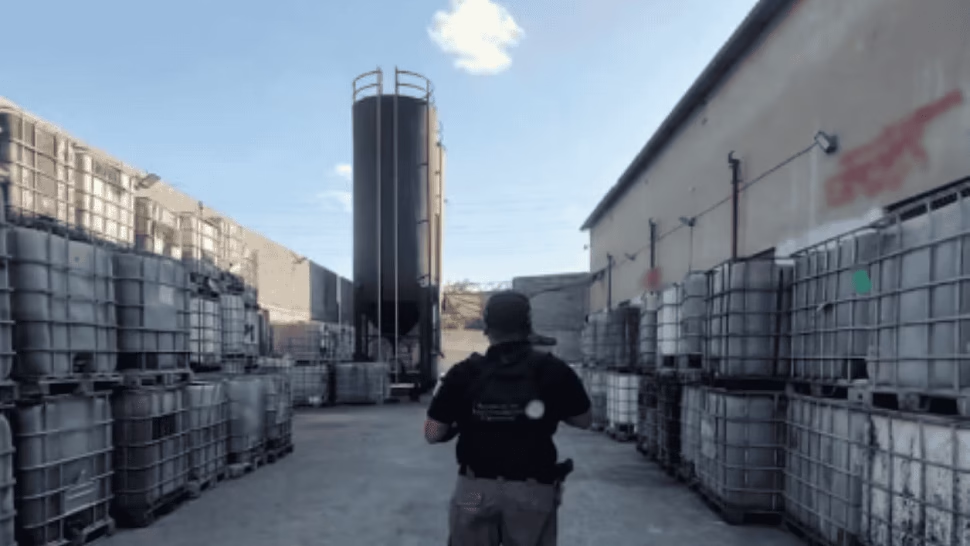

Vice Admiral appeals denial of protection for huachicol in the Navy

Manuel Roberto Farías Laguna seeks to reverse the ruling that keeps him detained by the huachicol network.

Vice Admiral Manuel Roberto Farías Laguna, accused of leading a huachicol network from the Navy, challenged the judicial decision that denied him protection. His defense presented an appeal for review before a Collegiate Court in Criminal Matters.

The court will define whether to admit or reject the appeal. If admitted, he will review the sentence of Judge Jorge Adrián Cruz Flores, who on June 22 denied federal protection. If he ratifies it, the Vice Admiral will continue to be held in the Altiplano prison.

Farías Laguna requested protection in October 2025, after Judge Mario Martínez Elizondo linked him to proceedings for organized crime and fuel trafficking. The FGR accuses him of leading an organization that operated the disembarkation of at least 31 vessels with fiscal huachicol at the customs of Altamira and Tampico, Tamaulipas.

Details of the accusation

According to the Prosecutor’s Office, a group of sailors and customs officials, led by brothers Manuel Roberto and Fernando Farías Laguna, would have coordinated the entry of stolen fuel during the six-year term of former president Andrés Manuel López Obrador. The network operated with complicity within the same institution.

The resolution of the Collegiate Court will be key for the legal future of the accused. The case shows the challenges in the fight against huachicol when it involves senior Navy commanders.

Continue reading

Former director of Pemex faces criminal proceedings in Atlacholoaya

Former director of Pemex claims fruit and judge orders medical attention in Atlacholoaya.

Entry to the Atlacholoaya prison

Víctor Rodríguez Padilla, former director of Petróleos Mexicanos (Pemex), was admitted to the Observation and Classification Center of the Atlacholoaya prison after his arrest at the Benito Juárez mayor’s office in Mexico City. He is accused of family and vicarious violence, for attacking his wife in the presence of their youngest daughter.

During his first morning in the protection area for officials, he expressed dissatisfaction because they did not bring him fruit. The prison rule is that fruit is served only to those who are on a sick diet. Later they gave him pieces of melon, and other prisoners indicated that he probably paid for this benefit, a common practice in that area.

Rodríguez occupies a single cell, wears a beige uniform and plain tennis shoes. So far he has not received visits from family or friends. He also did not have companions at the accusation formulation hearing last Wednesday. Judge Consuelo Adriana Carrera Ortiz asked twice if there was any family member present, without receiving a response.

In that same hearing, the former official reported that he is undergoing treatment for a malignant tumor in the prostate. The judge ordered immediate medical attention.

“I am going to order that the corresponding letter be sent to the director of the Social Reintegration Center so that they can immediately provide medical attention and they must inform me within 24 hours,” said the judge.

Rodríguez tried to detail his medication, but the judge interrupted him: “I cannot order in this office that you be given these medications, because I am not a doctor; however, a doctor will determine if it is pertinent for you to take these medications.” Complaints have been registered in the prison about lack of medication.

Continue reading

Leak in Cereso de Sonora activates search operation

Three inmates escaped from the Hermosillo prison; Federal and state forces are looking for them.

Three people deprived of liberty escaped from the Social Reintegration Center (Cereso) Number 2, in Sonora. The incident occurred in the early hours of Saturday, July 11, and triggered a security operation in the area.

The absence of the inmates was detected around 5:30 a.m. during the roll call. The prison is located at kilometer 21 of state highway 100, on the Hermosillo-Bahía de Kino route.

Search operation

Corporations from the three levels of government reinforced surveillance in the area. Elements of the State Public Security Police, the Ministerial Criminal Investigation Agency (AMIC), the National Guard and the Mexican Army guard the main and rear entrances. They also carry out tracking tours in the surrounding area.

The Secretary of Public Security of Sonora confirmed the evasion through a statement. He noted that the State Penitentiary System immediately activated security protocols.

Investigations in progress

All authorities participate in the actions to recapture the fugitives. At the same time, investigations are being carried out to determine how the escape occurred. So far, the identity of the escapees and the exact circumstances of the escape have not been revealed.

The agency indicated that it will continue to report on the progress of the operation and the investigations.

Continue reading