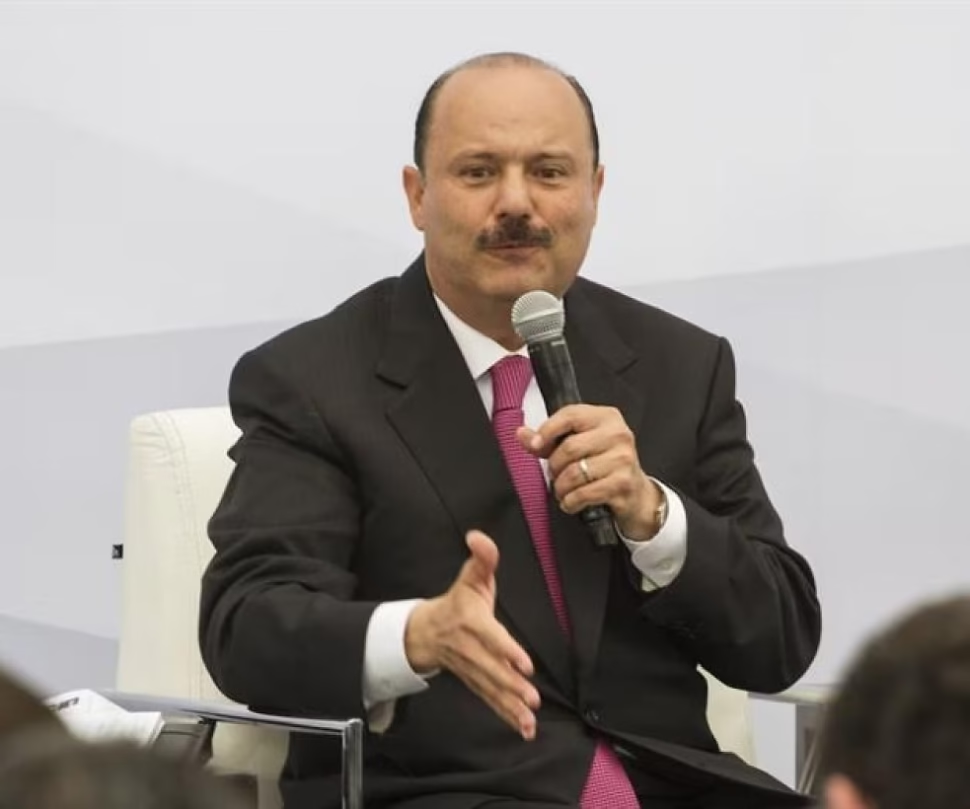
The FGR carries out the arrest of César Duarte for money laundering

The federal justice system closes its grip on the former president, executing an arrest warrant that marks a before and after in the case.

Any Monday in Chihuahua, or not so much

It seems that Mondays are not only hard for ordinary mortals. The Attorney General’s Office (FGR), in a fit of enviable punctuality, decided that this beginning of the week was the perfect time to give an institutional hug to the former governor of Chihuahua, César Duarte Jáquez. The reason? His alleged and always denied friendship with the crime of money laundering. Federal sources, those who always know more than us, confirmed the move. The former PRI president, who enjoyed a comfortable regime of conditional freedom while facing other happy little issues of corruption, was invited to an urgent meeting in the city that he once governed. What a coincidence, right?

Walking through the Altiplano: an unsolicited trip

Duarte, who served as boss in the entity between 2010 and 2016 (a period that, according to investigations, was quite creative at an accounting level), will not stay to enjoy the Chihuahuan climate. Your next destination is the exclusive Federal Social Rehabilitation Center number 1, El Altiplano. A maximum security residential complex in the State of Mexico, reserved for guests who allegedly committed high-impact misdeeds. Quite a detail. This arrest is the culmination of a months-long investigation, which starts from a previous chapter: the extradition of the former governor from the United States in 2022. At that time, Chihuahua was demanding him for gems such as diversion of funds and unexplained enrichment. It seems that the menu of charges has just been expanded.

RelatedCourt admits César Duarte’s complaint for denial of freedom

During the era of former PAN governor Javier Corral, a hole in the public coffers of about 6,000 million pesos was documented. A pittance, wow. Money that, according to the investigations, found a very loving way to benefit Duarte, materializing in properties in Mexico and the United States. After his return to homeland, and under the state government of María Eugenia Campos, the former president enjoyed certain procedural facilities. This situation generated more than one gesture of disapproval from the federal government, which pointed out – with all the irony that reality surpasses – the message of impunity that was being sent. Because nothing says “we believe in justice” like letting someone walk around accused of embezzling billions.

A change of direction (or of the prosecutor’s office)

The plot has a bureaucratic-delicious twist. For a year and a half, the Federation negotiated with the United States for permission to prosecute Duarte for federal crimes. It turns out that the initial extradition came with conditions, as if it were a cell phone offer, limiting the charges that could be filed. The long-awaited authorization arrived last week. Is anyone surprised that justice moves at the speed of a postal procedure? With this approval in hand, a federal judge issued the arrest warrant that the FGR zealously executed this Monday. This case represents the first major media movement – ​​sorry, I meant relevant blow – of the Prosecutor’s Office under the leadership of Ernestina Godoy, who recently took the reins after the departure of Alejandro Gertz Manero. What a way to take office for the first time, making it clear that you are not playing games.

In summary, we have a former governor, a million-dollar accusation of money laundering, an extradition, controversial paroles and a new prosecutor making her first masterstroke. Politics in Chihuahua, and the fight against corruption in Mexico, continue to write chapters that surpass any soap opera. The only question left is: will this be the end of the saga or simply a new episode full of appeals and legal resources? Time, and the courts, will tell. Meanwhile, citizens observe, between skepticism and hope, whether this act of law enforcement marks a real turning point or is just another show in the circus of Mexican justice.

Are you surprised by this twist in the endless Duarte case? Share this note on your social networks and help us continue covering the threads of corruption with this irreverent tone. Explore more content related to justice and politics on our site.
INEHRM becomes a research and teaching center

The INEHRM is transformed into a research and teaching center under the new secretariat.

Transformation of the INEHRM

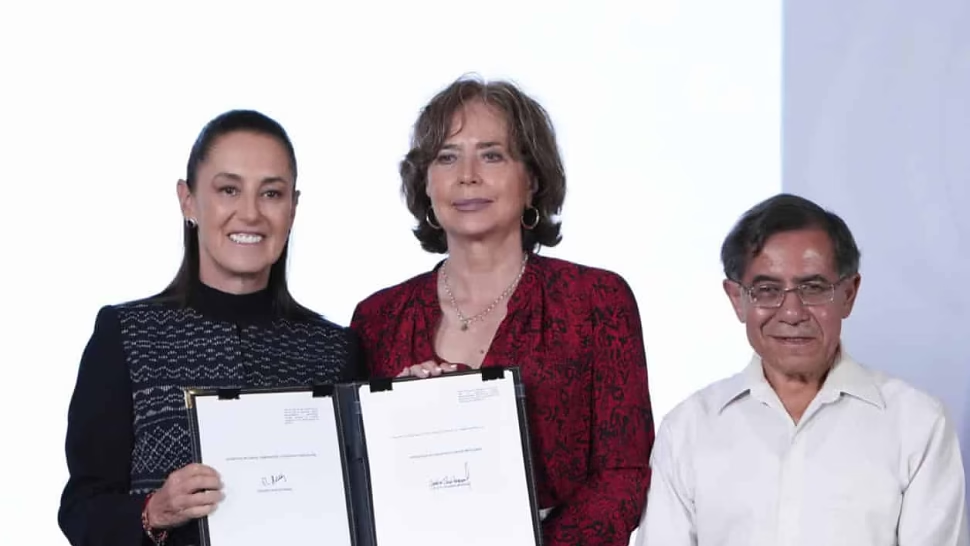
President Claudia Sheinbaum signed the decree that transfers the National Institute of Historical Studies of the Revolutions of Mexico (INEHRM) to the Secretariat of Science, Humanities, Technology and Innovation (SECIHTI). The institute becomes a decentralized public body with an academic focus.

Rosaura Ruiz Gutiérrez, head of SECIHTI, explained that the new scheme will train specialists in history to strengthen national capacities in social sciences and humanities.

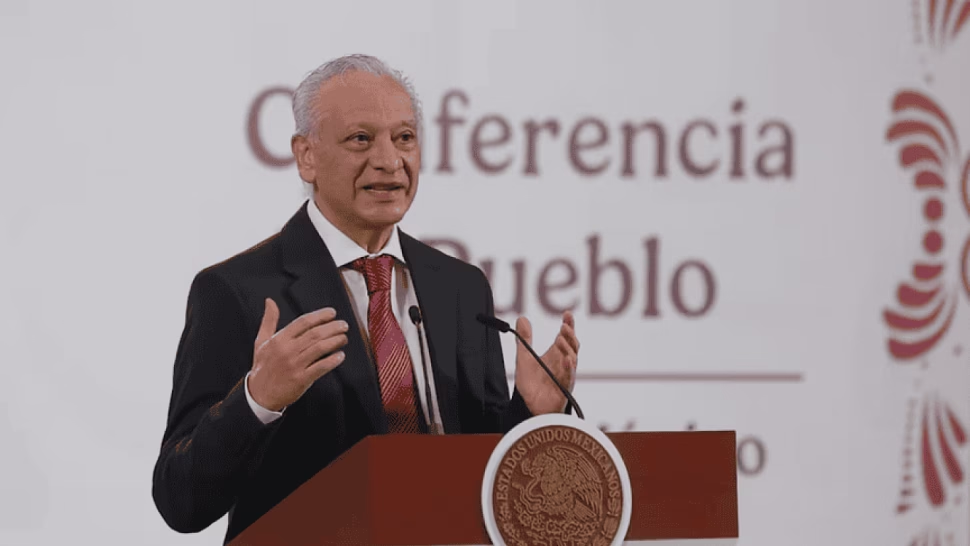
Felipe Arturo Ávila Espinosa, director of the INEHRM, explained that the study plans will link historical knowledge with social, economic, political and cultural problems of the country, and will address the needs of the Federal Public Administration.

Hybrid educational offer

The offer will include bachelor’s degrees in History, Social Sciences and Humanities, and Public Administration and Good Government. In postgraduate studies, master’s degrees will be added in Mexican Humanism, Gender and Feminism Studies, and Social Movements and Rescue of Historical Memory. There will also be specialties in Political Communication and History Teaching.

Graduates will cover topics such as agrarianism, health, migration, artificial intelligence, violence and human rights.

Headquarters and call

The new headquarters will be at 80 Guatemala Street, Historic Center of Mexico City. The first admission call will be launched in July, and classes will begin in September.

Continue reading

Prosecutor’s Office grants protection measures to victim of family violence

The Morelos Prosecutor's Office issued protection measures after a complaint of family violence against the former director of Pemex.

The Morelos Attorney General’s Office activated protection measures in favor of Felicia Jiménez Lavie, who filed a complaint for family violence against her husband, Víctor Rodríguez Padilla, former director of Pemex. This was reported by prosecutor Fernando Blumenkron Escobar.

The measures, the official explained, will be available when the victim requires them. The complaint was filed in Mexico City and the Women’s Secretariat of the Government of Mexico directly follows up on the case.

Investigation in progress

Until now, Jiménez Lavie has not gone to the local Public Ministry to contribute more elements to the investigation folder. This was initiated ex officio last Friday, June 26, after a video was broadcast with images of attacks against the woman.

Blumenkron assured that the portfolio continues its integration. “The proceedings have not stopped and we are going to continue to guarantee justice for the victim,” he said. In addition, he indicated that there is coordination with the Women’s Secretariat and the capital’s Prosecutor’s Office, under the care route for victims of family violence.

Among the actions carried out, the Morelos Prosecutor’s Office seeks to locate the address where the physical assault occurred, to carry out expert reports in accordance with the images of the video broadcast by the victim herself.

Continue reading

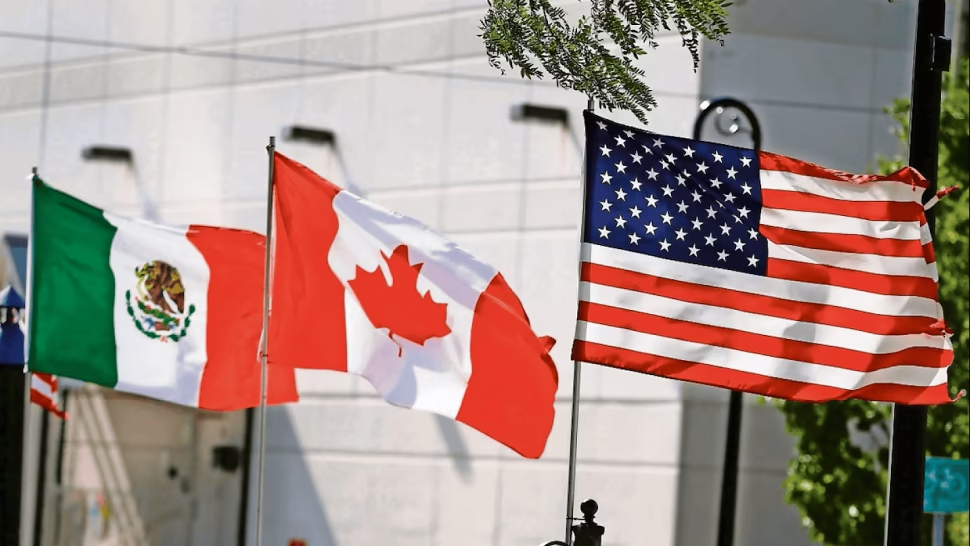
Trump does not extend T-MEC: Mexico faces annual review

US rejects automatic extension of the T-MEC; validity is reduced to 10 years with annual review.

Rejection of automatic extension

The United States decided not to automatically renew the Treaty between Mexico, the United States and Canada (T-MEC) for 16 years. This reduces its validity to a decade with an annual review. The measure generated concern among Mexican legislators.

Ricardo Monreal, coordinator of Morena in San Lázaro, explained that the treaty remains in force for another 10 years, but subject to evaluation each year. He noted that the United States presented 54 observations, including issues such as the vaquita porpoise and piracy. Mexico, for its part, raised 13 points, including clause 232 on tariffs.

“Only it will be reviewed year after year, but the Treaty is not finished, it continues for another 10 years because that is how it was signed six years ago,” declared Monreal.

The legislator warned that Donald Trump has been a constant critic of the USMCA and called for considering the benefits it has brought to the three nations.

Reactions of the opposition

Héctor Saúl Téllez, vice economic coordinator of the PAN, considered that the US position shows a lack of strategic anticipation on the part of the federal government.

“The US decision not to automatically extend the USMCA for 16 years in today’s review is not the end of the treaty, but it does reveal a lack of strategic anticipation by the federal government,” he stated.

Téllez recalled that Article 34.7 of the agreement had been known since 2018. Reaching July 1 without a clean extension represents a risk that, he said, should have been avoided.

The annual review will allow adjustments, but uncertainty about the future of regional trade persists. Mexico and Canada will seek to maintain the stability of the agreement for the next ten years.

Continue reading