Dramatic rescue in Cajeme frees kidnapped women and minors

An operation in the dead of night freed three souls trapped in a hell of threats.

The Night that Changed Everything

In the shadows of Cajeme, where fear reigned like a tyrant, a flash of hope burst forth with the force of lightning. The Ministerial Criminal Investigation Agency (AMIC), armed with courage and precision, carried out an operation that would shake the foundations of organized crime. Three lives, caught in the grip of despair, were torn from the jaws of their captors in a rescue that seemed straight out of a thriller.

The Clock Was Running Against

It was the night of May 12, 2025, when the silence of the Los Héroes neighborhood was broken by the roar of engines and the whisper of radios. The authorities, acting with the precision of a surgeon, broke into a building on Tomás de Aquino Street. There, between walls that kept unspeakable secrets, were a 36-year-old woman, a child of just 9 years old and another 39-year-old woman, whose faces reflected the terror of endless days under death threats.

RelatedArmed men kidnap a woman at a food stand in Cajeme

The psychological staff of the State Attorney General’s Office (FGJE) rushed to provide them with comfort, but the invisible scars promised to be deep. Meanwhile, justice was already moving its pieces: three arrest warrants were issued against the monsters who had woven this nightmare.

The Network Shuts Down

But the story didn’t end there. The next day, under the relentless light of midday, a new act of this drama unfolded. A coordinated search between AMIC, the Secretariat of National Defense and expert services revealed an arsenal that would chill the blood of even the bravest: AR15 rifles, AK47, pistols, radio frequency equipment, and the most chilling thing: wrappers with a bluish substance that screamed “methamphetamine.” Sealing machines, scales and a suitcase with ballistic material completed the picture of a macabre business.

A fourth individual, caught in his labyrinth of lies, was dragged to justice. The evidence and the detainees, now in the hands of the authorities, await the trial of the courts, while the echo of their crimes resonates in every corner of Sonora.

Do you dare to share this story of courage and justice? Spread this story on your networks and discover more about the tireless fight against darkness. #JusticeForCajeme

Sterile fly plant inaugurated in Chiapas; key binational cooperation

New binational plant will produce 100 million sterile insects per week to protect livestock.

Strategic plant against livestock pest

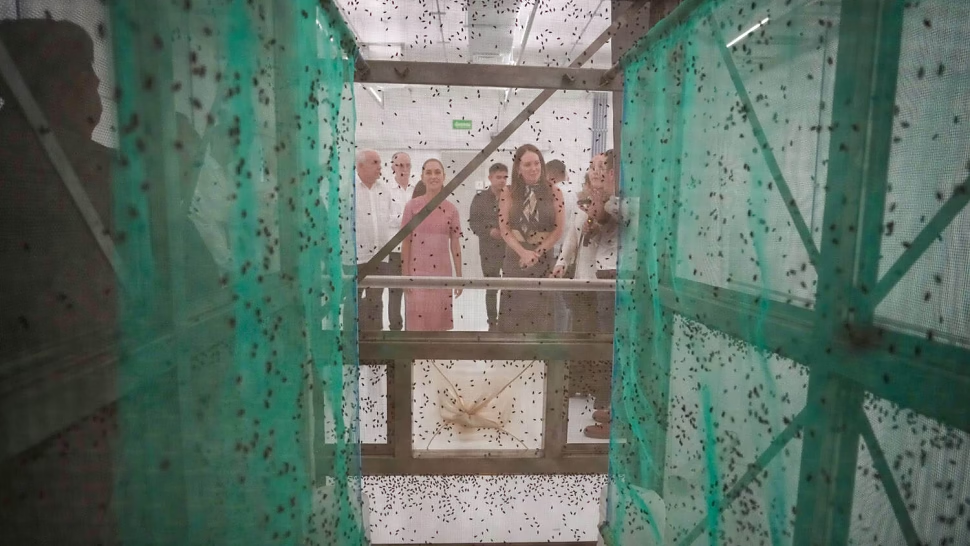
President Claudia Sheinbaum inaugurated the Production Plant for Sterile Livestock Screwworm Flies (GBG) in Metapa de Domínguez, Chiapas. The project is binational between Mexico and the United States.

The facility will produce 100 million sterile insects each week. The objective: control the pest and strengthen animal health in both countries.

Sheinbaum highlighted that international cooperation generates results in the face of phytosanitary challenges that do not recognize borders. He thanked President Donald Trump and the US authorities for their financial and technical contribution.

Investment and results

The US ambassador to Mexico, Ronald D. Johnson, announced an additional investment of 83.8 million dollars. The resources will be used to intensify the fight against the pest, increase the production of sterile flies and strengthen preventive strategies.

The US Secretary of Agriculture, Brooke L. Rollins, described the achievement as an example of the success of coordinated work.

For her part, the Secretary of Agriculture and Rural Development, Columba Jazmín López Gutiérrez, explained that the plant was built in 12 months. As part of the containment actions, 5.3 million heads of cattle have been inspected, more than 84 thousand commercial shipments have been verified and 7 billion sterile flies have been released with the support of specialists.

The bilateral relationship, Sheinbaum stressed, must continue on mutual respect, constant dialogue and sovereignty.

Continue reading

Former Pemex director investigated for alleged assault on his wife

The Morelos Prosecutor's Office is investigating Víctor Rodríguez Padilla for alleged assault on his wife.

Investigation in progress

The Attorney General’s Office of the State of Morelos initiated an investigation file against Víctor Rodríguez Padilla, former director of Petróleos Mexicanos, after the dissemination of a video in which he is seen allegedly attacking his wife, María Felicia Jiménez. The recording, which circulates on social networks, shows Rodríguez Padilla repeatedly hitting the victim inside a home in the municipality of Emiliano Zapata, adjacent to Cuernavaca. According to the metadata of the video, the attack occurred on March 15.

The state agency reported that since Friday it has been exchanging information with the Women’s Secretariat of the Government of Mexico to guarantee the protection of the victim.

“The Attorney General’s Office of the State of Morelos initiated an investigation folder for the probable criminal acts derived from the dissemination of a public complaint through a video, where an act of violence against a woman is seen,” cited the FGE.

Protection actions

The Morelos Prosecutor’s Office specified that the investigation was opened in full respect for the rights of women, girls, boys and adolescents. The statement indicates that the events probably occurred on March 15 inside a home in Emiliano Zapata, with the alleged participation of a former federal official.

The institution assumed the commitment to exhaust all measures to determine responsibilities and guarantee a life free of violence for the victim. So far, no precautionary measures have been reported against Rodríguez Padilla, and the investigation is still ongoing.

Continue reading

Sheinbaum supervises progress of IMSS-Wellbeing with governors

Sheinbaum leads meeting with 23 governors to evaluate progress in the health system.

Advances in public health

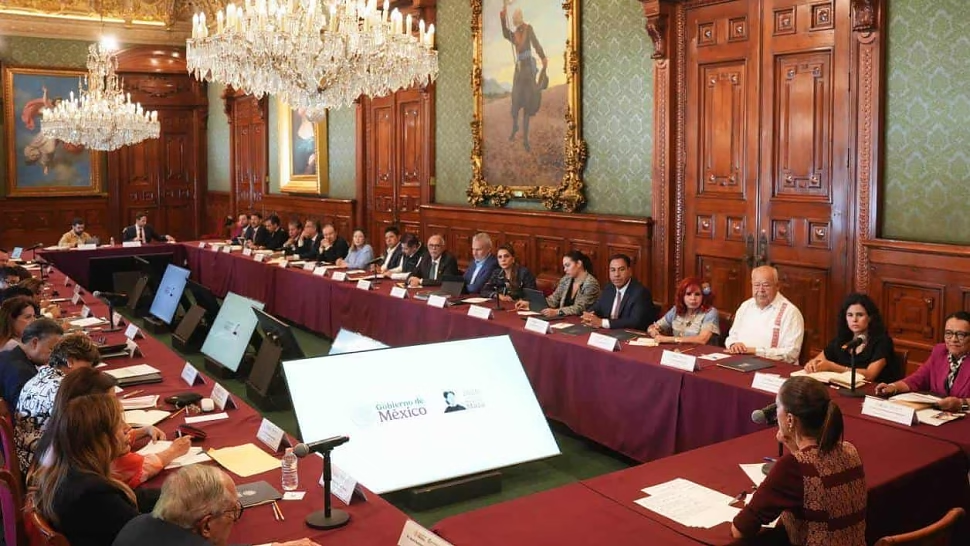
At the National Palace, President Claudia Sheinbaum led a follow-up meeting on the IMSS-Wellbeing model. Governors of the 23 entities integrated into the program participated.

“The objective is to guarantee quality, universal and free medical care for the people of Mexico.”

The federal cabinet was attended by Rosa Icela Rodríguez (Government), David Kershenobich (Health), Luisa María Alcalde (Legal Department), Eduardo Clark (Undersecretariat of Health), and the directors of IMSS-Bienestar (Alejandro Svarch), IMSS (Zoé Robledo) and Issste (Martí Batres).

The state leaders present were: Marina del Pilar Ávila (Baja California), Víctor Castro (Baja California Sur), Layda Sansores (Campeche), Eduardo Ramírez (Chiapas), Clara Brugada (CDMX), Indira Vizcaíno (Colima), Delfina Gómez (State of Mexico), Evelyn Salgado (Guerrero), Julio Menchaca (Hidalgo), Alfredo Ramírez (Michoacán), Margarita González (Morelos), Miguel Navarro (Nayarit), Salomón Jara (Oaxaca), Alejandro Armenta (Puebla), Mara Lezama (Quintana Roo), Ricardo Gallardo (San Luis Potosí), Yeraldine Bonilla (Sinaloa), Alfonso Durazo (Sonora), Javier May (Tabasco), Américo Villarreal (Tamaulipas), Lorena Cuéllar (Tlaxcala), Rocío Nahle (Veracruz), Joaquín Díaz (Yucatán) and David Monreal (Zacatecas).

The meeting is part of the periodic supervision to consolidate free coverage of health services in the country.

Continue reading