Deputies analyze reform that allows geolocation without a court order

A controversial legal reform reaches Congress, modifying the regulatory framework for communications in Mexico.

Telecommunications Reform: implications and structural changes

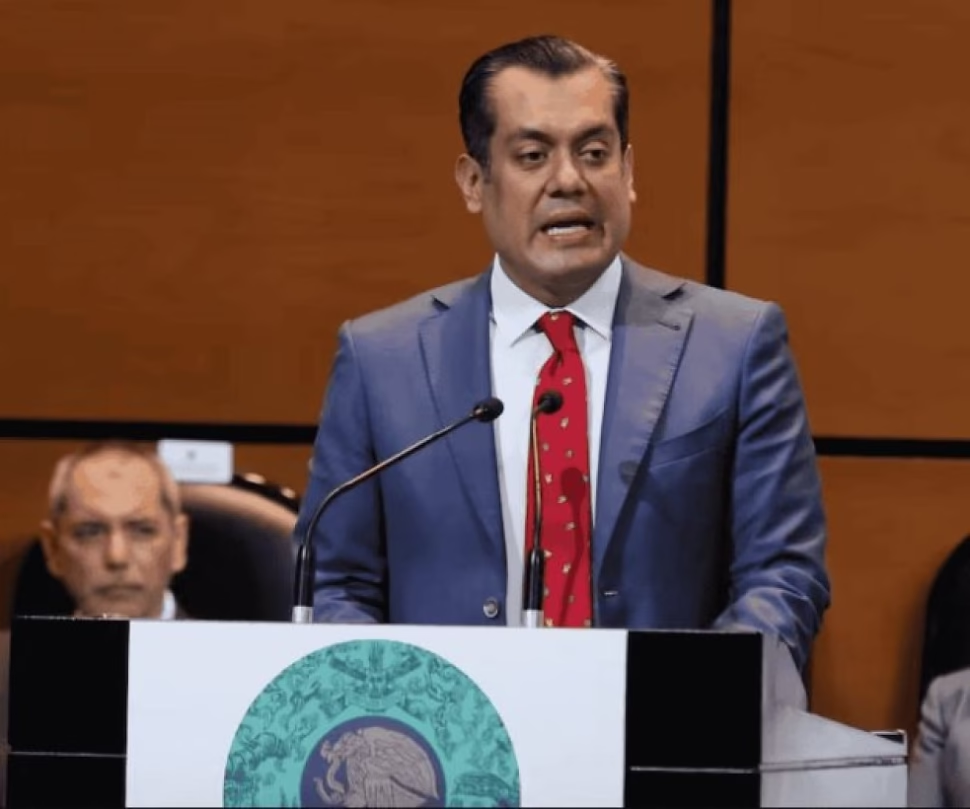
The Board of Directors of the Chamber of Deputies, headed by Sergio Gutiérrez Luna, formally received the minutes of the Telecommunications Law, a legal instrument that introduces substantial modifications to the regulatory framework for communications in Mexico. Among its most controversial provisions are the power to geolocate mobile devices in real time without prior judicial requirement, as well as mechanisms to interrupt radio and television transmissions under allegations of violation of audience rights.

Institutional reconfiguration and new powers

The legislative project, made up of 299 articles and 32 transitional provisions, proposes the extinction of the Federal Telecommunications Institute (IFT) and its replacement by the Digital Transformation and Telecommunications Agency (ATDT). This body will assume expanded powers in supervision of the radio spectrum, critical infrastructure and user protection. At the same time, the minutes were received to create the National Antitrust Commission, an entity that will absorb the functions of the defunct Cofece, with a government structure made up of five commissioners appointed by the federal Executive.

RelatedReform to the Amparo Law alters the balance of power

According to preliminary analyses, the regulations seek to balance three strategic axes:

  • Technological modernization of the sector
  • Protection of constitutional rights in digital environments
  • Strengthening state capacities for crisis intervention

Experts in digital law have pointed out that the provision on geolocation could contravene principles established in article 16 of the constitution, which regulates the right to privacy. Data from INEGI reveal that 89% of the Mexican population over 12 years of age uses mobile devices, which amplifies the potential impact of this measure.

Control mechanisms and legislative debate

Gutiérrez Luna affirmed that the parliamentary analysis will be carried out with “strict adherence to transparency protocols”, although civil organizations such as Article 19 have demanded the immediate publication of the complete opinion. Historically, similar reforms in countries such as Germany and Canada have required safeguard clauses to prevent abuses, including ex post judicial oversight and time limits on interventions.

The chapter on audience rights incorporates concepts from the current Federal Telecommunications and Broadcasting Law, but expands the causes for content suspension. This has generated concern among journalists’ associations, who fear an inhibitory effect on freedom of expression. Statistics from the CNDH show that 73% of complaints about censorship in digital media between 2020-2024 involved state authorities.

Are you interested in knowing how this reform will affect telecommunications users? Share this analysis on your social networks and follow our special on digital regulation. To delve deeper into the topic, explore our coverage on personal data protection in the age of artificial intelligence.
Floods in Aguascalientes after intense overnight rains

Storm in Aguascalientes left vehicles stranded and families rescued. Authorities activated protocols.

Rains collapse roads in Aguascalientes

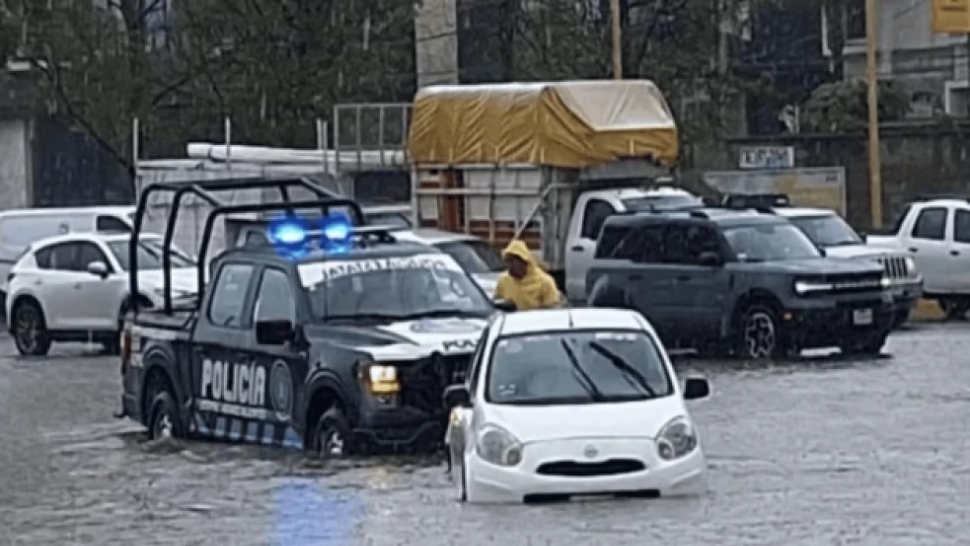
On Saturday night and early Sunday morning, intense rains affected Aguascalientes, Jesús María and Rincón de Romo. Boulevards and avenues were flooded, vehicles were covered in water and entire families were trapped.

Rescues and attention to the population

The greatest impact occurred in the capital. Firefighters and Civil Protection worked for hours to rescue people stranded in different parts of the metropolitan area. They provided assistance to occupants of cars stuck in neighborhoods such as Parques Industrial del Valle, San Francisco de los Romo, the first ring overpass and the exit to Zacatecas.

The overflowing of some channels concentrated the water in the avenues. The State Government reported that security corporations from several municipalities maintain a coordinated operation to provide timely support.

Recommendations and road closures

During the early morning, the authorities asked to avoid driving through flooded areas and to follow official information. The Municipal Public Security Secretariat detailed that the Road Police attended to 42 stranded vehicles and carried out 18 road closures to prevent risks to drivers and pedestrians.

Municipal agents moved entire families, women and minors who could not move due to the storm and flooding to their homes.

Continue reading

CNTE raises a sit-in after 20 days of protest in the Zócalo

The dissident teachers left losses of 410 million pesos and freed up spaces in the Historic Center.

End of the CNTE sit-in

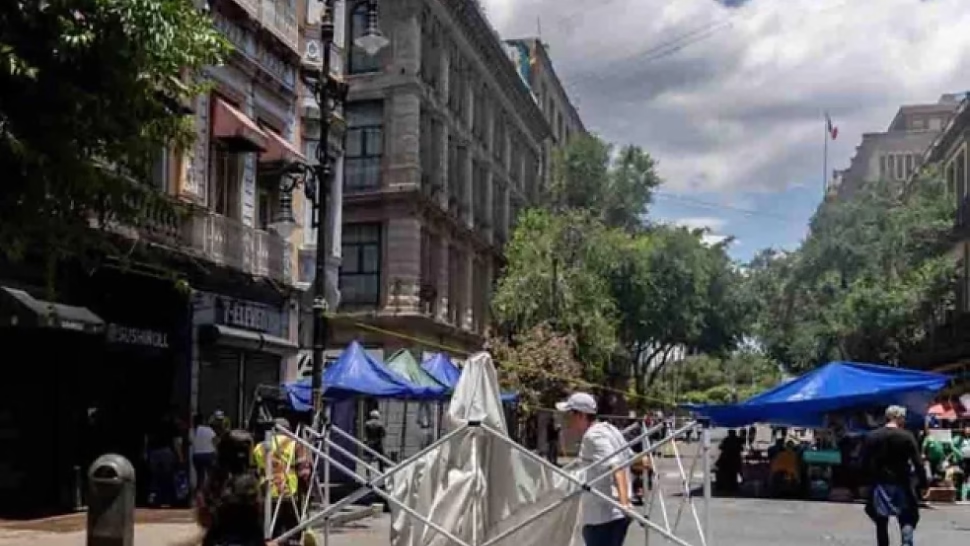
The National Coordinator of Education Workers (CNTE) ended its national strike this Saturday. For 20 days, the mobilizations and the camp in the Historic Center of Mexico City generated losses of more than 410 million pesos to established businesses, according to sector estimates.

Although it did not achieve the repeal of the ISSSTE Law of 2007 or the repeal of the educational reform, the CNTE obtained commitments, financial resources, places, recategorizations and support for education workers in several states.

The leaders assured that the withdrawal is not a defeat. They advanced a stage of reorganization to strengthen the movement and prepare new actions. They insisted that the federal government did not present a proposal to eliminate the ISSSTE Law of 2007 or to reverse the educational reform, demands that will remain in force.

Starting this Monday, around 1.4 million students who remained without classes will be able to return to classrooms in the entities where the CNTE had suspended activities.

Space release

Public space has been gradually freed up. Cleaning workers from the Government of Mexico City removed garbage in streets such as 5 de Mayo, Belisario Domínguez, 20 de Noviembre and República de Cuba. In some areas, the withdrawal was almost total; In others there were still tarps and tents.

A teacher from section 34 of Zacatecas declared: > “We are going to clean it, don’t say that we are going to leave it dirty.”

Merchants expressed relief at the departure of the teaching profession. A worker at the La Blanca restaurant, on May 5, commented: > “It’s good that they’re leaving, it was a very hard month; here we had like a 90% drop in customers.”

A snow seller on the same street indicated that they expected higher sales with the FIFA Fan Fest in the Zócalo, but the arrival of the CNTE reduced their income by 50%.

For his part, the Secretary of Education, Mario Delgado, rejected that the government had “bribed” Section 22 of Oaxaca to hold the sit-in.

Continue reading

Five deaths in bars in CDMX during the early hours of the morning

Two attacks in bars in the capital leave five dead and six arrested.

The early morning left two violent episodes in different parts of the capital

A man lost his life from gunshots outside a bar located in Plaza Garibaldi, Cuauhtémoc mayor’s office. According to the Secretariat of Citizen Security (SSC), the victim was attacked directly in the Lázaro Cárdenas Central Axis and the Republic of Honduras. After the attack, he ran inside the establishment, where he died.

The suspects fled in a gray car, but later returned to the scene along with a blue truck and a subject on a scooter. Agents approached and, after a search, they found packages with one and a half kilos of marijuana and a firearm. They were arrested.

In another incident, an alleged fight inside a bar in the Álvaro Obregón mayor’s office left four people dead and two arrested. One of them was taken to a hospital injured.

Data from the SSC indicate that several people began arguing inside the establishment, in the San Bartolo Ameyalco neighborhood. One of the subjects pulled out a firearm and shot several people. The detainees were placed at the disposal of the authorities.

Continue reading