Deputies analyze opening files for candidates for INE advisors

The Transparency Committee will evaluate opening files for 369 candidates for INE advisors.

The Chamber of Deputies reviews the reservation of information imposed on the selection process of INE counselors. Initially, it was determined to keep the files of 369 applicants under protection for five years.

Proposal of the Transparency Committee

The Transparency Committee of the Chamber of Deputies called an extraordinary meeting to reconsider that decision. The proposal is to open public versions of the documents, protecting only the personal data of the participants.

RelatedSheinbaum proposes electoral reform with INE advisors by popular vote

It is also proposed to create a microsite that concentrates information about the process, including evaluations and part of the files. This would allow greater access to public information.

Why is it being reviewed now?

The review occurs following requests for access to information. Legislative authorities consider that most of the documents can be made transparent. Initially, exams and evaluations were reserved based on criteria from the defunct INAI.

Balance between transparency and privacy

The Committee seeks to determine if it is viable to open the selection process for INE advisors. An attempt is made to balance the right to public information with the protection of applicants’ personal data.

The final decision could set a precedent on how to handle sensitive information in electoral authority designation processes.

Seizure of 48 thousand cans of illegal beer in Tabasco

Seizure of 48 thousand cans of beer without documentation on the Raudales-Malpaso highway.

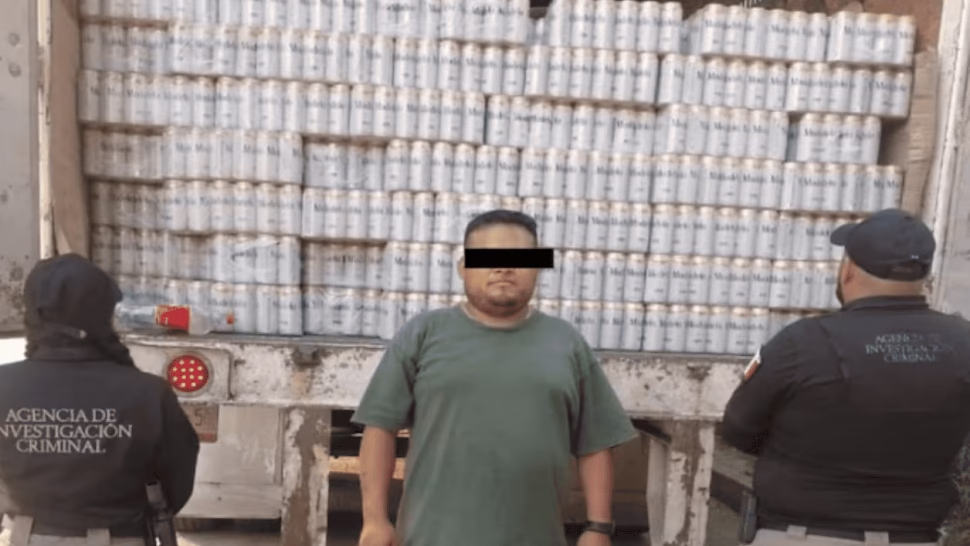
Federal and state security elements seized a tractor-trailer with approximately 48 thousand cans of beer of dubious origin in Tabasco. The driver was placed at the disposal of the authorities.

The operation occurred on the Raudales-Malpaso highway, in the municipality of Huimanguillo. The security forces acted following an anonymous complaint, which allowed strategic investigation work to begin.

At the scene they stopped an International tractor-trailer coupled to a dry box. During the inspection, they located two thousand plates of beer of various brands.

Due to the fact that the driver did not present the required documentation to prove the legal possession and transportation of the product, he was detained.

The detainee, the unit and the shipment were at the disposal of the Public Ministry of the Federation. An investigation folder will be opened to determine responsibilities.

The Attorney General’s Office highlighted the importance of the exchange of operational intelligence to prevent the circulation of illegal merchandise on the country’s roads.

Continue reading

Sheinbaum urges UNAM to resolve controversy over online exam

Sheinbaum asks UNAM to quickly resolve the online exam case.

President Claudia Sheinbaum asked the National Autonomous University of Mexico (UNAM) to quickly resolve the controversy over the online admission exam. The application seeks to give certainty to applicants.

Reaction of the president

During his morning conference, Sheinbaum admitted not having detailed information about the alleged irregularities in the virtual process. “I understand that they have to resolve it. I don’t have much information about how this situation occurred, but it is important that it be resolved soon to be able to give certainty to all the young people who want to enter UNAM,” he declared.

SEP Actions

Mario Delgado, Secretary of Public Education, reported that he spoke with the rector Leonardo Lomelí. According to Delgado, UNAM created a technical group to analyze the case. “The latest information we have is that the registrations that were going to occur starting today, at least, are postponed. They are evaluating what they are going to do, what measures they are going to take and we are there to support each other in whatever is necessary,” he explained.

Ricardo Villanueva, Undersecretary of Higher Education, explained that a technological and reagent review is being carried out. “They told us that everything starts from a typicality in the results, there is an atypical behavior that must be observed. Indeed there is a technological component that must be reviewed; there was a change in the way of taking the exam, which is now virtual,” he said. He added that virtuality alone does not explain the problem, since other institutions have applied online exams without setbacks.

Continue reading

Arrested for femicide in Juxtlahuaca: they demand justice

Relatives demand justice after the arrest of the alleged Delsi feminicide in Oaxaca.

Detention in Juxtlahuaca

Rufino González was arrested by the Attorney General’s Office of the State of Oaxaca (FGEO) as a probable person responsible for the feminicide of Delsi A., which occurred in the community of Nican de la Soledad, municipality of Santiago Juxtlahuaca, in the Mixteca region.

The events occurred on July 11, 2026. According to the investigation, after an argument, González attacked his partner with a firearm, causing a head injury. Delsi lost his life due to severe head trauma caused by a projectile.

“After receiving the complaint, the Oaxaca Prosecutor’s Office began the corresponding investigations, collecting interviews, expert opinions and other evidence that made it possible to establish the probable responsibility of the accused and obtain the arrest warrant,” reported the FGEO.

After the crime, Rufino González stated that Delsi had taken his own life. However, the family called for a thorough investigation. “We want justice for Delsi,” “that they investigate well because his family knew about the facts,” have been some of the demands from family members and community authorities. The victim was a mother of two minors, originally from San Miguel Cuevas.

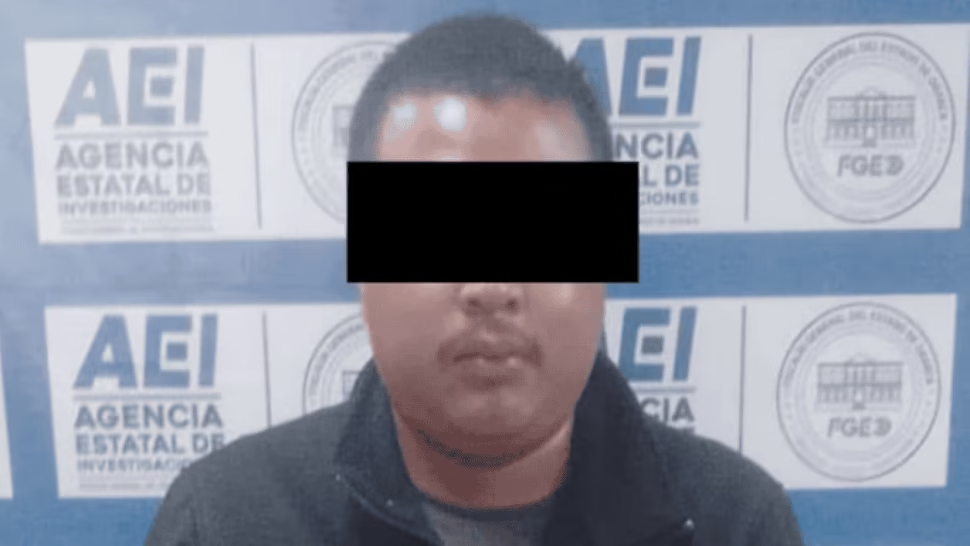
Rufino González was arrested this weekend by elements of the State Investigation Agency and placed at the disposal of the Public Ministry.

Violence figures

So far this year, 47 women have been violently deprived of their lives in Oaxaca, according to monitoring by the Documentation Center of the “Rosario Castellanos” Women’s Studies Group (GESMujer). In more than 50% of cases, the crime was committed with a firearm.

Continue reading