Day of the Holy Cross: faith, sweat and cement in Mexico

The cross in the works is not only faith, it is protection and mason pride.

The cross that crowns the works

This May 3, Mexico dresses in tradition. But be careful, it is not just a matter of saints and candles. The Day of the Holy Cross has become, over the years, the Day of the Mason. A fusion between the divine and the earthly that few countries achieve.

Official history says that it all began in the 4th century, when Saint Helena found the cross of Christ in Jerusalem. Nice story. But here, in Mexico, things took a different turn: the cross was climbed onto the scaffolding.

RelatedDeath is dressed in fame on the altars

Why did the bricklayers adopt it?

Simple: they needed protection. In a profession where carelessness can cost one’s life, placing a cross at the top of the work is an act of faith, yes, but also of concrete hope. Let there be no accidents. May the project go well. Let the employer pay on time.

“The cross not only represents faith, but also protection, effort and pride for thousands of bricklayers”

How to celebrate today

The works are filled with color: crosses decorated with flowers and paper, blessings, masses… and the best: the fellowship. The bosses usually raffle off food, and sometimes even beer. It’s not charity, it’s recognition. Or at least it should be.

The date is no longer just religious. It is a reminder that the country stands on the shoulders of those who mix cement and carry blocks. Without them, there would be no houses, no schools, no government buildings where decisions are made that later affect us all.

So this May 3, when you see a cross in a work, remember: it is not an ornament. It is a silent cry for labor dignity.

Pemex cuts investment and production deviates from the goal

Pemex reduced its investment by 5.9% in the first quarter; crude oil production is moving away from the goal.

Pemex adjusted its spending again. The exploration and production subsidiary received a 5.9% cut in its investment capital during the first quarter compared to what was scheduled.

The approved budget was 86.7 billion pesos, but the company reported to the US Securities and Exchange Commission that it invested 81.6 billion. The difference directly affects the production platform.

Currently, Pemex extracts 1.6 million barrels per day, far from the goal of 1.8 million. Gonzalo Monroy, director of GMEC, warned:

“We are flying directly and non-stop at 1.2 million barrels per day in 2027, which means that once the water is discounted, we would be at a million extraction levels during the next year.”

Drilling rigs also decreased: from 32 to 25 between January and May, according to data from the consulting firm. So far this six-year term, 10 mixed contracts have been awarded, seven in a first block (fields such as Macavil and Tamaulipas) and three recently (Rabasa, San Ramón and Cinco Presidentes). Pemex plans to produce up to 450 thousand barrels per day with these contracts, but the developments would take place beyond 2033.

Oil vocation in question

Miriam Grunstein, an academic at the Mexico Center at Rice University, said that the situation is alarming in the short term. Pemex loses income from lower exports and from privileging feeding the National Refining System, instead of extracting more crude oil.

“Sheinbaum’s government is betting on renewable electricity generation projects. Meanwhile, the budget cut in crude oil extraction indicates that the country no longer has a conviction or vocation for oil,” he said.

Grunstein added that the difference in investment between renewable energy and exploration is enormous: “At some point we are going to face a very harsh reality. The abandonment of extraction has been so much that it is alarming.”

Agreement with Petrobras, but without teeth

The Mexican government signed a collaboration agreement with the Brazilian Petrobras to acquire extraction techniques in deep waters, where Pemex has minimal activity. It includes exchange of knowledge and best practices, but the pact is non-binding, valid for two years and renewable.

Both Monroy and Grunstein agreed that the agreement was weak. Moody’s, when lowering Mexico’s rating on May 20, expressed greater concern about government debt and support for Pemex. The agency estimated that the government provided support for 35 billion dollars in 2025, equivalent to 1.9% of GDP, and budgeted another 14 billion for 2026. An improvement in the rating will depend on reducing the deficit and contingent risks of the oil company.

Continue reading

Jareta and Bundas: the canines that stop drug trafficking in Veracruz

Seven trained dogs detect illicit substances in ports and airports.

Jareta: discipline and training

Jareta, a Belgian Malinois, moves with precision between wooden boxes during an exercise at the Veracruz Naval Air Base. It is part of the seven canines that make up the unit of the First Naval Region. Their training combines play with challenging routines to develop detection skills.

“Due to their operational life and functions for which they are prepared, they are very calm little animals that manage to concentrate on their work,” describes Lieutenant Montserrat Zamora, veterinary doctor of the unit.

The specialist explains that Jareta ignores weapon detonations, explosions and the noise of turbines. When it detects narcotics, it makes a passive alert. “The truth is, it is a great pride because we are a team,” says the officer.

Bundas, forged in trust

At three years old, Bundas reflects inexhaustible energy. He stands out for his obedience and has established a special bond with Second Master Armando Sosa Rojas, in charge of the Canine Department.

“We have created a special bond. I feel a love and an attachment because since he arrived I had to receive him and we are still together,” highlights Sosa.

Bundas is among the unit’s most effective agents. Throughout his service he has contributed to the largest number of seizures through the detection of drug shipments. The teacher remembers that the main objective of the training is that “illicit substances do not reach their destination.”

“I trust my canine a lot, I know him and he is a good asset,” says the officer.

In 2024, the 38 binomials deployed in Veracruz and Tamaulipas secured close to a ton of prohibited substances. The unit operates from the Las Bajadas Aeronaval Base and carries out inspections on vehicles, ships and aircraft.

Continue reading

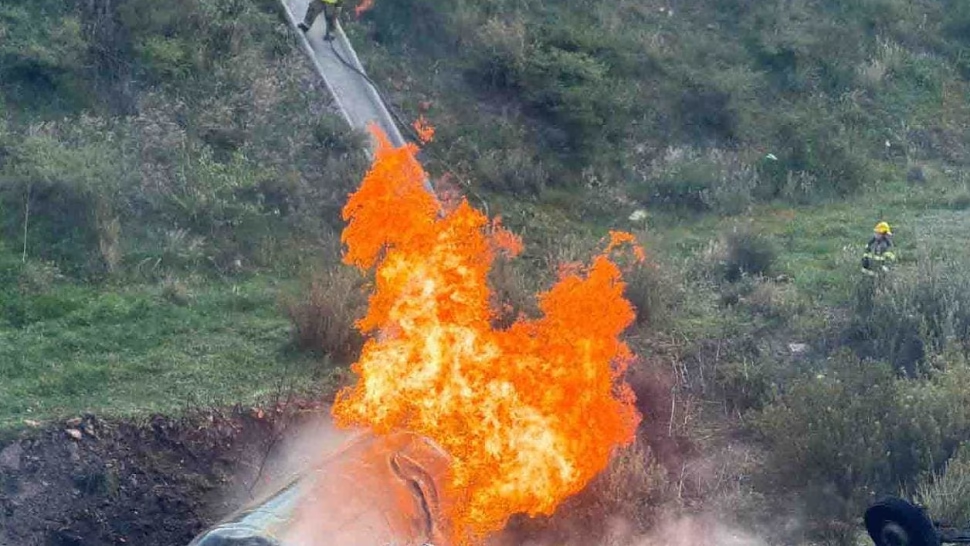
LP gas pipe explosion in Texcoco leaves two dead

LP gas pipe overturning leaves two dead and one injured in Texcoco.

Accident on the Texcoco-Calpulalpan highway

An LP gas pipe overturned and exploded on the Texcoco-Calpulalpan highway. The balance: two people dead and a woman with injuries.

The accident occurred at 7:30 a.m. on Saturday. The driver lost control near the community of Santa Inés. The unit, of the Freightliner brand with a capacity of 24 thousand liters, transported liquefied petroleum gas for the Global Gas company.

After the overturn, the pipe began to burn. The fire hit the driver and his passenger, who were burned to death at the scene.

A woman who was walking in the area was hit by a metal splinter. She suffered injuries to her pelvic limb and was taken to the Guadalupe Victoria Hospital in Texcoco.

The explosion generated a shock wave that damaged the facade of a taco restaurant, which also caught fire. Emergency services extinguished the fire.

Additionally, a Ford Edge pickup truck was damaged. Its driver, a 65-year-old man, was treated by paramedics for facial irritation.

The accident occurred on the borders of Tepetlaoxtoc and Texcoco. Emergency services from both municipalities and the General Coordination of Civil Protection and Comprehensive Risk Management of the State of Mexico attended.

Continue reading