Claudia Sheinbaum begins testing the innovative Chalco-Santa Marta Trolleybus

A revolutionary project that will transform mobility in the Valley of Mexico, reducing time and pollution.

A Historic Milestone in Urban Mobility

The destiny of millions of inhabitants of the Valley of Mexico changed forever on a day that will be recorded in the annals of history. President Claudia Sheinbaum Pardo, with the determination of a leader who defies the impossible, gave the initial signal to the operational tests of the Chalco-Santa Marta Trolleybus. It was not a simple formal act, but the dawn of a new era in public transportation, a work that promises to revolutionize the lives of 2.9 million souls.

With the solemnity of someone who knows he is writing a crucial chapter, Sheinbaum declared: “This is not just transportation, it is a symbol of social justice, a cry of hope for those who have less.” His words resonated like an echo in the hearts of those who have suffered from road chaos and inequality for decades. The electric and sustainable trolleybus will not only reduce travel time from an hour and a half to just 40 minutes, but it will clean the air of a city choked by pollution.

RelatedThe trolleybus that promises to end road chaos in CDMX

A Work Without Precedent in the World

The president did not exaggerate when describing this work as unique on the planet. Imagine: a second floor dedicated exclusively to trolleybuses, where no polluting vehicle will be able to get in the way. A marvel of modern engineering that defies the laws of convention. However, as in any great drama, there are obstacles to overcome. Six stations are still under construction, three of them paralyzed by the works on the storm sewer in Chalco, a battle against time and nature to avoid future floods.

“The tests begin today, but the inauguration will be on May 18,” Sheinbaum announced, his voice charged with emotion. Every word of his was a quickening heartbeat, a reminder that the clock is ticking. The pending stations are the last obstacle in this epic race towards the mobility of the future.

This project is not just concrete and cables; It is a collective dream come true, a beacon of progress in a sea of ​​challenges. The Metropolitan Area of the Valley of Mexico will never be the same again.

Ready to witness this urban revolution? Share this news and join the conversation about the future of transportation. #SustainableMobility #SocialJustice

Claudia Sheinbaum pone en marcha pruebas del Trolebús Chalco-Santa Marta

INEHRM becomes a research and teaching center

The INEHRM is transformed into a research and teaching center under the new secretariat.

Transformation of the INEHRM

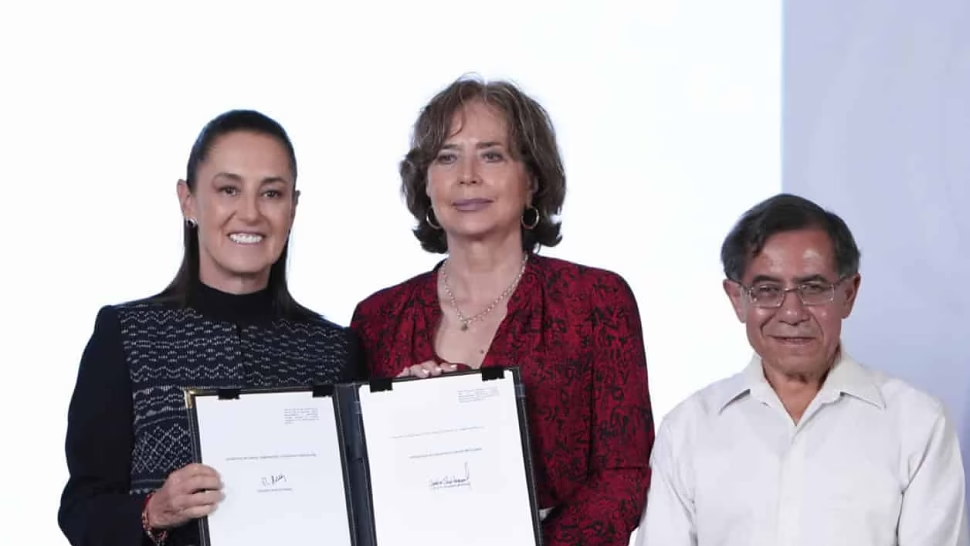
President Claudia Sheinbaum signed the decree that transfers the National Institute of Historical Studies of the Revolutions of Mexico (INEHRM) to the Secretariat of Science, Humanities, Technology and Innovation (SECIHTI). The institute becomes a decentralized public body with an academic focus.

Rosaura Ruiz Gutiérrez, head of SECIHTI, explained that the new scheme will train specialists in history to strengthen national capacities in social sciences and humanities.

Felipe Arturo Ávila Espinosa, director of the INEHRM, explained that the study plans will link historical knowledge with social, economic, political and cultural problems of the country, and will address the needs of the Federal Public Administration.

Hybrid educational offer

The offer will include bachelor’s degrees in History, Social Sciences and Humanities, and Public Administration and Good Government. In postgraduate studies, master’s degrees will be added in Mexican Humanism, Gender and Feminism Studies, and Social Movements and Rescue of Historical Memory. There will also be specialties in Political Communication and History Teaching.

Graduates will cover topics such as agrarianism, health, migration, artificial intelligence, violence and human rights.

Headquarters and call

The new headquarters will be at 80 Guatemala Street, Historic Center of Mexico City. The first admission call will be launched in July, and classes will begin in September.

Continue reading

Prosecutor’s Office grants protection measures to victim of family violence

The Morelos Prosecutor's Office issued protection measures after a complaint of family violence against the former director of Pemex.

The Morelos Attorney General’s Office activated protection measures in favor of Felicia Jiménez Lavie, who filed a complaint for family violence against her husband, Víctor Rodríguez Padilla, former director of Pemex. This was reported by prosecutor Fernando Blumenkron Escobar.

The measures, the official explained, will be available when the victim requires them. The complaint was filed in Mexico City and the Women’s Secretariat of the Government of Mexico directly follows up on the case.

Investigation in progress

Until now, Jiménez Lavie has not gone to the local Public Ministry to contribute more elements to the investigation folder. This was initiated ex officio last Friday, June 26, after a video was broadcast with images of attacks against the woman.

Blumenkron assured that the portfolio continues its integration. “The proceedings have not stopped and we are going to continue to guarantee justice for the victim,” he said. In addition, he indicated that there is coordination with the Women’s Secretariat and the capital’s Prosecutor’s Office, under the care route for victims of family violence.

Among the actions carried out, the Morelos Prosecutor’s Office seeks to locate the address where the physical assault occurred, to carry out expert reports in accordance with the images of the video broadcast by the victim herself.

Continue reading

Trump does not extend T-MEC: Mexico faces annual review

US rejects automatic extension of the T-MEC; validity is reduced to 10 years with annual review.

Rejection of automatic extension

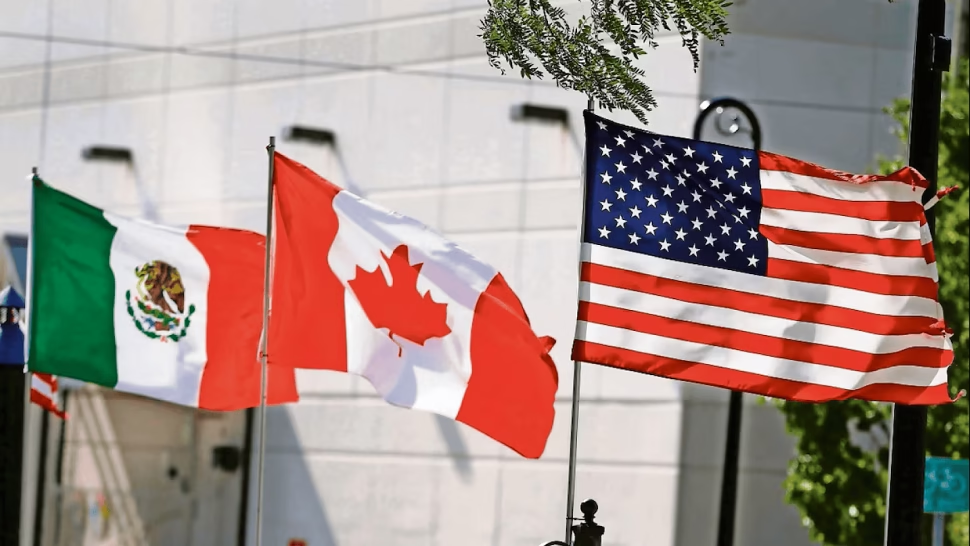
The United States decided not to automatically renew the Treaty between Mexico, the United States and Canada (T-MEC) for 16 years. This reduces its validity to a decade with an annual review. The measure generated concern among Mexican legislators.

Ricardo Monreal, coordinator of Morena in San Lázaro, explained that the treaty remains in force for another 10 years, but subject to evaluation each year. He noted that the United States presented 54 observations, including issues such as the vaquita porpoise and piracy. Mexico, for its part, raised 13 points, including clause 232 on tariffs.

“Only it will be reviewed year after year, but the Treaty is not finished, it continues for another 10 years because that is how it was signed six years ago,” declared Monreal.

The legislator warned that Donald Trump has been a constant critic of the USMCA and called for considering the benefits it has brought to the three nations.

Reactions of the opposition

Héctor Saúl Téllez, vice economic coordinator of the PAN, considered that the US position shows a lack of strategic anticipation on the part of the federal government.

“The US decision not to automatically extend the USMCA for 16 years in today’s review is not the end of the treaty, but it does reveal a lack of strategic anticipation by the federal government,” he stated.

Téllez recalled that Article 34.7 of the agreement had been known since 2018. Reaching July 1 without a clean extension represents a risk that, he said, should have been avoided.

The annual review will allow adjustments, but uncertainty about the future of regional trade persists. Mexico and Canada will seek to maintain the stability of the agreement for the next ten years.

Continue reading